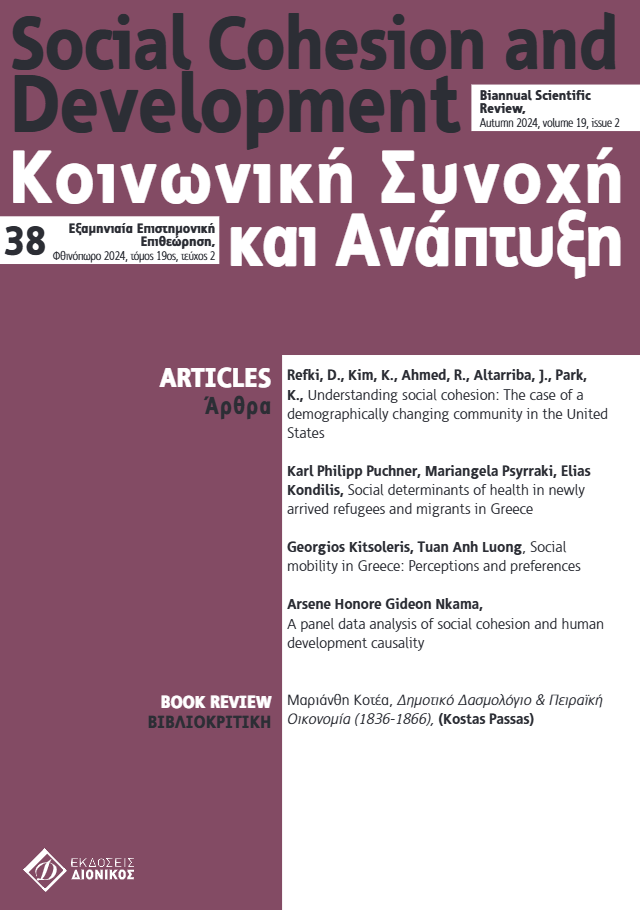
Social mobility in Greece: Perceptions and preferences

Δημοσιευμένα: Jan 21, 2026
Georgios Kitsoleris
https://orcid.org/0000-0001-9416-8944
Tuan Anh Luong
https://orcid.org/0000-0001-9416-8944
Περίληψη

The purpose of this article is to present the  views and perceptions of Greek individuals regarding social mobility based on a questionnaire survey conducted after the end of the financial crisis. Optimistically, most Greeks acknowledge the existence of social mobility in the country, reflecting positive changes in equality of opportunities. Personal experiences and recent income changes influenced participants' views. The main barrier to social mobility based on the citizens’ answers includes the transition from education to the labour market. On the other hand, cognitive and noncognitive skills and professional experience were deemed important for upward mobility.
The participants also underscored the significance of different aspects of mobility.

Λεπτομέρειες άρθρου
  • Ενότητα
  • Άρθρα
Λήψεις
Τα δεδομένα λήψης δεν είναι ακόμη διαθέσιμα.
Βιογραφικά Συγγραφέων
Georgios Kitsoleris, De Montfort University – Perrotis CollegeThessaloniki, Greece

Georgios Kitsoleris is Head of Institutional Research, Accreditation and Quality Assurance at Perrotis College (Thessaloniki, Greece) and former Deputy of the Business Department at De Montfort University International College (Leicester-UK). He holds a Ph.D. in Economics from De Montfort University-UK, with a thesis on socio-economic mobility in Greece and the role of education. His research interests include intergenerational social mobility, income inequality, education policy, and labour market programs. He has published in Public Sector Economics and other peer-reviewed journals, and serves as reviewer for Public Sector Economics.

Tuan Anh Luong, De Montfort University

Tuan Anh Luong is currently an Associate Professor (Reader) at De Montfort University. He received his PhD in Economics from Princeton University. He is also the Vice Director of the Institute for Research in Economics, Environment and Data Science. His research focuses on using firm-level data to gain insights on the impacts of globalization on firms’ performance, labour market and recently on the environment. He is particularly interested in the intersections between Globalization and Climate Change. His work was published in the Journal of Development Economics, Canadian Journal of Economics, Journal of Comparative Economics, the World Economy, Review of International Economics, among others.

Αναφορές
Acemoglu, D., Egorov, G. and Sonin, K., 2016. Social Mobility and Stability of Democracy: Reevaluating De Tocqueville. National Bureau of Economic Research Working Paper Series.
Alesina, A., Stantcheva, S., & Teso, E. (2018). Intergenerational Mobility and Preferences for Redistribution. American Economic Review, 108(2), 521-54.
Bazzani, G. (2023). Futures in Action: Expectations, Imaginaries and Narratives of the Future. Sociology, 57(2), 382-397.
Berman, Y. (2022). Absolute intragenerational mobility in the United States, 1962–2014. The Journal of Economic Inequality, 20, 587–609
Bernasconi, M., & Dardanoni, V. (2005). Measuring and Evaluating Intergenerational Mobility:Evidence from Students’ Questionnaires. In U. Schmidt & S. Traub (Eds.), Advances in Public Economics: Utility, Choice and Welfare (pp. 215-239). Springer.
Björklund, A. and Jäntti, M., 1997. Intergenerational Income Mobility in Sweden Compared to the United States. American Economic Review, 87(5), pp. 1009-1018.
Breen, R. (1997). Inequality, economic growth and social mobility. British Journal of Sociology,48(3), 429-449.
Chetty, R., Hendren, N., Kline, P., & Saez, E. (2014). Where is the Land of Opportunity? The Geography of Intergenerational Mobility in the United States. The Quarterly Journal of Economics, 129(4), 1553-1623.
Citi GSP (2023). Economic and social mobility: The role of business in improving outcomes, Global Perspectives and Solutions Report.
Corak, M., Lindquist, M.J. and Mazumder, B. (2014). A comparison of upward and downward intergenerational mobility in Canada, Sweden and the United States. Labour Economics,30, pp. 185-200.
Council of Europe (2012). Fostering social mobility as a contribution to social cohesion. Council of Europe, Strasbourg.
Cruces, Guillermo & Perez-Truglia, Ricardo & Tetaz, Martín. (2013). Biased perceptions oincome distribution and preferences for redistribution: Evidence from a survey experiment. Journal of Public Economics. 98. 100-112.
Eurofound. (2017). Social mobility in the EU. Publications Office of the European Union, Luxembourg.
Fields, G. S., & Ok, E. A. (1999). The Measurement of Income Mobility: An Introduction to the Literature. Handbook of Income Inequality Measurement, 557-598. Springer Netherlands.
Grawe, N. (2004). Intergenerational mobility for whom? The experience of high- and lowearning sons in international perspective. In M. Corak (Ed.), Generational Income Mobility in North America and Europe (pp. 58-89). Cambridge: Cambridge University Press
Hilson, M. (2008) The Nordic model : Scandinavia since 1945, Reaktion, London.
Hong, Y. (2021). The Educational Hopes and Ambitions of Left-Behind Children in Rural China:An Ethnographic Case Study. United Kingdom: Taylor & Francis.
Katsimi, M., Moutos, T., Pagoulatos, G., & Sotiropoulos, D. (2014). Growing Inequalities and their Impacts in Greece. Country Report for Greece GINI Country Report.
Romer, D. (2003). Misconceptions and Political Outcomes. Economic Journal. 113. 1-20.
Solnick, S. & Hemenway, D. (1998) Is more always better?: A survey on positional concerns, Journal of Economic Behavior & Organization, 37(3), p. 373-383.
Solon, G. (1992). Income inequality and intergenerational income mobility in the United States. The American Economic Review, 82(3), 393-408.
Wilkinson, R.G. & Pickett, K. (2010). The Spirit Level: Why equality is better for everyone (New). Penguin.
Yang, J., & Qiu, M. (2016). The impact of education on income inequality and intergenerational mobility. China Economic Review, 37(December 015), 110-125.