From Digital Humanities to Cultural Informatics and beyond
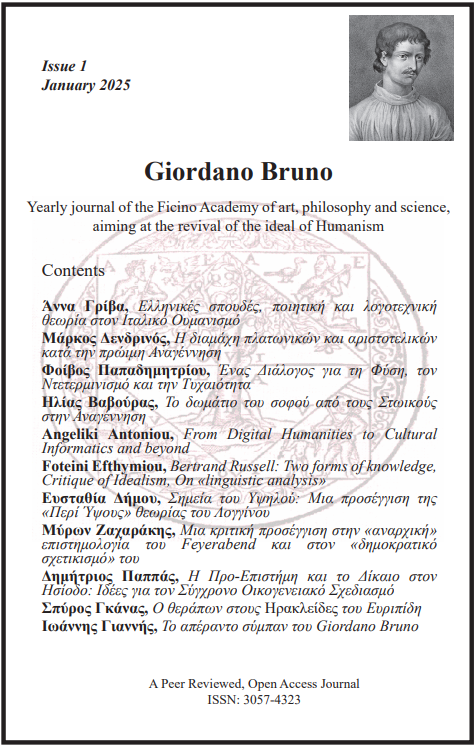
Published:
Dec 4, 2025
Keywords:
Digital Humanities Cultural Informatics Interdisciplinarity
Abstract
The paper discusses the field of Digital Humanities, its transition to Cultural Informatics and its dynamic evolution, incorporating different scientific disciplines and arts. Specific examples from the literature are presented, showcasing different aspects of Cultural Informatics. The future of the field is also discussed, and important considerations are raised, like the need for ethics.
Article Details
- Section
- Articles
References
Alachouzakis, K., Veneris, N.D., Kavvadias, S., Antoniou, A. and Lepouras, G., 2018, November. A study of micro-augmentations: personality, gender, emotions and effects on attention and brain waves. In Proceedings of the 22nd Pan-Hellenic Conference on Informatics (pp. 190-195).
Antoniou, A., Chrysanthopoulos, C., Efthymiou, F., Papastathis, K., Theodosis, S., Kamara, A. and Triantafyllou, I., 2024. Τhe Digistoryteller project: walking around refugee Attica. Journal of Integrated Information Management, 9(1), pp.37-43.
Antoniou, A., Katifori, A., Roussou, M., Vayanou, M., Karvounis, M., Kyriakidi, M. and Pujol-Tost, L., 2016. Capturing the visitor profile for a personalized mobile museum experience: an indirect approach. In 24th ACM Conference on User Modeling, Adaptation and Personalisation (UMAP 2016), Workshop on Human Aspects in Adaptive and Personalized Interactive Environments (HAAPIE), Halifax, Canada, 13-17 July 2016
Antoniou, A., Vayanou, M., Katifori, A., Chrysanthi, A., Cheilitsi, F. and Ioannidis, Y., 2021. “Real Change Comes from Within!”: Towards a Symbiosis of Human and Digital Guides in the Museum. ACM Journal on Computing and Cultural Heritage (JOCCH), 15(1), pp.1-19.
Antoniou, A., Lampada, D., Kamara, A. and Kyriaki-Manessi, D., 2024b. Phygital Heritage Experiences in Refugee Attica. In Proceedings of the11th International Symposium on the Conservation of Monuments in the Mediteranian Basin (MONUBASIN), 17-19 June 2024, Athens, Greece
Antoniou, A., Love, J., Lykourentzou, I., Gu, H. and Stathi, M., 2023, September. Archaeological trails and contemporary art: soundscapes for visually impaired visitors. In AMID@ MobileHCI (pp. 9-16).
Antoniou, A., Morillo, S.R., Lepouras, G., Diakoumakos, J., Vassilakis, C., Nores, M.L. and Jones, C.E., 2019. Bringing a peripheral, traditional venue to the digital era with targeted narratives. Digital Applications in Archaeology and Cultural Heritage, 14, p.e00111.
Antoniou, A., O'Brien, J., Bardon, T., Barnes, A. and Virk, D., 2015, October. Micro-augmentations: situated calibration of a novel non-tactile, peripheral museum technology. In Proceedings of the 19th Panhellenic Conference on Informatics (pp. 229-234).
Busa, R., 1980. The annals of humanities computing: The index thomisticus. Computers and the Humanities, pp.83-90.
Busa, R.A., 2004. Foreword: Perspectives on the digital humanities. A companion to digital humanities, pp.xvi-xxi.
Caggianese, G., De Pietro, G., Esposito, M., Gallo, L., Minutolo, A. and Neroni, P., 2020. Discovering Leonardo with artificial intelligence and holograms: A user study. Pattern Recognition Letters, 131, pp.361-367.
Cahill, L. and McGaugh, J.L., 1998. Mechanisms of emotional arousal and lasting declarative memory. Trends in neurosciences, 21(7), pp.294-299.
Foroughi, M., de Andrade, B. and Roders, A.P., 2023. Capturing public voices: the role of social media in heritage management. Habitat International, 142, p.102934.
Gamber, C., 2021. Emerging Technologies and the Advent of the Holocaust “Hologram”. In Emerging Technologies and the Digital Transformation of Museums and Heritage Sites: First International Conference, RISE IMET 2021, Nicosia, Cyprus, June 2–4, 2021, Proceedings 1 (pp. 217-231). Springer International Publishing.
Hayek, F.A., 1943. The facts of the social sciences. Ethics, 54(1), pp.1-13.
Hellou, M., Lim, J., Gasteiger, N., Jang, M. and Ahn, H.S., 2022. Technical methods for social robots in museum settings: An overview of the literature. International Journal of Social Robotics, 14(8), pp.1767-1786.
Huutoniemi, K., 2010. Evaluating interdisciplinary research. The Oxford handbook of interdisciplinarity, 10, pp.309-320.
Jones, S.E., 2016. Roberto Busa, SJ, and the emergence of humanities computing: the priest and the punched cards. Routledge.
Kasemsarn, K., Sawadsri, A., Harrison, D. and Nickpour, F., 2024. Museums for Older Adults and Mobility-Impaired People: Applying Inclusive Design Principles and Digital Storytelling Guidelines—A Review. Heritage, 7(4), pp.1893-1916.
Katifori, A., Perry, S., Vayanou, M., Antoniou, A., Ioannidis, I.P., McKinney, S., Chrysanthi, A. and Ioannidis, Y., 2020. “Let them talk!” exploring guided group interaction in digital storytelling experiences. Journal on Computing and Cultural Heritage (JOCCH), 13(3), pp.1-30.
Klein, J.T., 2014. Interdisciplinary teamwork: The dynamics of collaboration and integration. Interdisciplinary collaboration, pp.23-50.
Kontiza, K., Liapis, A. and Jones, C.E., 2020, September. Reliving the experience of visiting a gallery: Methods for evaluating informal learning in games for cultural heritage. In Proceedings of the 15th International Conference on the Foundations of Digital Games (pp. 1-11).
Kurz, I., 1995. Interdisciplinary research—Difficulties and benefits. Target. International Journal of Translation Studies, 7(1), pp.165-179.
Li, H., Ikebe, K., Kinoshita, T., Chen, J., Su, D. and Xie, J., 2024. How heritage promotes social cohesion: An urban survey from Nara city, Japan. Cities, 149, p.104985.
Lyall, C., Tait, J., Meagher, L., Bruce, A., & Marsden, W. (2011). A short guide to evaluating interdisciplinary research.
Lykourentzou, I., Naudet, Y. and Vandenabeele, L., 2016, October. Reflecting on European History with the Help of Technology: The CrossCult Project. In GCH (pp. 67-70).
Mansilla, V. B. (2006). Assessing expert interdisciplinary work at the frontier: an empirical exploration. Research evaluation, 15(1), 17-29.
Srinivasan, R. and Chander, A., 2021. Biases in AI systems. Communications of the ACM, 64(8), pp.44-49.
Varitimiadis, S., Kotis, K., Pittou, D. and Konstantakis, G., 2021. Graph-based conversational AI: Towards a distributed and collaborative multi-chatbot approach for museums. Applied Sciences, 11(19), p.9160.
Vassilakis, C., Antoniou, A., Lepouras, G., Wallace, M., Lykourentzou, I. and Naudet, Y., 2016. Interconnecting objects, visitors, sites and (Hi) stories across cultural and historical concepts: the CrossCult project. In Digital Heritage. Progress in Cultural Heritage: Documentation, Preservation, and Protection: 6th International Conference, EuroMed 2016, Nicosia, Cyprus, October 31–November 5, 2016, Proceedings, Part I 6 (pp. 501-510). Springer International Publishing.
Vassilakis, C., Antoniou, A., Lepouras, G., Poulopoulos, V., Wallace, M., Bampatzia, S. and Bourlakos, I., 2017. Stimulation of reflection and discussion in museum visits through the use of social media. Social Network Analysis and Mining, 7, pp.1-12.
Vassilakis, C., Poulopoulos, V., Antoniou, A., Wallace, M., Lepouras, G. and Nores, M.L., 2018. exhiSTORY: Smart exhibits that tell their own stories. Future Generation Computer Systems, 81, pp.542-556.
Youngwerth, J. and Twaddle, M., 2011. Cultures of interdisciplinary teams: how to foster good dynamics. Journal of palliative medicine, 14(5), pp.650-654.