test Ο θεράπων στους Ηρακλείδες του Ευριπίδη|Giordano Bruno

Ο θεράπων στους Ηρακλείδες του Ευριπίδη
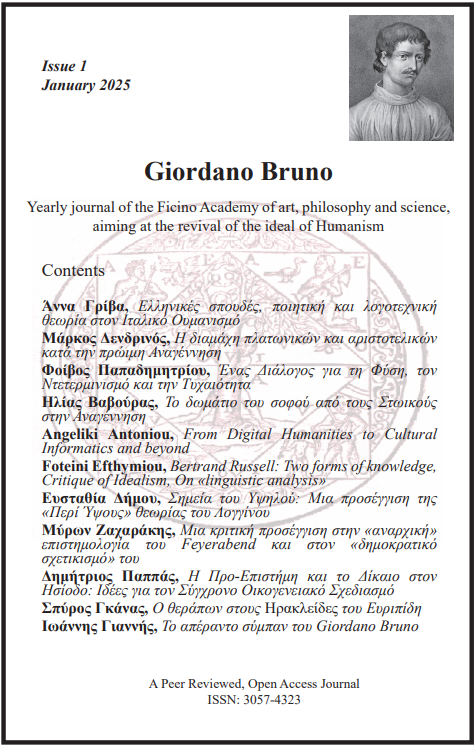

Published: Dec 4, 2025
Keywords:
Ηρακλείδες Ευριπίδης Ελληνική Τραγωδία Ελάσσονες Χαρακτήρες στην Ελληνική Τραγωδία Αφηγηματολογία Ανάπτυξη Χαρακτήρα Ελληνικό Θέατρο Δράμα Heraclidae Euripides Greek Tragedy Minor Characters in Greek Tragedy Narratology Character Development Greek Theatre Drama
Σπύρος Γκάνας
Abstract

In this short study, an attempt is made on the one hand to analyze the action of the Θεράπων, a minor character in the Euripidean Heraclidae, and on the other to outline his action and the effect he has on the plot of the play. In order to approach this issue, the problems concerning the naming of this character, which arise from the recensio of the manuscripts in which the work is handed to us, must first be overcome. With the attempted analysis, we try to show the almost voluntary action undertaken by this slave and how with his presence he gives a comic variation to the work while at the same time he initiates his own autonomous character development, which is primarily evident in the unmerciful Exodus of the tragedy. A careful reading will reveal a well-known Euripidean technique regarding such characters· this slave represents the voice of reason, not simply embodied as the sensus communis of the Chorus, a voice which often expresses considerable opposition to the wills and decisions of the drama's protagonists.

Article Details
  • Section
  • Articles
Author Biography
Σπύρος Γκάνας

Ο Σπύρος Γκάνας είναι φοιτητής Φιλολογίας του Τμήματος Φιλοσοφίας του Αριστοτέλειου Πανεπιστήμιου Θεσσαλονίκης. Έχει εκπονήσει άρθρα που αφορούν τους Στωικούς (στο Φιλοσοφεῖν) και τον Μακκιαβέλι (στο Cogito). 

References
Allan, W. ed. (2001). Euripides: Children of Heracles. Warminster: Aris and Phillips.
Burian, P. (1977). ‘Euripides’ Heraclidae: an interpretation’, Classical Philology 72: 1–21.
Carter, D.M. (2020). "Children of Heracles". In Brill’s Companion to Euripides. Leiden: Brill: 96-120.
Cartledge, P. A. & Olshausen, E. (2006). Penestai. In Brill's New Pauly Online. Leiden: Brill.
De Temmerman, K., & van Emde Boas, E. (2017). "Character and Characterization in Ancient Greek Literature: An Introduction". In Characterization in Ancient Greek Literature. Leiden: Brill: 1–23.
Diggle, J. (1984). Euripides Fabulae I. Oxford: Oxford University Press.
Ebbott, M. (2005). “Marginal figures,” in J. Gregory (Ed.), A Companion to Greek Tragedy Oxford: Oxford University Press: 366–376.
Ferguson, J. (1972). A Companion to Greek Tragedy. Austin: University of Texas Press.
Goslin, O.E. (2017). Children of Heracles in L. McClure (Εd.), A Companion to Euripides, 92–106, Malden and Oxford: Wiley-Blackwell.
Jendza, C. (2020). Paracomedy: appropriations of comedy in Greek tragedy. New York: Oxford University Press.
Kyriakou, P. (2020). "Minor Characters in Euripides". In Brill’s Companion to Euripides. Leiden: Brill: 911–929.
Pearson A. C. (1907). Euripides, The Heraclidae. Cambridge: Cambridge University Press.
Scodel, R. (2016). Wisdom from Slaves. In P. Kyriakou & A. Rengakos (eds.), Wisdom and Folly in Euripides. Berlin, Boston: De Gruyter: 65-82.
van Emde Boas, E. (2017). "Euripides". In De Temmerman, K., & van Emde Boas, E. (Eds.), Characterization in Ancient Greek Literature. Leiden: Brill: 355–374.
Wilkins, J. (1993). Euripides: Heraclidae. Oxford: Oxford University Press.
Yoon, F. (2012). The use of anonymous characters in Greek tragedy. Leiden: Brill
Yoon, F. (2015). THE HERALD OF HYLLUS? IDENTIFYING THE ϒΛΛΟϒ ΠΕΝΕΣΤΗΣ IN EURIPIDES’ “HERACLIDAE.” The Classical Quarterly, 65(1), 51–59.
Yoon, F. (2020). Euripides: Children of Heracles. London: Bloomsbury Publishing.