test Το απέραντο σύμπαν του Giordano Bruno|Giordano Bruno

Το απέραντο σύμπαν του Giordano Bruno
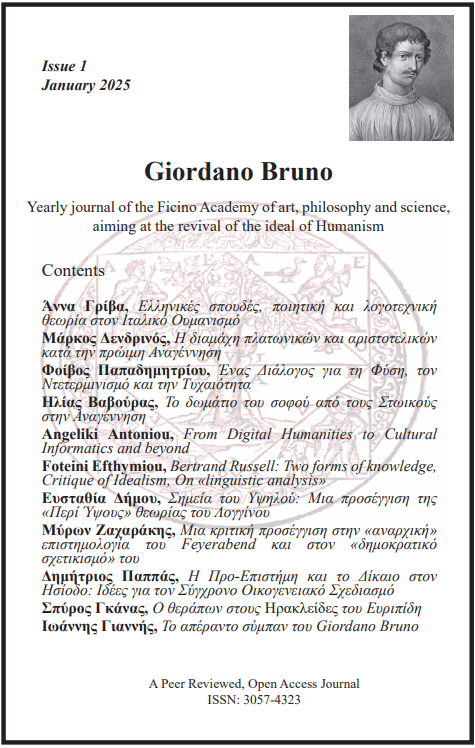

Published: Dec 4, 2025
Keywords:
Giordano Bruno Άπειρο Σύμπαν Φυσική Φιλοσοφία Αναγέννηση Επιστήμη Ουμανισμός Infinite Universe Natural Philosophy Renaissance Science Humanism
Ιωάννης Γιαννής
Abstract

Giordano Bruno was the philosopher who encapsulated all the intellectual achievements of the Renaissance, blending them with poetic genius and the teachings of Democritus, Plato, and the Neopythagorean philosophers. Living during a time when the Middle Ages were waning and the scientific theories of Copernicus and Galileo were emerging, he was the first to intuitively yet consciously articulate, with clarity and boldness, the prophetic idea that the universe is infinite, comprising countless worlds coexisting harmoniously within an organic, meaningful framework. Simultaneously, his martyrdom at the hands of the Inquisition for his ideas and his refusal to renounce them made him a symbol of free and unyielding scientific thought against all forms of intolerance. His teachings and life inspired later thinkers in philosophy, science, and even poetry. This work focuses on his views regarding the infinity of the universe and the place of God and humanity within the Cosmos.

Article Details
  • Section
  • Articles
Author Biography
Ιωάννης Γιαννής, Hellenic Open University

Ο Ιωάννης Γιαννής είναι Δικαστικός Επιμελητής του Εφετείου Πειραιώς από το 1999. Σπουδάζει στο Ελληνικό Ανοικτό Πανεπιστήμιο (Ε.Α.Π.), στο πρόγραμμα «Σπουδές στον Ευρωπαϊκό Πολιτισμό».

References
Butterfield, Herbert, 2005, Η καταγωγή της σύγχρονης επιστήμης (1300-1800), μτφρ. Ιορδάνης Αρζόγλου, Αντώνης Χριστοδουλίδης, Μ.Ι.Ε.Τ., Αθήνα.
Heimsoeth, Heinz, 2012, Τα έξι μεγάλα ερωτήματα της δυτικής μεταφυσικής και οι ρίζες της νεότερης φιλοσοφίας, μτφρ. Μιχάλης Παπανικολάου, Πανεπιστημιακές Εκδόσεις Κρήτης, Αθήνα.
Koyre, Alexandre, 1989, Από τον κλειστό κόσμο στο άπειρο σύμπαν, μτφρ. Παυλίνα Λάμψα, Ευρύαλος, Αθήνα.
Routledge Encyclopedia of Philosophy, Version 1.0, 1998, London and New York: Routledge.
Windelbland W. & Heimsoeth H., 1985,.Εγχειρίδιο ιστορίας της Φιλοσοφίας, Τόμος Β΄, μτφρ. Ν.Μ. Σκουτερόπουλος, ΜΙΕΤ, Αθήνα.
Vedrine, Helene, 1990, Η νέα εικόνα του κόσμου από τον Νικόλαο Κουζανό στον Giordano Bruno, στο F. Chatelet (επιμ.) Η Φιλοσοφία (από τον Γαλιλαίο έως τον Ζ.Ζ. Ρουσσώ), μτφρ. Κωστής Παπαγιώργης, Γνώση, Αθήνα, σ.σ. 41-71.
Αθανασόπουλος, Κωνσταντίνος, 2001, Φιλοσοφία στην Ευρώπη (από τον 6 έως τον 16ο αι.), Τόμος Α΄, Ελληνικό Ανοικτό Πανεπιστήμιο, Πάτρα.
Γουδέλη, Κυριακή, 2008, Μετακαρτεσιανικός μονισμός στον 17ο αι.: Περί της σχέσεως σώματος – νου στον Spinoza και στον Leibnitz στον συλλογικό τόμο Κείμενα νεότερης και σύγχρονης φιλοσοφίας, Ελληνικό Ανοικτό Πανεπιστήμιο, Πάτρα, σ.σ. 55-78.
Καλδής, Βύρων, 2008, Leibnitz: στοιχεία μεταφυσικής, στον συλλογικό τόμο Κείμενα νεότερης και σύγχρονης φιλοσοφίας, Ελληνικό Ανοικτό Πανεπιστήμιο, Πάτρα, σ.σ. 79-108.
Πουλκούρας, Ιορδάνης, (α.χ.), Η απόκρυφη παράδοση της Ευρώπης (Bleeding Angels), Αρχέτυπο, Θεσσαλονίκη.