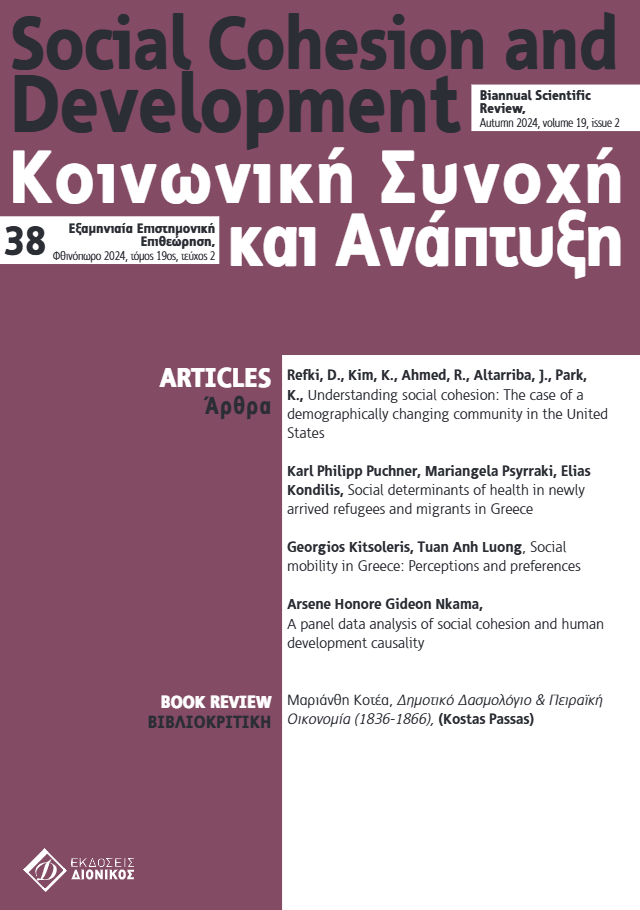
Understanding social cohesion: The case of a demographically changing community in the United States The case of a demographically changing community in the United States

Δημοσιευμένα: Jan 21, 2026
Λέξεις-κλειδιά:
Κοινωνική συνοχή, κοινότητα, ΗΠΑ, εθνοτική ποικιλομορφία, πολιτισμική ποικιλομορφία, θεωρία της Κοινωνικής Κυριαρχίας.
Dina Refki
https://orcid.org/0000-0002-1292-1750
Esther (Kyu Yon) Kim
https://orcid.org/0000-0002-1292-1750
Rukhsana Ahmed
https://orcid.org/0000-0002-1292-1750
Jeanette Altarriba
https://orcid.org/0000-0002-1292-1750
Kyung Hyun Park
https://orcid.org/0000-0002-1292-1750
Περίληψη

Η κοινωνική συνοχή συνδέεται με την ευημερία της κοινότητας και την ευημερία και την ποιότητα ζωής των μελών της. Μελέτες έχουν δώσει ανάμεικτες απαντήσεις στο ερώτημα εάν η εθνοτική ποικιλομορφία διαβρώνει την κοινωνική. Η παρούσα μελέτη συμβάλλει σε αυτό το σύνολο βιβλιογραφίας προσαρμόζοντας, δοκιμάζοντας και βελτιώνοντας ένα εργαλείο που μετρά την κοινωνική συνοχή σε μια αγροτική εθνικά ομοιογενή περιοχή των βορειοανατολικών Ηνωμένων Πολιτειών και χρησιμοποιώντας το επικυρωμένο εργαλείο για την αξιολόγηση των επιπτώσεων της νεοσύστατης ποικιλομορφίας στις αντιλήψεις των μελών της κοινότητας για την κοινωνική συνοχή. Προβλέψαμε ότι η διαφοροποίηση θα ενεργοποιούσε τη δυναμική της κοινωνικής
ανισότητας και κυριαρχίας, σύμφωνα με τη θεωρία της Κοινωνικής Κυριαρχίας. Η σύγκριση των αντιλήψεων πολλαπλών ομάδων έδειξε ότι οι άνδρες συμμετέχοντες και οι μαύροι κάτοικοι ανέφεραν χαμηλότερο επίπεδο εμπιστοσύνης και ότι οι κάτοικοι με
πολιτισμική ποικιλομορφία είναι λιγότερο πιθανό να επιδεικνύουν υψηλό επίπεδο κοινωνικής συνοχής και πιο πιθανό να αισθάνονται απομονωμένοι.

Λεπτομέρειες άρθρου
  • Ενότητα
  • Άρθρα
Λήψεις
Τα δεδομένα λήψης δεν είναι ακόμη διαθέσιμα.
Βιογραφικά Συγγραφέων
Dina Refki, University at Albany, State University of New York

Dina Refki, D.A. is the Director of the Center for Women in Government & Civil Society (CWGCS), and Clinical Professor at the Department of Public Administration & Policy, Rockefeller College of Public Affairs & Policy, University at Albany. She also the founder and director of the Institute on Immigrant Integration Research & Policy, Rockefeller Institute of Government, State University of New York. Her research focuses on the intersections of socially constructed identities, cultures and nstitutional structures and explores their role in shaping economic, social and civic outcomes for minoritized populations. She is the lead author of the Data Gateway, a first in the nation tool that measures the economic and social integration of immigrants and creates a multi-year scorecard to account for the performance of different localities in integrating immigrants in the economic and social fabric of their communities. Her research also examines structural and systematic adaptations required to facilitate the integration of foreignborn residents (contact Author: [email protected])

Esther (Kyu Yon) Kim, Center for Women in Government & Civil Society at the University at Albany, SUNY

Esther (Kyu Yon) Kim, Ph.D., is Research Associate at the Center for Women in Government &
Civil Society at the University at Albany, SUNY. She earned her doctorate in Educational Psychology and Methodology, where her dissertation focused on the social well-being of immigrantorigin students. Her research interests include gender equity in education and emp

Rukhsana Ahmed, University at Albany, State University of New York

Rukhsana Ahmed is Professor of Communication, Faculty Associate at the Center for the Elimination of Minority Health, and Faculty Fellow at the Center for Technology in Government at
the University at Albany, State University of New York, New York, USA. She is the Co-Founder
and Co-Director of the Health and Equity Justice Lab at UAlbany and Georgia State University.
Her research examines the role of communication, culture, media, and technology in shaping
health outcomes among marginalized communities and promoting broader organizational and
social changes and innovations in local, national, and international health contexts. She is the
Chief Editor of the Health Communication section of Frontiers in Communication. Her recent
co-edited book is titled Theory and Application of Health Acculturation: A Communication Perspective (2024; Lexington Books). She received the Eastern Communication Association 2024
Distinguished Research Fellows Award.

Jeanette Altarriba, University at Albany, State University of New York

Jeanette Altarriba is Professor of Psychology and Dean of the College of Arts and Sciences at the
University at Albany, State University of New York, Albany, New York, USA. She is the Founder
and Director of the Cognition and Language Laboratory at UAlbany. Her most recent publications
include: El-Dakhs, D. A. S., Ahmed, M. M., Altarriba, J., & Sonbul (2024), Differential Emotional
Expression in Autobiographical Narratives: The case of Arabic-English Bilinguals, International
Journal of Bilingualism; and Toglia, M., Otgar, H., Altarriba, J., Erikson, W. B. (Eds.), Interdisciplinary Perspectives and Advances in Understanding Adaptive Memory (Oxford University Press,
2024). Her research interests focus on bilingualism, emotion, adaptive and survival memory, and
cohesion and adaptability of various demographic groups

Kyung Hyun Park , University at Albany, State University of New York

Dr. Kyung Hyun Park specializes in educational psychology, with a focus on gifted education
and talent development from a lifelong perspective. Her research primarily focuses on racially,
ethnically, and culturally marginalized and underrepresented talented young people. Currently,
she is a postdoctoral fellow at the Department of Medical Education, Yonsei University College
of Medicine in Seoul, South Korea.

Αναφορές
Abascal, M., & Baldassarri, D. (2015). Love thy neighbor? Ethnoracial diversity and trust
reexamined. American Journal of Sociology, 121(3), 722-782.
Abbott, P., & Wallace, C. (2012). Social quality: A way to measure the quality of society. Social
indicators research, 108, 153-167.
Alcoff, L. M. (2003). Latino/as, Asian Americans, and the black–white binary. The Journal of
Ethics, 7(1), 5-27.
American Community Survey, U.S. Census. Retrieved from: https://www.census.gov/programssurveys/acs
Anderson, C. J. and Paskeviciute, A. (2006) ‘How Ethnic and Linguistic Heterogeneity Influence
the Prospects for Civil Society: A Comparative Study of Citizenship Behavior’, Journal of
Politics, 68 (4), 783–802.
Anoll, A. P. (2018). What makes a good neighbor? Race, place, and norms of political
participation. American Political Science Review, 112(3), 494-508.
Arant, R., Larsen, M., & Boehnke, K. (2021). Acceptance of diversity as a building block of social
cohesion: Individual and structural determinants. Frontiers in Psychology, 12, 1-13.
Ariely, G. (2014). Does diversity erode social cohesion? Conceptual and methodological issues.
Political Studies, 62(3), 573-595.
Bell, M.P., Kwesiga, E.N. and Berry, D.P. (2010), "Immigrants: The new “invisible men and
women” in diversity research", Journal of Managerial Psychology, Vol. 25 No. 2, pp. 177-
Blair IV, Steiner JF, Fairclough DL, et al. Clinicians' implicit ethnic/racial bias and perceptions of
care among Black and Latino patients. Annals Fam Med. 2013; 11(1): 43-52.
Botterman, S., Hooghe, M. and Reeskens, T. (2012) “One Size Fits All”? An Empirical Study
into the Multidimensionality of Social Cohesion Indicators in Belgian Local Communities’,
Urban Studies, 49 (1), 185-202.
Boyd, M. (1984). At a disadvantage: The occupational attainments of foreign born women in
Canada. International migration review, 18(4), 1091-1119.
Chan, J., To, H. P. and Chan, E. (2006) ‘Reconsidering Social Cohesion: Developing a Definition and
Analytical Framework for Empirical Research’, Social Indicators Research, 75 (2), 273-302.
Chappell NL, Havens B. Old and female: Testing the double jeopardy hypothesis. Sociological
Quart. 2016; 21(2): 157-171.
Coffé, H. and Geys, B. (2006) ‘Community Heterogeneity: A Burden for the Creation of Social
Capital?’, Social Science Quarterly, 87 (5), 1053-72.
Cooper LA, Roter DL, Carson KA, et al. The Associations of clinicians’ implicit attitudes about
race with medical visit communication and patient ratings of interpersonal care. Am J
Public Health. 2012; 102(5): 979-987. 37.
Crenshaw K. Demarginalizing the intersection of race and sex: A black feminist critique of
antidiscrimination doctrine, feminist theory and antiracist politics. Univ Chicago Legal
Forum. 1989.
De Jong, G. F., & Madamba, A. B. (2001). A double disadvantage? Minority group, immigrant
status, and underemployment in the United States. Social Science Quarterly, 82(1), 117-130.
Dickes, P., Valentova, M. and Borsenberger, M. (2010) ‘Construct Validation and Application
of a Common Measure of Social Cohesion in 33 European Countries’, Social Indicators
Research, 98 (3), 451-73.
Dincer, O. C. (2011) ‘Ethnic Diversity and Trust’, Contemporary Economic Policy, 29 (2), 284–93.
Dinesen, P.T. (2011) ‘Me and Jasmina Down by the Schoolyard: An Analysis of the Impact of Ethnic
Diversity in School on the Trust of Schoolchildren’, Social Science Research, 40 (2), 572-85.
Dinesen, P. T., Schaeffer, M., & Sønderskov, K. M. (2020). Ethnic diversity and social trust: A
narrative and meta-analytical review. Annual Review of Political Science, 23, 441-465.
Donato, K. M., Piya, B., & Jacobs, A. (2014). The double disadvantage reconsidered: Gender,
immigration, marital status, and global labor force participation in the 21st century.
International Migration Review, 48(1_suppl), 335-376.
Dragolov, G., Ignacz, Z., Lorez, J., Delhey, J., & Boehnke, K. (2013). Social cohesion radar
measuring common ground: An international comparison of social cohesion methods
Fieldhouse, E. and Cutts,D. (2010) ‘Does Diversity Damage Social Capital? A Comparative Study
of Neighborhood Diversity and Social Capital in the US and Britain’, Canadian Journal of
Political Science, 43 (2), 289-318.
Green AR, Carney DR, Pallin DJ, et al. Implicit bias among physicians and its prediction of
thrombolysis decisions for black and white patients. J Gen Int Med. 2007; 22(9): 1231-
Gesthuizen, M., Van Der Meer, T. and Scheepers, P. (2009) ‘Ethnic Diversity and Social Capital
in Europe: Tests of Putnam’s Thesis in European Countries’, Scandinavian Political Studies,
(2), 121-42.
Guibernau, M. (2013). Secessionism in Catalonia: after democracy. Ethnopolitics, 12(4), 368-393.
Giddens, A. (1991). Modernity and Self-identity. Polity Press, Cambridge.
Harell, A. and Stolle, D. (2010) ‘Diversity and Democratic Politics: An Introduction’, Canadian
Journal of Political Science, 43 (2), 235-56.
Haselhuhn, M. P., Kennedy, J. A., Kray, L. J., Van Zant, A. B., & Schweitzer, M. E. (2015). Gender
differences in trust dynamics: Women trust more than men following a trust violation.
Journal of Experimental Social Psychology, 56, 104-109.
Hausmann LRM, Myaskovsky L, Niyonkuru C, et al. Examining implicit bias of physicians who
care for individuals with spinal cord injury: A pilot study and future directions. J Spinal
Cord Med. 2015; 38(1): 102-110.
Hawes, D. P. and Rocha, R. R. (2011) ‘Social Capital, Racial Diversity, and Equity: Evaluating the
Determinants of Equity in the United States’, Political Research Quarterly, 64 (4), 924-37.
Hero, R. E. (2007) Racial Diversity and Social Capital. New York: Cambridge University Press.
Hersch, J. (2008). Profiling the new immigrant worker: The effects of skin color and height.
Journal of Labor Economics, 26(2), 345-386.
Hu, L., & Bentler, M. P. (1999). Cutoff criteria for fit indexes in covariance structure analysis:
Conventional criteria versus new alternatives. Structural Equation Modeling: A
Multidisciplinary Journal, 6(1), 1-55.
Hulse, D. K. and Stone, W. (2007) ‘Social Cohesion, Social Capital and Social Exclusion’, Policy
Studies, 28 (2), 109-28.
Jagsi R, Griffith KA, Jones R, Perumalswami CR, Ubel P, Stewart A. Sexual Harassment and
Discrimination Experiences of Academic Medical Faculty. JAMA. 2016;315:2120. https://
doi.org/10.1001/jama.2016.2188.
Jenson, J. (2010) Defining and Measuring Social Cohesion. London: Commonwealth Secretariat.
Kazemipur, A. (2006) ‘A Canadian Exceptionalism? Trust and Diversity in Canadian Cities’,
Journal of International Migration and Integration, 7 (2), 219-40.
Kesler, C. and Bloemraad, I. (2010) ‘Does Immigration Erode Social Capital? The Conditional
Effects of Immigration- Generated Diversity on Trust, Membership, and Participation across
Countries, 1981–2000’, Canadian Journal of Political Science, 43 (2), 319-47.
Lancee, B. and Dronkers, J. (2011) ‘Ethnic, Religious and Economic Diversity in Dutch
Neighborhoods: Explaining Quality of Contact with Neighbors, Trust in the Neighborhood
and Inter-ethnic Trust’, Journal of Ethnic and Migration Studies, 37 (4), 597-618.
Laurence, J. (2011) ‘The Effect of Ethnic Diversity and Community Disadvantage on Social
Cohesion: A Multi-level Analysis of Social Capital and Interethnic Relations in UK
Communities’, European Sociological Review, 27 (1), 70-89.
Leonard, B. (2008), "HR staff charged in child labor violations", HR Magazine, November, p. 24.
Letki, N. (2008) ‘Does Diversity Erode Social Cohesion? Social Capital and Race in British
Neighborhoods’, Political Studies, 56 (1), 99-126.
Macías Mejía, Y.D. (2023). Beyond Racial Linked Fate: Inter-Minority Political Solidarity and
Political Participation. Political Behavior. https://doi.org/10.1007/s11109-023-09861-2
Maddux, W. W., & Brewer, M. B. (2005). Gender differences in the relational and collective
bases for trust. Group Processes & Intergroup Relations, 8(2), 159-171.
Massey, D. S., & Gelatt, J. (2010). What Happened to the Wages of Mexican Immigrants?
Trends and Interpretations. Latino Studies, 8, 328-354
Mclaughlin, D., Vagenas, D., Pachana, N. A., Begum, N., & Dobson, A. (2010). Gender
differences in social network size and satisfaction in adults in their 70s. Journal of Health
Psychology, 15(5), 671-679.
Moore, A.R. and Amey, F.K. (2002), "Earnings differentials among male African immigrants in
the US", Equal Opportunities International, Vol. 21 No. 8, pp. 30-49.
Moskowitz GB, Stone J, Childs A. Implicit stereotyping and medical decisions: Unconscious
stereotype activation in practitioners' thoughts about African Americans. Am J Public
Health. 2012; 102(5): 996-1001. 29.
Muthen, L. K., & Muthen, B. O. (1998-2017). Mplus User’s Guide (8th ed.). Los Angeles, CA:
Muthen & Muthen.
Nannestad, P. (2008) ‘What Have We Learned about Generalized Trust, if Anything?’, Annual
Review of Political Science, 11, 413-36.
Newton, K. (2007) ‘Social and Political Trust’, in J. R. Dalton and H. Klingemann (eds), Oxford
Handbook of Political Behavior. New York: Oxford University Press, pp. 342-61.
Ogungbe, O., Mitra, A. K., & Roberts, J. K. (2019). A systematic review of implicit bias in health
care: A call for intersectionality. IMC Journal of Medical Science, 13(1), 005-005.
Oliver MN, Wells KM, Joy-Gaba JA, Hawkins CB, Nosek BA. Do physicians' implicit views of African
Americans affect clinical decision making? J Am Board Fam Med. 2014; 27(2): 177-188.
Pahl, R.E., Spencer, L., 2004. Personal communities. Not simply families of fate or choice. Curr.
Sociol. 52(2),199e222.
Painter, M. (2013) Immigrant and Native Financial Well-being: The Roles of Place of Education
and Race/Ethnicity, Social Science Research, Volume 42, Issue 5, https://doi.org/10.1016/j.
ssresearch.2013.04.001.
Pew Research Center (2019). Race in America 2019. Retrieved from: https://www.pewresearch.
org/social-trends/2019/04/09/race-in-america-2019/
Pew Research Center (2021). Majorities of Americans see at least some discrimination against
Black, Hispanic and Asian people in the U.S. Retrieved from https://www.pewresearch.org/
short-reads/2021/03/18/majorities-of-americans-see-at-least-some-discrimination-againstblack-hispanic-and-asian-people-in-the-u-s/
Pew Research Center (2007). Views of Immigrants. https://www.pewresearch.org/
hispanic/2010/10/28/ii-views-of-immigrants/
Portes, A. and Vickstrom, E. (2011) ‘Diversity, Social Capital, and Cohesion’, Annual Review of
Sociology, 37, 461-79.
Pratto, F.,Sidanius, J., Stallworth, L.M., & Malle, B.F. (1994). Social dominance orientation: A
personality variable predicting social and political attitudes. Journal of Personality and
Social Psychology, 67, 741-763.
Putnam, R. D. (2007) ‘E Pluribus Unum: Diversity and Community in the Twenty-First Century –
the 2006 Johan Skytte Prize Lecture’, Scandinavian Political Studies, 30 (2), 137-74.
Puumala SE, Burgess KM, Kharbanda AB, et al. The role of bias by emergency department
providers in care for American Indian children. Med Care. 2016; 54(6): 562-569.
Rainie, L., Wellman, B., 2012. Networked. The New Social Operating System. MIT Press,
Massachusetts.
Reeskens, T. and Wright, M. (2013) ‘Nationalism and the Cohesive Society: A Multi-level
Analysis of the Interplay between Diversity, National Identity, and Social Capital across 27
European Societies’, Comparative Political Studies
Reeskens,T. (2010) ‘Ethnic-Cultural Diversity, Migrant Integration Policies and Social Cohesion
in Europe: Investigating the Conditional Effect of Ethnic-Cultural Diversity on Generalized
Trust’. Paper presented at the ‘Migration: A World in Motion’ conference, Maastricht, 18-
February.
Rivera-Batiz, F.L. (1999), "Undocumented workers in the labor market: an analysis of the
earnings of legal and illegal Mexican immigrants in the United States", Journal of
Population Economics, Vol. 12 No. 1, pp. 91-116.
Sabin JA, Nosek BA, Greenwald AG, Rivara FP. Physicians’ implicit and explicit attitudes about race
by MD race, ethnicity, and gender. J Health Care Poor Underserved. 2009; 20(3): 896-913.
Sakamoto, A., Goyette, K. A., & Kim, C. (2009). Socioeconomic attainments of Asian
Americans. Annual Review of Sociology, 35, 255-276.
Schiefer, D., van der Noll, J., Delhey, J., & Boehnke, K. (2012). Cohesion Radar: Measuring
Cohesiveness. Social Cohesion in Germany – a preliminary Review. Gütersloh: Bertelsmann
Foundation
Sidanius,J.,&Pratto, F.(1999).Social dominance: An intergroup theory of social hierarchy and
oppression. New York: Cambridge University Press.
Sidanius, J., Levin, S., Federico, C., & Pratto, F. (2001). Legitimizing ideologies: Thesocial
dominance approach. In J. Jost & B. Major (Eds.), The psychology of legitimacy: Emerging
perspectives on ideology, justice, and intergroup relations (pp.307–331). Cambridge:
Cambridge University Press.
Stolle, D., Soroka, S. and Johnston, R. (2008) ‘When Does Diversity Erode Trust? Neighborhood
Diversity, Interpersonal Trust and the Mediating Effect of Social Interactions’, Political
Studies, 56 (1), 57-75.
Tacconelli, E., Poljak, M., Cacace, M., Caiati, G., Benzonana, N., Nagy, E., & Kortbeek, T. (2012).
Science without meritocracy. Discrimination among European specialists in infectious
diseases and clinical microbiology: a questionnaire survey. BMJ open, 2(6), e001993.
Tolsma, J., van der Meer, T. and Gesthuizen, M. (2009) ‘The Impact of Neighborhood and
Municipality Characteristics on Social Cohesion in the Netherlands’, Acta Politica, 44 (3),
-313.
Turkle, S., 2013. Alone Together: Why We Expect More from Technology and Less from Each
Other. Basic Books, Philadelphia.
Uslaner, E. M. (2002) The Moral Foundations of Trust. Cambridge: Cambridge University Press.
Uslaner, E. M. (2012) Segregation and Mistrust. Cambridge MA: Cambridge University Press.
Vergolini, L. (2011) ‘Social Cohesion in Europe: How do the Different Dimensions of Inequality
Affect Social Cohesion?’, International Journal of Comparative Sociology, 52 (3), 197-214.
Wallace,C., 2013. Is social quality enhanced by information technology and communications?
Int. J. Soc. Qual. 2(2),98e117.
Wallace, C., Vincent, K., Luguzan, C., Townsend, L., & Beel, D. (2017). Information technology
and social cohesion: A tale of two villages. Journal of Rural Studies, 54, 426-434.
Williams JC. Double jeopardy? An empirical study with implications for the debates over
implicit bias and intersectionality. Harvard J Law Gender. 2014; 37(1): 185-242.
Wu, Z., Hou, F. and Schimmele, C. M. (2011) ‘Racial Diversity and Sense of Belonging in Urban
Neighborhoods’, City &Community, 10 (4), 373-92.
Zavodny, M. (2003). Race, wages, and assimilation among Cuban immigrants. Population
Research and Policy Review, 22, 201-219.