
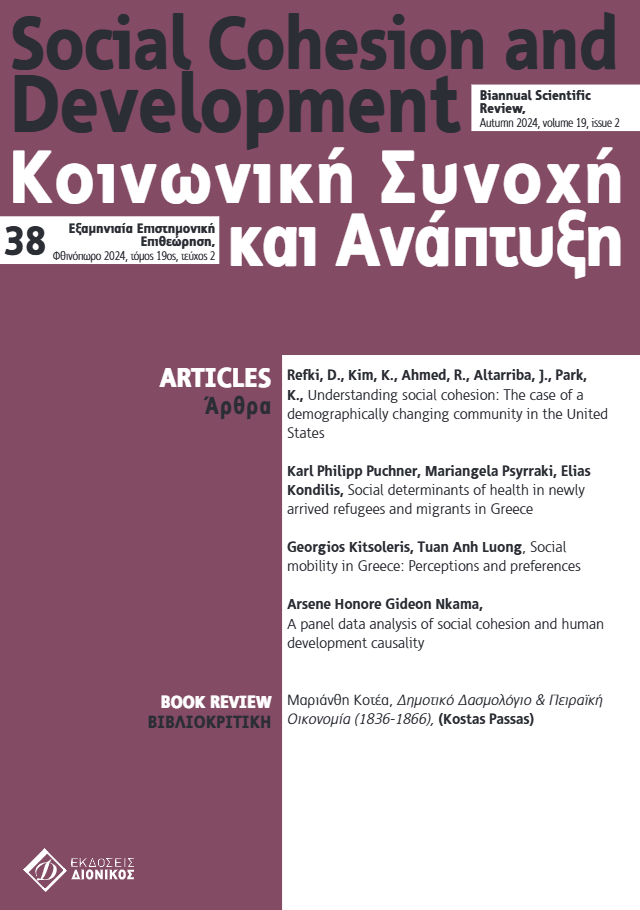
Understanding social cohesion: The case of a demographically changing community in the United States The case of a demographically changing community in the United States
Abstract
ABSTRACT
Social cohesion is associated with community welfare and its members’ wellbeing and quality of life. Studies have provided mixed answers to the question of whether ethnic diversity erodes social cohesion. This study contributes to this body of literature by adapting, testing, and refining an instrument that measures social cohesion in a rural ethnically homogenous region of the Northeast United States; and by using the validated instrument to assess the effects of nascent diversity on community members’ perceptions of social cohesion. We predicted that diversification would activate dynamics of social inequality and dominance, consistent with Social Dominance theory.Comparison of perceptions of multiple groups showed that male participants and Black
residents reported lower level of trust and that culturally diverse residents are less likely to display high level of social cohesion and more likely to feel isolated.
Article Details
- How to Cite
-
Refki, D., (Kyu Yon) Kim, E., Ahmed, R., Altarriba, J., & Park , K. H. (2026). Understanding social cohesion: The case of a demographically changing community in the United States: The case of a demographically changing community in the United States. Social Cohesion and Development, 19(2 (No 38), 5–30. https://doi.org/10.12681/scad.44213
- Section
- Articles

This work is licensed under a Creative Commons Attribution-NonCommercial-ShareAlike 4.0 International License.
Authors who publish with this journal agree to the following terms:
- Authors retain copyright and grant the journal right of first publication with the work simultaneously licensed under a Creative Commons Attribution Non-Commercial License that allows others to share the work with an acknowledgement of the work's authorship and initial publication in this journal.
- Authors are able to enter into separate, additional contractual arrangements for the non-exclusive distribution of the journal's published version of the work (e.g. post it to an institutional repository or publish it in a book), with an acknowledgement of its initial publication in this journal.
- Authors are permitted and encouraged to post their work online (preferably in institutional repositories or on their website) prior to and during the submission process, as it can lead to productive exchanges, as well as earlier and greater citation of published work (See The Effect of Open Access).

