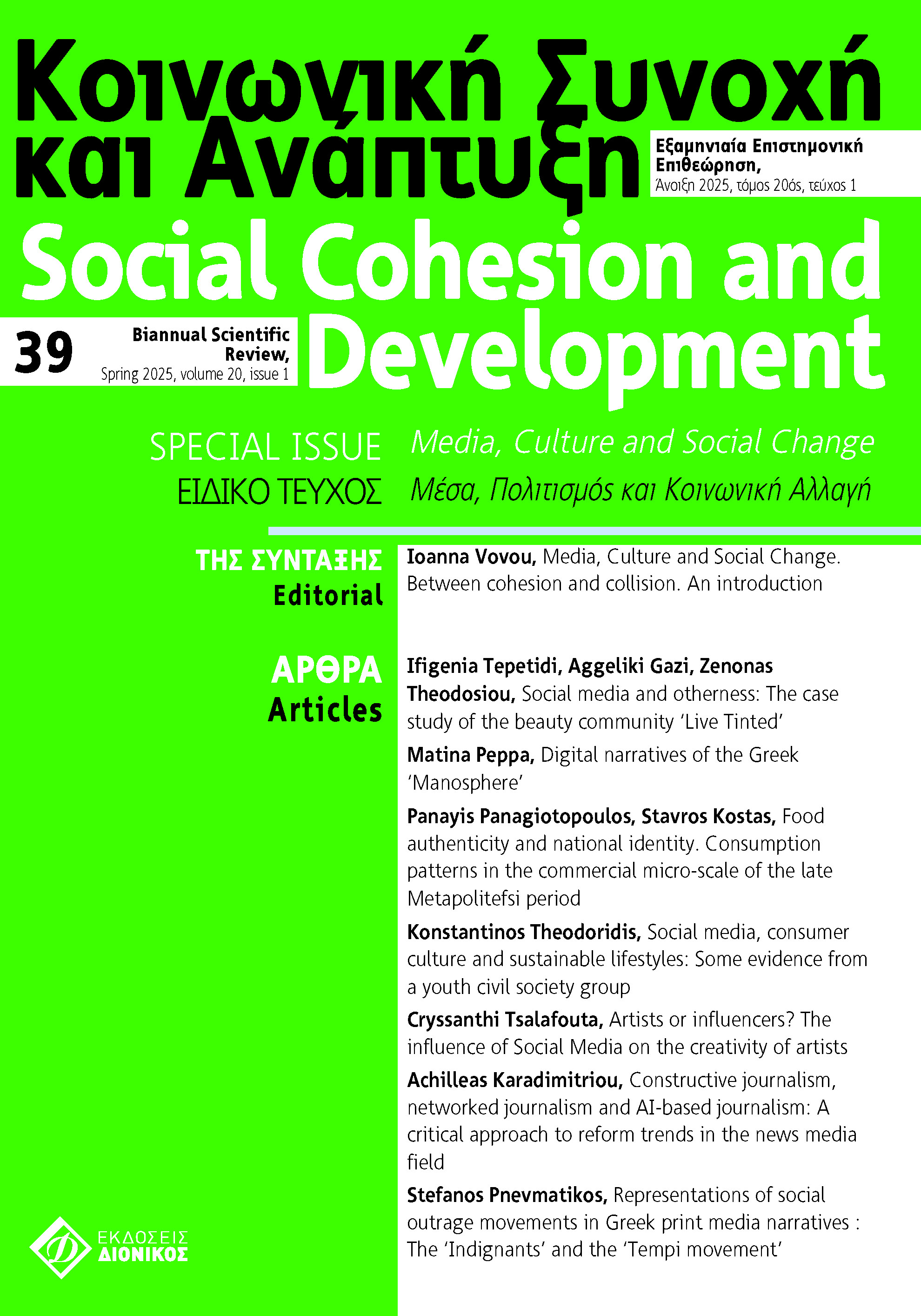
Artists or influencers? The influence of social media on the creativity of artists”

Published: Mar 4, 2026
Keywords:
Social media, platforms, algorithms, creativity, artists
Chrysanthi Tsalafouta
Abstract

This paper examines the relationship between artists in Athens and social media, as well as the impact of the “platformization” of the Cultural Industries on their creativity. Through the method of in-depth interviews, the paper navigates into the social media used by the artists and the ways in which they engage with them. The study highlights how the power of algorithms creates a sense of insecurity among artists, who feel the need to negotiate their artistic identity on these digital platforms. This condition opens a dialogue about the relationship between the artist and the content creator (influencer), as well as the strategies artists employ to safeguard their creativity. Finally, the article explores changes in the role of the artist and their relationship with the “art worlds” through the use of social media digital platforms.

Article Details
  • Section
  • Articles
Downloads
Download data is not yet available.
Author Biography
Chrysanthi Tsalafouta, Panteion University of Social and Political Sciences,Athens, Greece

Chrysanthi Tsalafouta is a cultural manager based in Athens. She is a graduate of the Department of Philology (NKUA) with postgraduate studies in Classical Philology (NKUA). She also holds a master’s specialization in Cultural Management from Panteion University of Athens, with a focus on Cultural Communication, while at the same time completing her studies in German Language and Literature (NKUA). She is currently working as project manager at Karpos – Centre for Media Education, and is also Head of Communication at the Arts & Cultural Management Conference (ACMC). She has participated in international organizations (Erasmus Student Network, Humanity in Action) and various art festivals (Athens International Film Festival, Positively Different Short Film Festival, etc.). E-mail:[email protected]

References
Bain, A. & McLean, H. (2013). The artistic precariat. Cambridge Journal of Regions, Economy, and Society, 6, 93-11. tps://doi.org/10.1093/cjres/rss020
Bakshi, H., Djumalieva, J. and Easton, E. (2019). The creative digital skills revolution. London: Creative Industries Policy and Evidence Centre and Nesta. https://www.pec.ac.uk/researchreports/the-creative-digital-skills-revolution
Bakhshi, S., Shamma, D.A. & Gilbert, E. (2014). Faces engage us: Photos with faces attract more likes and comments on instagram. Proceedings of the SIGCHI Conference on Human Factors in Computing Systems, Toronto 26 April- 1 May 2014 (pp. 1–26). Toronto: CHI '14:CHI Conference on Human Factors in Computing Systems.
Bishop, S. (2023). Influencer creep: How artists strategically navigate the platformisation of art worlds. New Media & Society, 27(4), 2109-2126. https://doi.org/10.1177/14614448231206090
Braun, V., & Clarke, V. (2012). Thematic analysis. Στο Η. Cooper, M. P. Camic, D. Long, T. A. Panter, D. Rindskopf & K. J. Sher (Επιμ.), A handbook of research methods in psychology, Vol. 2. Research designs: Quantitative, qualitative, neuropsychological, and biological. (σσ. 51-71). American Psychological Association. https://doi.org/10.1037/0000319-000
Conor, B., Gill, R., & Taylor, S. (2015). Gender and Creative Labour. The Sociological Review, 63, 1-22. https://doi.org/10.1111/1467-954X.12237
Duffy, B. E. (2020). Social Media Influencers. Στο K. Ross, I. Bachmann, V. Cardo, S. Moorti & M. Scarcelli (Επιμ.) The International Encyclopedia of Gender,Media, and Communication JohnWiley & Sons, Inc.
Flew, T. (2018). Understanding Global Media. Second Edition. London: Red globe Press.
Freidson, E. (1990). Labors of love: a prospectus. Στο E. Erikson, S. P. Vallas (Eπιμ). The Nature of
Work: Sociological Perspectives (σσ. 149-61). New Haven: Yale University Press.
Fuchs, C. (2015). Culture and Economy in the Age of Social Media. New York: Routledge.
Gerber, A. (2017). The Work of Art. Value in Creative Careers. California: Standford University
Press.
Gillespie, T. (2010). The politics of ‘platforms’. New Media & Society, 12(3), 347-364.: https://
doi.org/10.1177/1461444809342738
Hausmann, A. (2010). German Artists Between Bohemian Idealism and Entrepreneurial
Dynamics: Reflections on Cultural Entrepreneurship and the Need for Start-Up
Management. International Journal of Arts Management 12 (2), 17-29. 10.2307/41065015
Hund, E. (2023). The Influencer Industry: The Quest for Authenticity on Social Media. New
Jersey: Princeton University Press.
Jenkins, H. (2009). Confronting the Challenges of Participatory Culture: Media Education for the
st Century. Massachusetts: The Mit Press.
Kang, X. & Chen, W. (2017). The Like Economy: The Impact of Interaction between Artists and
Fans on Social Media in Art Market. International Conference on Business and Information
Management, Beijing 23-25 July 2017, (σσ. 45-49). New York: Association for Computing
Machinery.
Kang, X., Chen, W. & Kang, J. (2019). Art in the Age of Social Media: Interaction Behavior
Analysis of Instagram Art Accounts. Informatics, 6, 6-19. 10.3390/informatics6040052
Καρακιουλάφη, Χ. (2012). «Είναι και τέχνη και επάγγελμα»: προσλήψεις της καλλιτεχνικής
εργασίας-το παράδειγμα των ηθοποιών στην Ελλάδα. Επιθεώρηση Κοινωνικών Ερευνών,
Lindström, S. (2016). Artists and Multiple Job Holding—Breadwinning Work as Mediating
Between Bohemian and Entrepreneurial Identities and Behavior. Nordic Journal of Working
Life Studies, 6(3), 43–58. https://doi.org/10.19154/njwls.v6i3.5527
Menger, P. M. (1999). Artistic Labor Markets and Careers. Annual Review of Sociology, 25,
Menger, P. M. (2001). Artists as workers: Theoretical and methodological challenges, Poetics,
Μπαλτζής, Α. & Τσιγγίλης, Ν. (2020). Συνθήκες Εργασίας και Διαβίωσης των Εικαστικών
Καλλιτεχνών στην Ελλάδα [Ερευνητική Έκθεση.] Μητροπολιτικός Οργανισμός Μουσείων
Εικαστικών Τεχνών Θεσσαλονίκης (MOMUS), Αριστοτέλειο Πανεπιστήμιο Θεσσαλονίκης.
Rosenblum, B. (1986). Artists, alienation and the market. Στο R. Moulin (Επιμ.) Sociologie de
L’art. Paris: L’Harmattan.
Poell, T., Nieborg, D.B & Duffy, B.E. (2022). Platforms and Culture Production. Cambridge: Polity
Press.
Proctor, N. (2010). Digital: Museum as Platform, Curator as Champion in the Age of Social
Media. Curator. The Museum Journal, 53(1), 35-43. 10.1111/j.2151-6952.2009.00006.x
Riccioni, I. (2018). Art, Capitalist Markets, and Society: Insights and Reflections on
Contemporary Art. Στο V. Alexander, S. Hägg, S. Häyrynen & E. Sevänen (Επιμ.) Art and the
Challenge of Markets Volume 2. Sociology of the Arts. Cham: Palgrave Macmillan.
Walmsley, B. (2016). From arts marketing to audience enrichment: How digital engagement can
deepen and democratize artistic exchange with audiences, Poetics, 58, 66-78. https://doi.
org/10.1016/j.poetic.2016.07.001.
Δικτυογραφία
Influencer (χ.χ.). Στο Oxford English Dictionary οnline. Προσπελάστηκε στις 31 Αυγούστου 2025.
Similarweb: Top Websites Ranking. Most Visited Social Media Networks Websites in Greece.
Προσπελάστηκε στις 31 Αυγούστου 2025. Ανακτήθηκε από: https://www.similarweb.com/
top-websites/greece/computers-electronics-and-technology/social-networks-and-onlinecommunities/ .