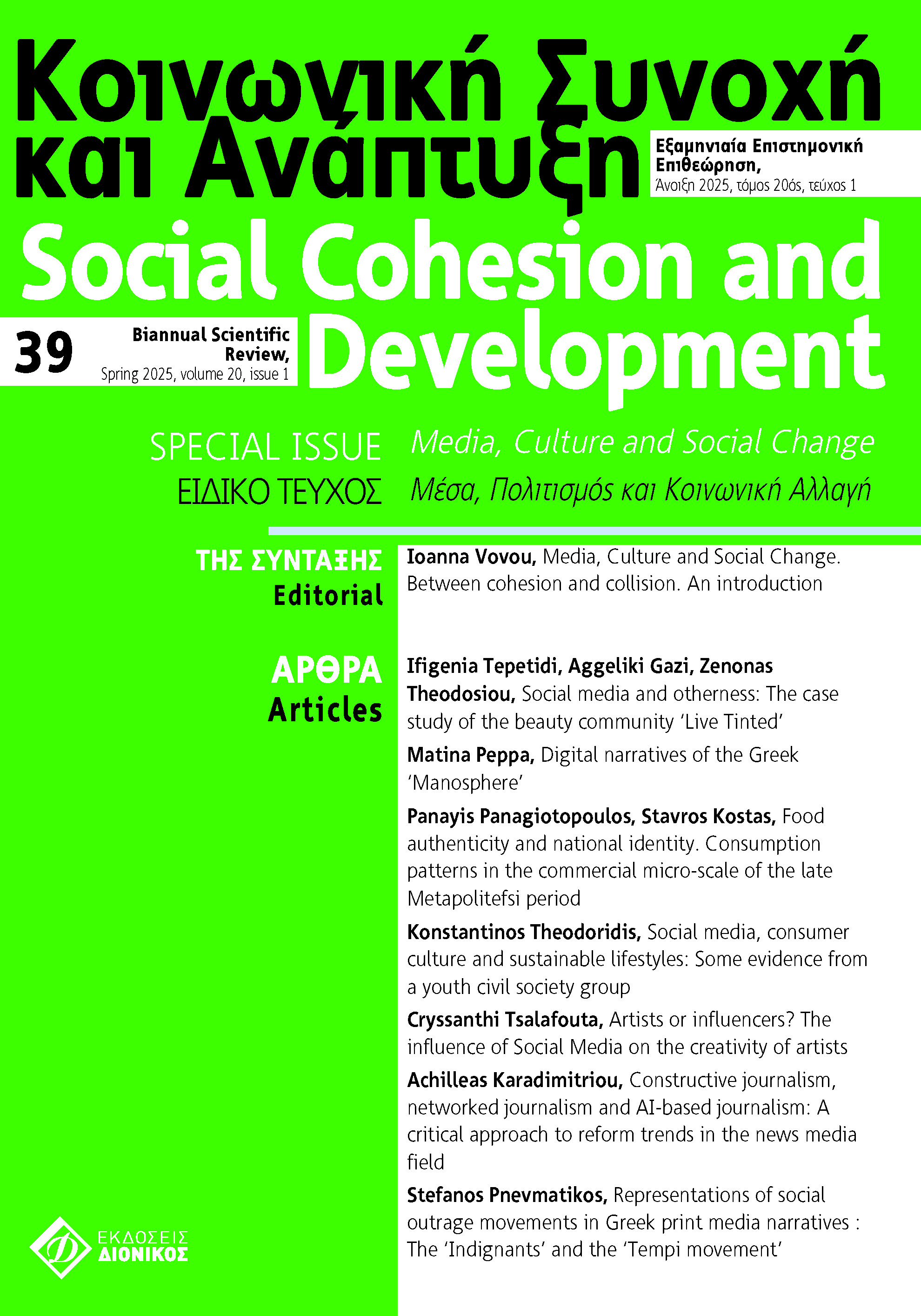
Representations of social outrage movements in Greek print media narratives: The ‘Indignants’ and the ‘Tempi movement’
Abstract
This article examines how the Greek print media highlighted, through their narratives, the social anger expressed by the Indignants movement (2011) and the Tempi movement (2023), two collective mobilizations emerging in distinct periods of crisis. Focusing on the coverage of three Greek newspapers – I Kathimerini, Ta Nea and To Vima – the study investigates the extent to which journalistic narratives contributed to the empowerment of these movements. It further aims to identify and interpret potential shifts in tone, within the broader framework and orientation of journalistic storytelling, in relation to the evolving dynamics of those two movements
Article Details
- How to Cite
-
Pnevmatikos, S. (2026). Representations of social outrage movements in Greek print media narratives: The ‘Indignants’ and the ‘Tempi movement’. Social Cohesion and Development, 20(1), 109–124. https://doi.org/10.12681/scad.44793
- Section
- Articles

This work is licensed under a Creative Commons Attribution-NonCommercial-ShareAlike 4.0 International License.
Authors who publish with this journal agree to the following terms:
- Authors retain copyright and grant the journal right of first publication with the work simultaneously licensed under a Creative Commons Attribution Non-Commercial License that allows others to share the work with an acknowledgement of the work's authorship and initial publication in this journal.
- Authors are able to enter into separate, additional contractual arrangements for the non-exclusive distribution of the journal's published version of the work (e.g. post it to an institutional repository or publish it in a book), with an acknowledgement of its initial publication in this journal.
- Authors are permitted and encouraged to post their work online (preferably in institutional repositories or on their website) prior to and during the submission process, as it can lead to productive exchanges, as well as earlier and greater citation of published work (See The Effect of Open Access).