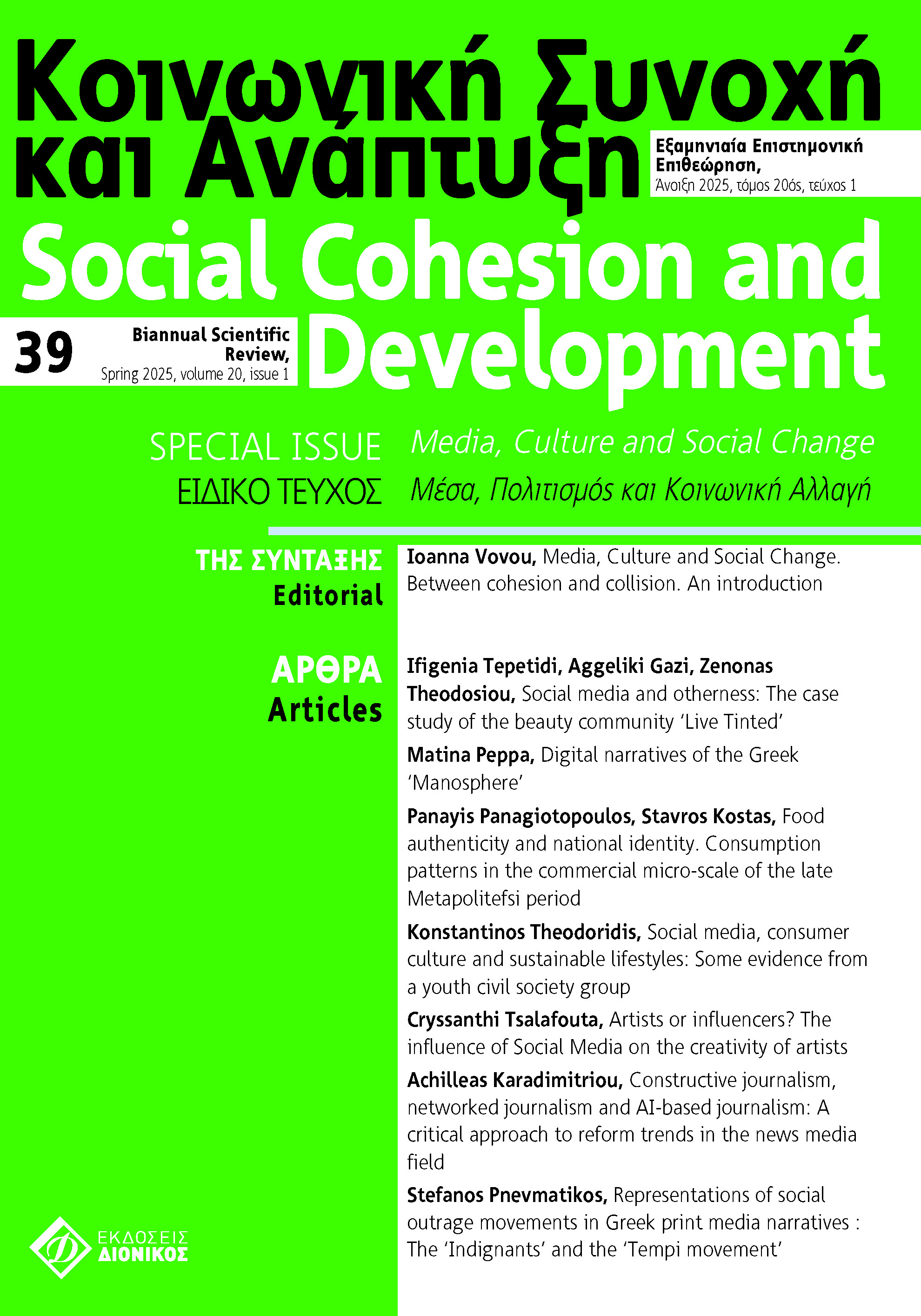
Constructive journalism, networked journalism and AI-based journalism: A critical approach to reform trends in the news media field
Περίληψη
This chapter critically examines the evolving role of journalism in the twenty-first century, focusing on three reform “movements”: constructive journalism, networked journalism, and AI-driven journalism. It is argued that transforming journalism culture depends on gradual social change rather than solely on technology. The “movements” discussed play dynamic roles that enhance, rather than undermine, journalists’ professional identities, fostering new models for information dissemination and social change. These trends indicate a shift towards a «postindustrial» model of news production.
Λεπτομέρειες άρθρου
- Πώς να δημιουργήσετε Αναφορές
-
Karadimitriou, A. (2026). Constructive journalism, networked journalism and AI-based journalism: A critical approach to reform trends in the news media field. Κοινωνική Συνοχή και Ανάπτυξη, 20(1), 95–108. https://doi.org/10.12681/scad.44792
- Ενότητα
- Άρθρα

Αυτή η εργασία είναι αδειοδοτημένη υπό το CC Αναφορά Δημιουργού – Μη Εμπορική Χρήση – Παρόμοια Διανομή 4.0.
Οι συγγραφείς των άρθρων που δημοσιεύονται στην Κοινωνική Συνοχή και Ανάπτυξη διατηρούν τα δικαιώματα πνευματικής ιδιοκτησίας επί των άρθρων τους, δίνοντας στο περιοδικό το δικαίωμα της πρώτης δημοσίευσης. Άρθρα που δημοσιεύονται στην Κοινωνική Συνοχή διατίθενται με άδεια Creative Commons 4.0 και σύμφωνα με την άδεια μπορούν να χρησιμοποιούνται ελεύθερα, με αναφορά στο/στη συγγραφέα και στην πρώτη δημοσίευση για μη κερδοσκοπικούς σκοπούς και με δικαίωμα τροποποίησης μόνον με παρόμοια διανομή (αν αναμείξετε, τροποποιήσετε, ή δημιουργήσετε πάνω στο υλικό, πρέπει να διανείμετε τις δικές σας συνεισφορές υπό την ίδια άδεια όπως και το πρωτότυπο).Λήψεις
Τα δεδομένα λήψης δεν είναι ακόμη διαθέσιμα.
Αναφορές
Aitamurto, T., & Varma, A. (2018). The Constructive Role of Journalism: Contentious metadiscourse on constructive journalism and solutions journalism. Journalism Practice, 12(6), 695–713. https://doi.org/10.1080/17512786.2018.1473041
Anderson, C.W., Bell, E. & Shirky, C. (2012) Post-Industrial Journalism: Adapting to the Present. New York: Tow Center for Digital Journalism.
Banafi, W. (2024). A review of the role of artificial intelligence in journalism. Edelweiss Applied Science and Technology, 8 (6), 3951-3961. https://doi.org/10.55214/25768484.v8i6.2865
Beckett, C., Mansell, R. (2008). Crossing Boundaries: New Media and Networked Journalism. Communication, Culture and Critique, 1, (1): 92–104, https://doi.org/10.1111/j.1753-9137.2007.00010.x
Beckett, C. (2010). The Value of Networked Journalism. Research Paper in Economics. Report researched and written by Charlie Beckett with Polis interns Jaime Herve-Azevedo, Kyle Moughan, David McDougall, Daniela Moreira, Bjork Kjaernested, and Sachi Doctor. Polis Journalism and Society & The London School of Economics and Political Science. Retrieved from https://eprints.lse.ac.uk/31050/1/Beckett_Value_networked_journalism_2010.pdf
Benkler, Y. (2006). The Wealth of Networks: How Social Production Transforms Markets and Freedom. Yale University Press.
Bro, P. (2018). Constructive journalism: Proponents, precedents, and principles. Journalism,
(4), 504-519. https://doi.org/10.1177/1464884918770523 (Original work published
.
Bro, P., and C. Gyldensted (2021). “Constructive Journalism: Portraying the World Accurately
Through Positive Psychology reporting.” In McIntyre Hopkinson, K. and Dahmen, N. S.
(Eds), Reporting Beyond the Problem: From Civic Journalism to Solutions Journalism, 31-48.
New York: Peter Lang.
Chadwick, A. (2013). The hybrid media system: Politics and Power. Oxford University Press.
Chan, J. M. (2018). From networked commercialism to networked authoritarianism:
The biggest challenge to journalism. Journalism, 20 (1), 64-68. https://doi.
org/10.1177/1464884918806741 (Original work published 2019)
Chouliaraki, L. (2010). Ordinary witnessing in post-television news: towards a new moral
imagination. Critical Discourse Studies, 7 (4), 305–319. https://doi.org/10.1080/17405904
.2010.511839
Dennis, J. (2024). How News Found the Avoiders: The Changing News Routines of Infodemically
Vulnerable Young People in England During Covid-19. Journalism Studies, 25 (12),
Deuze, M., & Witschge, T. (2017). Beyond journalism: Theorizing the transformation of
journalism. Journalism, 19 (2), 165-181. https://doi.org/10.1177/1464884916688550
(Original work published 2018).
Dodds, T., Zamith, R., & Lewis, S. C. (2025). The AI turn in journalism: Disruption, adaptation,
and democratic futures. Journalism, 0(0). https://doi.org/10.1177/14648849251343518
Diakopoulos, N. (2014). Algorithmic Accountability: Journalistic investigation of computational
power structures. Digital Journalism, 3(3), 398–415. https://doi.org/10.1080/21670811.20
976411
Fölscher-Kingwill, B. & Wasserman, H. (2024): The Ideal and Practice of Constructive Journalism:
How South African Journalists Perceive Their Roles, Journalism Practice, DOI: 10.1080/1751
2024.2362802
From, U., & Kristensen, N. N. (2018). Rethinking Constructive Journalism by Means of Service
Journalism. Journalism Practice, 12(6), 714-729. https://doi.org/10.1080/17512786.2018.1
Gyldensted, C. (2015). From Mirrors to Movers: Five Elements of Positive Psychology in
Constructive Journalism. Lexington, KY: Ggroup Publishing.
Haagerup, U. (2014). Constructive News: How to Save the Media and Democracy with
Journalism of Tomorrow. New York: InnoVatio Publishing.
Κοινωνικη Συνοχη και Αναπτυξη
Haagerup, U. (2017). Constructive News: How to save the media and democracy with journalism
of tomorrow (2nd ed.). Aarhus University Press. https://doi.org/10.2307/j.ctv62hhq4
Haak, B.V., Parks, M., & Castells, M. (2012). The Future of Journalism: Networked Journalism.
International Journal of Communication, 6 (16): 2923-2938.
Hermans, L. & Drok, N. (2018). Placing Constructive Journalism in Context. Journalism Practice,
(6), 679-694. https://doi.org/10.1080/17512786.2018.1470900
Helberger, N. (2019). On the Democratic Role of News Recommenders. Digital Journalism, 7 (8),
Helberger, N. (2024). FutureNewsCorp, or how the AI Act changed the future of news.
Computer Law & Security Review, 52, Article 105915. https://doi.org/10.1016/j.
clsr.2023.105915
Jarvis, J. (2007). Networked journalism. Retrieved July 19, 2007, from http://www.buzzmachine.
com/2006/07/05/networked-journalism/
Kalyango, Y., Hanusch, F., Ramaprasad, J., Skjerdal, T., Hasim, M. S., Muchtar, N., Ullah, M.
S., Manda, L. Z., and Kamara, S. B. (2017). Journalists’ Development Journalism Role
Perceptions: Select countries in Southeast Asia, South Asia, and sub-Saharan Africa.
Journalism Studies, 18 (5), 576–594. https://doi.org/10.1080/1461670X.2016.1254060
Kevin-Alerechi, E., Abutu, I., Oladunni, O., Osanyinro, E., Ojumah, O. & Ogundele, R. (2025). AI
and the Newsroom: Transforming Journalism with Intelligent Systems. Journal of Artificial
Intelligence, Machine Learning and Data Science, 3(1), 1930-1937. DOI: doi.org/10.51219/
JAIMLD/Elfredah-Kevin-Alerechi/426
Lough, K., and McIntyre, K. (2021). Transitioning to Solutions Journalism: One Newsroom’s
Shift to Solutions-Focused Reporting. Journalism Studies 22 (2): 193–208. https://doi.
org/10.1080/ 1461670X.2020.1843065
McIntyre, K. (2019). Solutions Journalism: The Effects of Including Solution Information in News
Stories about Social Problems. Routledge.
McIntyre, K., Hopkinson, R., & Dahmen, N. S. (2021). Solutions Journalism: The Effects of
Including Solution Information in News Stories about Social Problems. Journalism & Mass
Communication Quarterly, 98(1), 130–150.
McIntyre Hopkinson, K., and Dahmen, N. (2021). Reporting Beyond the Problem: From Civic
Journalism to Solutions Journalism. Peter Lang: New York.
McIntyre, K. E., & Gyldensted, C. (2017). Constructive Journalism: Applying Positive Psychology
Techniques to News Production. The Journal of Media Innovations, 4: 20-34.
McIntyre, K., and Gyldensted, C. (2018). Positive Psychology as a Theoretical Foundation for
Constructive Journalism. Journalism Practice, 12 (6): 662–678. https://doi.org/10.1080/
2018.1472527
Natale, S., Bory, P. & Balbi, G. (2019). The rise of corporational determinism: digital media
corporations and narratives of media change. Critical Studies in Media Communication,
(4), 323-338. https://doi.org/10.1080/15295036.2019.1632469
Social Cohesion and Development [107]
Oh, S., & Jung, J. (2025). Harmonizing Traditional Journalistic Values with Emerging AI
Technologies: A Systematic Review of Journalists’ Perception. Media and Communication,
, Article 9495. https://doi.org/10.17645/mac.9495
Opdahl, A. L., Tessem, B., Dang-Nguyen, D.-T., Motta, E., Setty, V., Throndsen, E., Tverberg, A.,
& Trattner, C. (2023). Trustworthy journalism through AI, Data & Knowledge Engineering,
Papp, J. T. (2024). Adapting to change: AI’s potential impacts on journalism. Pázmány Law
Review, 11(1), 17–31. https://doi.org/10.55019/plr.2024.1.17-31
Pavlik, J. V. (2023). Collaborating With ChatGPT: Considering the Implications of Generative
Artificial Intelligence for Journalism and Media Education. Journalism & Mass
Communication Educator, 78(1), 84-93. https://doi.org/10.1177/10776958221149577
(Original work published 2023)
Rosen, J. (1999). What are journalists for? Binghamton, NY: Vail-Ballou Press.
Simon, F. (2024). Artificial intelligence in the news: How AI retools, rationalizes, and
reshapes journalism and the public arena. Tow Center for Digital Journalism, Columbia
University. Retrieved from https://towcenter.columbia.edu/content/publications0#!#%2Ffilter%2Fyear%2F2024 (Accessed June 15th, 2025).
Skovsgaard, M., & Andersen, K. (2019). Conceptualizing News Avoidance: Towards a Shared
Understanding of Different Causes and Potential Solutions. Journalism Studies, 21 (4),
Sonni, A. F. (2025). Digital transformation in journalism: mini review on the impact of AI on
journalistic practices. Front. Commun. 10:1535156. doi: 10.3389/fcomm.2025.1535156
Thier, K., Abdenour, J., Walth, B., & Dahmen, N. S. (2019). A narrative solution: The relationship
between solutions journalism, narrative transportation, and news trust. Journalism, 22(10),
-2530. https://doi.org/10.1177/1464884919876369 (Original work published 2021).
van Antwerpen, N., R. A. Searston, D. Turnbull, L. Hermans, and P. Kovacevic (2022a). The
Effects of Constructive Journalism Techniques on Mood, Comprehension, and Trust.”
Journalism, 146488492211057. https://doi.org/10.1177/14648849221105778.
van Antwerpen, N., Turnbull, D. and Searston, R. A. (2022b). Perspectives from Journalism
Professionals on the Application and Benefits of Constructive Reporting for Addressing
Misinformation. The International Journal of Press/Politics, 194016122110727. https://doi.
org/ 10.1177/19401612211072782
van Der Haak, B., Parks, M., & Castells, M. (2012). The Future of Journalism: Networked
Journalism. International Journal of Communication, 6 (16): 2923-2938. Retrieved from
van Haak, B., Parks, M. & Castells, M. (2013). The Future of Journalism: Networked Journalism.
Chinese Journal of Journalism & Communication. 2013, 35(1): 53-66
Vrijenhoek, S., Kaya, M., Metoui, N., Möller, J., Odijk, D., & Helberger, N. (2021).
Recommenders with a mission: Assessing diversity in news recommendations. In
Proceedings of the 2021 Conference on Human Information Interaction and Retrieval
(CHIIR ‘21). Association for Computing Machinery, New York, NY, USA, 173–183. https://
doi.org/10.1145/3406522.3446019
Κοινωνικη Συνοχη και Αναπτυξη
Waisbord, S., & Russell, A. (2020). News Flashpoints: Networked Journalism and Waves of
Coverage of Social Problems. Journalism & Mass Communication Quarterly, 97(2), 376-
https://doi.org/10.1177/1077699020917116 (Original work published 2020)
Yu, X., Haroon, M., Menchen-Trevino, E. & Wojcieszak, M. (2024). Nudging recommendation
algorithms increases news consumption and diversity on YouTube, PNAS Nexus, 3 (12):