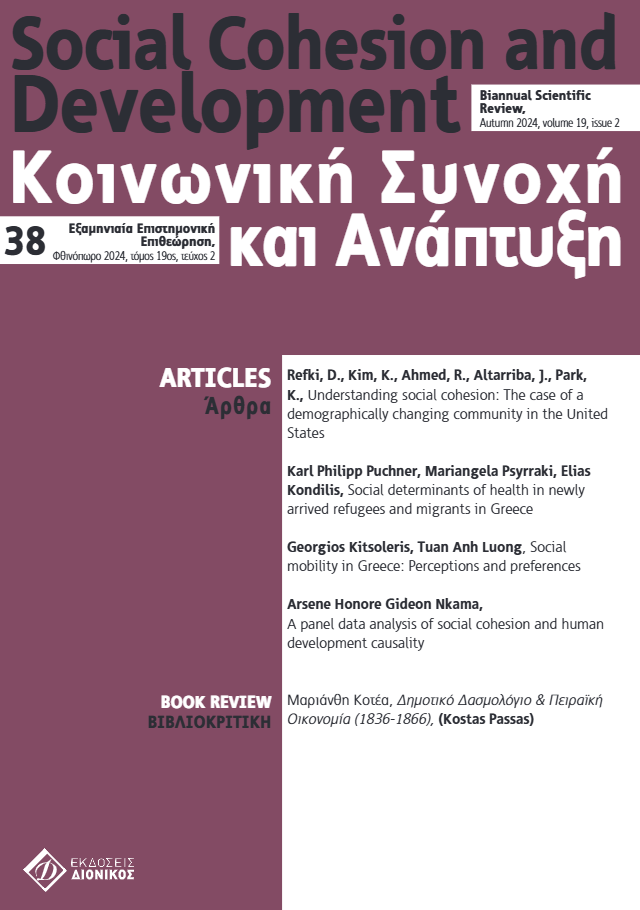
Social determinants of health in newly arrived refugees and migrants in Greece
Abstract
The Greek state applies significantly different migration policies for Ukrainian versus other third country nationals and stateless (OTCNS) R&Ms. Using the framework of the SDoH, in this paper, we have assessed policies related to the asylum and temporary international protection processes and elaborated their potential health impact. Our results suggest that in both groups, existing policies may have
negative health impacts with the impact on SDoH being however less detrimental in the case of Ukrainians R&Ms. Also, policies applied to OTCNS R&Ms sustain a prolonged state of precarity, which might have an independently negative health effect. This dichotomous migration policy might result in poorer health outcomes of the OTCNS R&Ms. Due to the nonnegligible size of this population, the eroding
effects of these policies on the social cohesion and health status of the Greek society, should not be underestimated. Critical review of the current migration policy and swift leveling up policy equalization for all categories of R&Ms is needed.
Article Details
- How to Cite
-
Puchner, K. P., Psyrraki, M.-A., & Kondilis, E. (2026). Social determinants of health in newly arrived refugees and migrants in Greece. Social Cohesion and Development, 19(2 (No 38), 31–40. https://doi.org/10.12681/scad.44242
- Section
- Articles

This work is licensed under a Creative Commons Attribution-NonCommercial-ShareAlike 4.0 International License.
Authors who publish with this journal agree to the following terms:
- Authors retain copyright and grant the journal right of first publication with the work simultaneously licensed under a Creative Commons Attribution Non-Commercial License that allows others to share the work with an acknowledgement of the work's authorship and initial publication in this journal.
- Authors are able to enter into separate, additional contractual arrangements for the non-exclusive distribution of the journal's published version of the work (e.g. post it to an institutional repository or publish it in a book), with an acknowledgement of its initial publication in this journal.
- Authors are permitted and encouraged to post their work online (preferably in institutional repositories or on their website) prior to and during the submission process, as it can lead to productive exchanges, as well as earlier and greater citation of published work (See The Effect of Open Access).