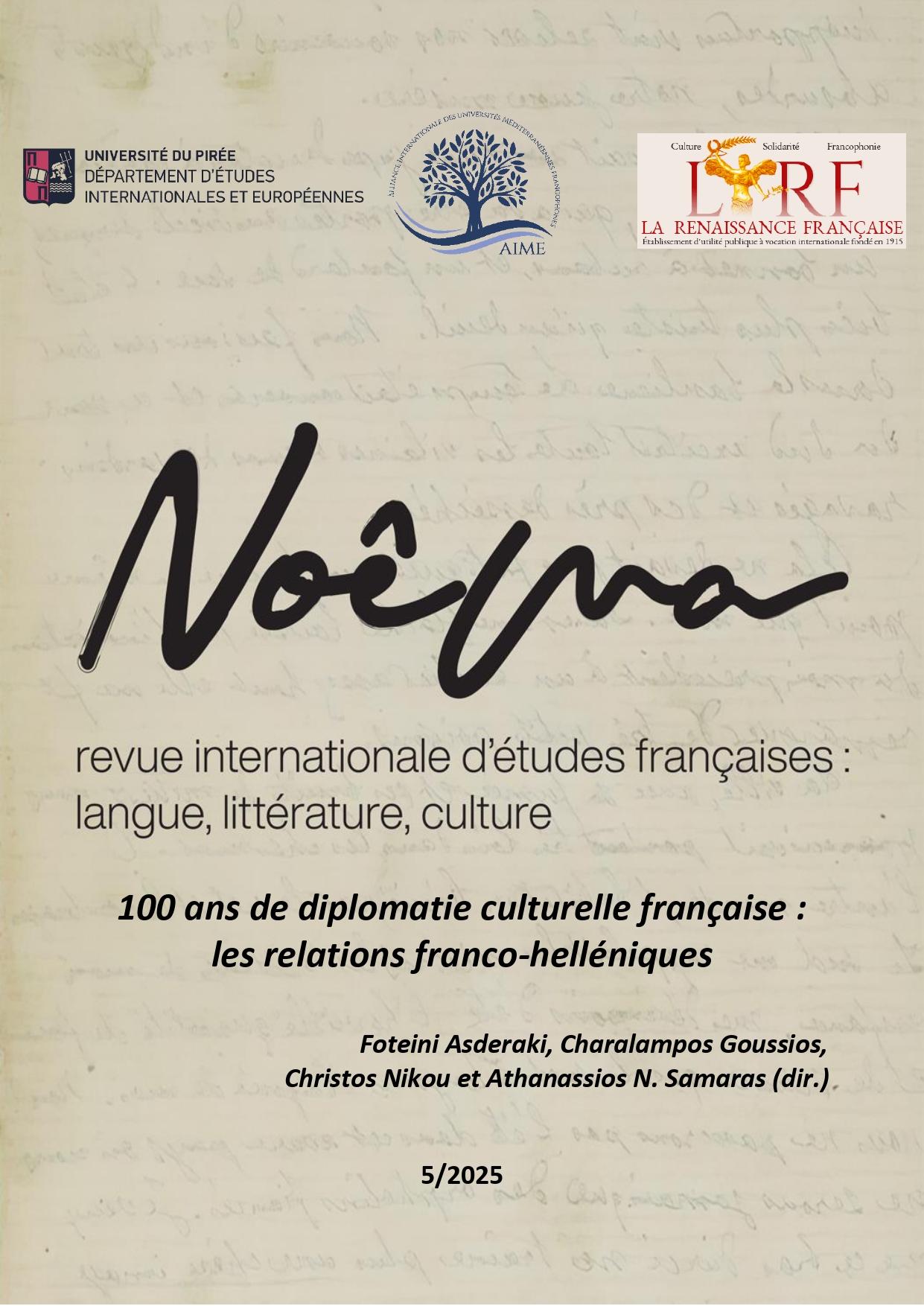
The Evolution of Franco-Hellenic Relations: From the Mataroa Expedition to the Creation of French Language and Literature Departments in Greece and Modern Greek Studies Departments in France
Abstract
The aim of this article is to examine how Greece proceeded with the establishment of Departments of French Language and Literature, what France contributed to their development—particularly in the wake of the success of the Mataroa expedition—the impact these new university teaching and research units had on French-language education at all levels in Greece, the changes they later underwent and the reasons for them, as well as the consequences of these developments. The article also briefly discusses how the two countries approached the development of modern Greek language and culture studies in France. Concrete examples drawn from over forty-two years of experience in higher education—as a French teacher in Greek universities, a professor specializing in a French language and culture department, and a lecturer in modern Greek in a modern Greek department in France—will illustrate these points, in order to highlight the achievements and the limits of cultural and scientific diplomacy between the two countries.
Article Details
- How to Cite
-
Fréris, G. (2025). The Evolution of Franco-Hellenic Relations: From the Mataroa Expedition to the Creation of French Language and Literature Departments in Greece and Modern Greek Studies Departments in France. Noêma, 1(5), 59–66. https://doi.org/10.12681/noema.43883
- Section
- Articles

This work is licensed under a Creative Commons Attribution-NonCommercial-ShareAlike 4.0 International License.
Licence / Avis de droit d’auteur / Déclaration de droits
1) Licence de publication
Tous les articles de cette revue sont mis à disposition selon les termes de la licence Creative Commons Attribution – Pas d’Utilisation Commerciale – Partage dans les Mêmes Conditions 4.0 International (CC BY-NC-SA 4.0).
https://creativecommons.org/licenses/by-nc-sa/4.0/
Vous êtes autorisé·e·s à partager (copier, redistribuer) et à adapter le contenu, à condition :
- de créditer correctement l’auteur et la source,
- d’indiquer si des modifications ont été effectuées,
- de ne pas en faire un usage commercial, et
- de diffuser toute adaptation sous la même licence (CC BY-NC-SA 4.0).
2) Droit d’auteur·rice
Les auteur·rice·s conservent leurs droits d’auteur et accordent à la revue le droit de première publication.
3) Droits d’utilisation (réutilisation)
Les articles peuvent être partagés, copiés et adaptés à des fins non commerciales, à condition :
- d’attribuer correctement la paternité à l’auteur original,
- de fournir un lien vers la licence, et
- d’indiquer si des modifications ont été apportées.
Toute redistribution, adaptation ou création dérivée de l’article doit être diffusée sous la même licence (CC BY-NC-SA 4.0).
4) Diffusion et archivage
Les auteur·rice·s peuvent conclure des ententes contractuelles additionnelles non exclusives pour la diffusion de la version publiée de l’article (par exemple, dépôt dans un répertoire institutionnel ou publication dans un ouvrage collectif),
à condition que la publication initiale dans cette revue soit clairement mentionnée.
Les auteur·rice·s sont encouragé·e·s à archiver leurs articles (prépublications ou versions acceptées) sur des plateformes ouvertes ou dépôts institutionnels, avant ou pendant le processus d’évaluation, ce qui peut favoriser une meilleure visibilité et un plus grand nombre de citations.
(Copyright Notice / Copyright Statement)
1) Publication license
All articles in this journal are made available under the terms of the Creative Commons Attribution–NonCommercial–ShareAlike 4.0 International (CC BY-NC-SA 4.0) license.
https://creativecommons.org/licenses/by-nc-sa/4.0/
You are allowed to share (copy, redistribute) and adapt the content, provided that you:
- give appropriate credit to the author and the source,
- indicate if changes were made,
- do not use the material for commercial purposes, and
- distribute any adaptations under the same license (CC BY-NC-SA 4.0).
2) Copyright
Authors retain copyright and grant the journal the right of first publication.
3) Reuse rights
Articles may be shared, copied, and adapted for non-commercial purposes, provided that you:
- properly attribute the original author,
- provide a link to the license, and
- indicate if changes were made.
Any redistribution, adaptation, or derivative work must be distributed under the same license (CC BY-NC-SA 4.0).
4) Dissemination and archiving
Authors may enter into additional non-exclusive contractual arrangements for the dissemination of the published version of the article (for example, deposit in an institutional repository or publication in an edited volume), provided that initial publication in this journal is clearly acknowledged.
Authors are encouraged to archive their articles (preprints or accepted manuscripts) on open platforms or in institutional repositories, before or during the peer-review process, which may contribute to greater visibility and increased citations.