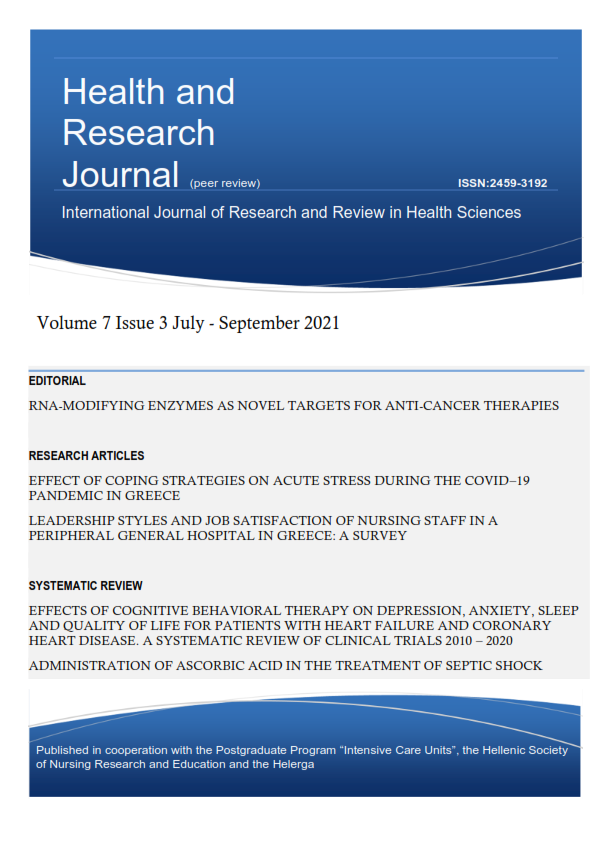
Effect of coping strategies on acute stress during the COVID–19 pandemic in Greece
Abstract
Background: The psychological impact of quarantine, due to the SARS COVID-19 outbreak, was examined with a specific focus on the relationship between 7 coping strategies: (i) active coping, (ii) positive reframing, (iii) acceptance, (iv) use of emotional support, (v) religion, (vi) substance use and (vii) self-blame and acute stress. This study aimed to identify specifically which of those coping strategies could increase or decrease acute stress levels.
Method and Material: The data collection took place during the lockdown and was performed using online surveys. The finale sample size reached up to 1154 Greek adults (age M= 40.51). Two adapted and translated scales were used to measure the variables of interest, including: Brief-COPE questionnaire as well as Acute Stress Disorder Scale (ASDS).
Results: “Active coping”, “acceptance”, “positive reframing” and “emotional support”, four of the coping strategies examined, that were found to be significantly associated with stress reduction. Meanwhile, “religion”, “self-blame” and “substance use” were not associated with stress reduction.
Conclusions: This study initially provides an insight of acute stress and effective coping strategies associated with the quarantine period during the COVID – 19 pandemic in Greece. The outcome of this study equip support for the expected inflation of the mental health issues stemmed from the unusual stressors, and urge clinicians, mental health providers, and public agencies to assemble, in an attempt to make possible the widespread implementation of more effective and beneficial coping strategies.
Article Details
- How to Cite
-
Strongylaki, N. P., Pilafas, G., Dermati, A., Menti, D., & Lyrakos, G. (2021). Effect of coping strategies on acute stress during the COVID–19 pandemic in Greece. Health & Research Journal, 7(3), 98–108. https://doi.org/10.12681/healthresj.27473
- Section
- Original Articles
Copyright notice:
Authors retain copyright of their work and grant the Health and Research Journal the right of first publication.
License:
Articles are published under the Creative Commons Attribution 4.0 International License (CC BY 4.0). This license permits use, sharing, adaptation, distribution, and reproduction in any medium or format, including for commercial purposes, provided that appropriate credit is given to the author(s) and the original publication in this journal, a link to the license is provided, and any changes are indicated.
Attribution requirement:
Any reuse must include the article citation and DOI (where available), and indicate if changes were made.