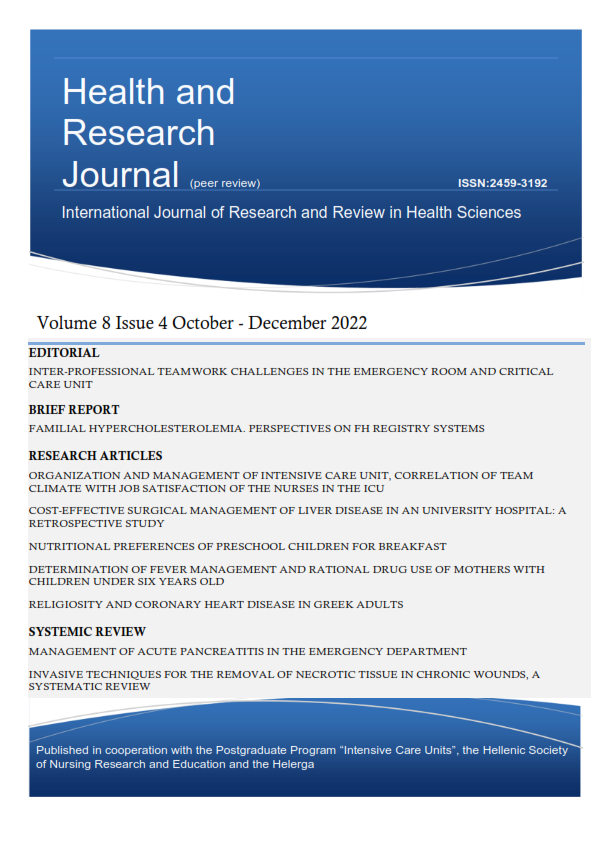
Management of acute pancreatitis in the Emergency Department
Abstract
Background: Heterogeneity in clinical manifestations and outcome of pancreatitis constitutes an obstacle for the creation of a common treatment algorithm by the scientific community.
Aim: The aim of the present study was to systematically review the management of cases of acute pancreatitis in Emergency Department (ED) and her correlation with outcome.
Methods: Search the database Pubmed and were included observational studies and randomized trials in adults in English.
Results: The search yielded 13 studies. Of these, 3 concerned the diagnostic approach of the disease in ED and concluded that lipase is the most reliable test in diagnosis, while computed tomography of the abdomen is not recommended as a routine examination. 5 out of 13 studies analyzed the usefulness of disease severity classification systems, with the BISAP and HASP score appearing as reliable as the APACHE II and RANSON score, but having an advantage in rapid patient evaluation. The last 5, studied the need for immediate therapeutic / invasive method, with the time of surgery from the arrival at the ED being decisive as it affects the outcome of the disease. It is generally seen that the early invasive method is gaining ground in the treatment of the disease.
Conclusion: The main goal is to predict the most severe forms of the disease in order to receive the right (invasive or not) treatment to improve survival and quality of life.
Article Details
- How to Cite
-
Tsiampas , I. (2022). Management of acute pancreatitis in the Emergency Department. Health & Research Journal, 8(4), 325–337. https://doi.org/10.12681/healthresj.31560
- Section
- Systematic Reviews
Copyright notice:
Authors retain copyright of their work and grant the Health and Research Journal the right of first publication.
License:
Articles are published under the Creative Commons Attribution 4.0 International License (CC BY 4.0). This license permits use, sharing, adaptation, distribution, and reproduction in any medium or format, including for commercial purposes, provided that appropriate credit is given to the author(s) and the original publication in this journal, a link to the license is provided, and any changes are indicated.
Attribution requirement:
Any reuse must include the article citation and DOI (where available), and indicate if changes were made.