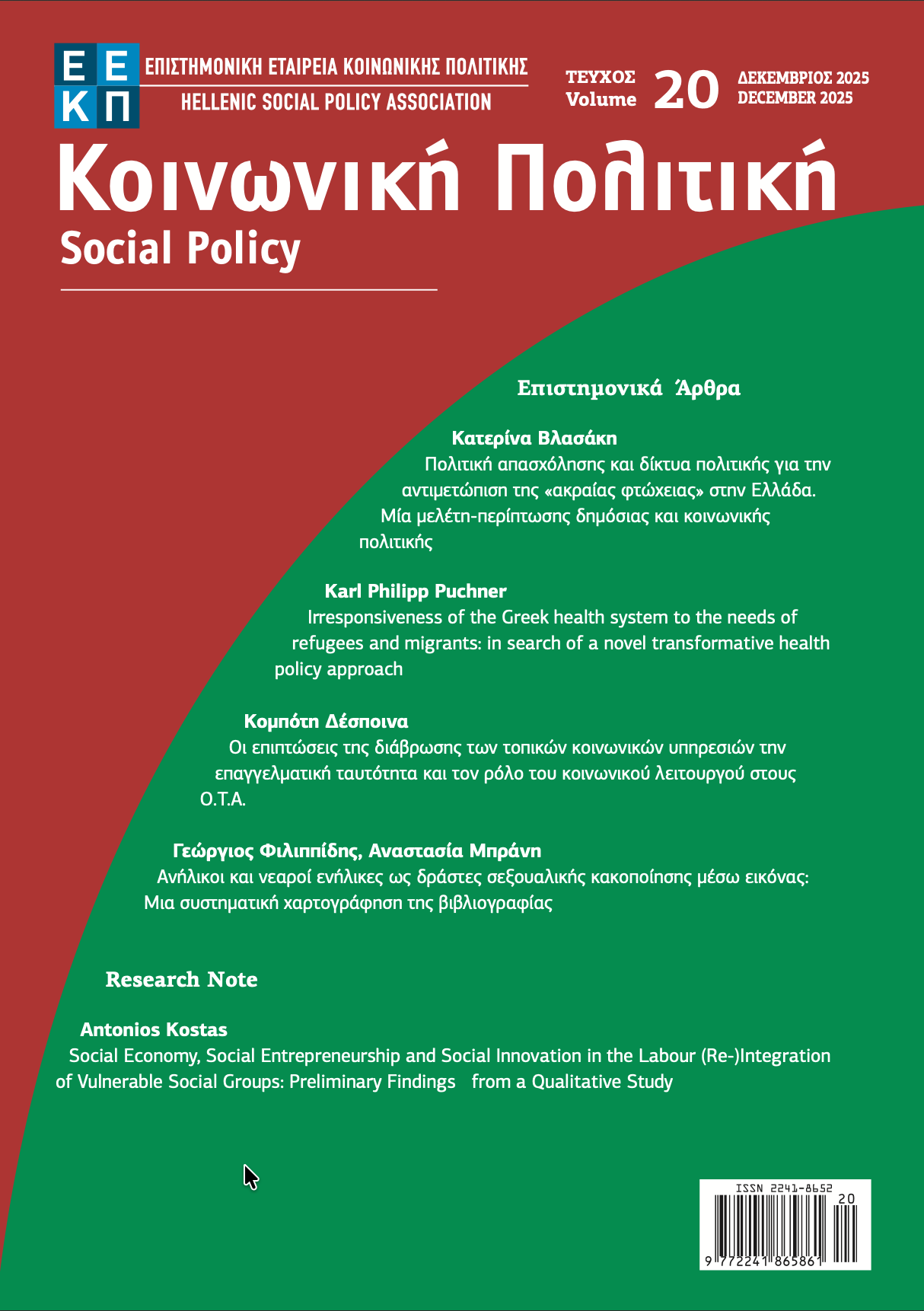
Οι επιπτώσεις της διάβρωσης των τοπικών κοινωνικών υπηρεσιών στην επαγγελματική΄ ταυτότητα και τον ρόλο του κοινωνικού λειτουργού στους Ο.Τ.Α.

Δημοσιευμένα: Φεβ 16, 2026
Λέξεις-κλειδιά:
επαγγελματική ταυτότητα κοινωνικού λειτουργού κοινωνικές υπηρεσίες στην τοπική αυτοδιοίκηση
Δέσποινα Κομπότη
Περίληψη

Η παρουσία και η ανάπτυξη της επαγγελματικής ταυτότητας είναι σημαντική στην άσκηση της κοινωνικής εργασίας. Η αντίληψη  για την επαγγελματική ταυτότητα συντελεί στην ενίσχυση του ρόλου  του κοινωνικού και της κοινωνικής λειτουργού, στην κινητοποίησή του, στη δέσμευσή του απέναντι στο επάγγελμα και στην ικανοποίηση που αντλεί μέσα από αυτό. Στο επίκεντρο αυτής της μελέτης είναι να διερευνήσει με ποιο τρόπο η  άσκηση  της  κοινωνικής εργασίας σε τοπικό επίπεδο επηρεάζει την επαγγελματική ταυτότητα των επαγγελματιών κοινωνικών λειτουργών . Υποστηρίζεται ότι η κοινωνική εργασία ορίζεται από τη θέση της στο ευρύτερο κοινωνικό περιβάλλον  και ότι οι εξωτερικές οικονομικές, κοινωνικές και πολιτικές δυνάμεις έχουν μεγαλύτερη επιρροή στη διαμόρφωση της φύσης της πρακτικής από τις ενδοεπαγγελματικές επιλογές. Για την υλοποίηση του σκοπού  αυτού  πραγματοποιήθηκε  εμπειρική έρευνα ώστε να διερευνηθούν και να καταγραφούν οι απόψεις των κοινωνικών λειτουργών που εργάζονται σε κοινωνικές υπηρεσίες στην τοπική αυτοδιοίκηση,  επί των παραμέτρων που συνθέτουν τις παραπάνω έννοιες.

Λεπτομέρειες άρθρου
  • Ενότητα
  • Άρθρα
Λήψεις
Τα δεδομένα λήψης δεν είναι ακόμη διαθέσιμα.
Αναφορές
Δημοπούλου-Λαγωνίκα, Μ., (2011). Μεθοδολογία Κοινωνικής Εργασίας Μοντέλα παρέμβασης: Από την ατομική στη γενική-ολιστική προσέγγιση. Σε συνεργασία με
τους Ταυλαρίδου-Καλούτση, Α. & Μουζακίτης, Χ. Αθήνα: Εκδόσεις Τόπος
Καραγκούνης, Β. (2020). Κοινοτική Κοινωνική Εργασία. Αθήνα: Τόπος
Πετμεζίδου, Μ., (2018). Τα ευρωπαϊκά κοινωνικά κράτη μετά τη μεγάλη ύφεση. Στο Κ. Δημουλάς & Γ. Κουζής (Επιμ.), Κρίση και Κοινωνική Πολιτική. Αδιέξοδα και Λύσεις (σ. 21-43). Αθήνα: Τόπος.
Πουλόπουλος, Χ. (2014). Κρίση, φόβος και διάρρηξη της κοινωνικής συνοχής. Αθήνα: Τόπος
Σκαμνάκης Χ. και Πανταζόπουλος Σ., (2014). Κοινωνική προστασία και τοπική αυτοδιοίκηση, η εξέλιξη ενός διπλού ελλείματος, Περιφέρεια, Τομ.4, Αρ.4.
Φερώνας, Α. (2018). Η κοινωνική πρόνοια στην Ελλάδα της κρίσης: Ο «φτωχός συγγενής» στη δίνη της νεοφιλελεύθερης λιτότητας. Στο Κ. Δημουλάς & Γ. Κουζής (Επιμ.), Κρίση και Κοινωνική Πολιτική. Αδιέξοδα και Λύσεις(σσ.193-213s). Αθήνα: Τόπος.
Χάρδας, Α., και Σκαμνάκης, Χ.(2016). Η κοινωνική πολιτική των ελληνικών Δήμων σε περίοδο οικονομικής κρίσης: Kρατική ‘αυτόνομη εμπέδωση’ υπηρεσιών κοινωνικής πολιτικής σε τοπικό επίπεδο, Αειχώρος, 25, Πανεπιστημιακές Εκδόσεις Θεσσαλίας
Bryman, A. (2017). Μέθοδοι Κοινωνικής Έρευνας. (μτφρ. Παναγιώτης Σακελλαρόυ και επιμ. Ααθανάσιος Αϊδίνης)Αθήνα: GUTENBERG.
Adams, K., Hean, S., Sturgis, P. & Clark, J.M. (2006). Investigating the factors influencing professional identity of first-year health and social care students. Learning in Health and Social Care, [online] 5(2), pp.55–68. doi:10.1111/j.1473-6861.2006.00119.x.
Abramovitz, M. (2012). Theorising the Neoliberal Welfare State for Social Work. In M. Gray, J. Midgley & S.A. Webb (Eds.), The SAGE Handbook of Social Work. Thousand Oaks, California: SAGE.
Allen-Meares, P. & Garvin, C.D. (2000). The handbook of social work direct practice. Thousand Oaks, Calif.: Sage Publications.
Ambrose-Miller, W. & Ashcroft, R. (2016). Challenges Faced by Social Workers as Members of Interprofessional Collaborative Health Care Teams: Table 1: Health & Social Work, [online] 41(2), pp.101–109. doi:10.1093/hsw/hlw006.
Antoniadou, M. & Karagkounis, V. (2019). ‘It’s difficult to be a social worker these days’: implications of austerity for social work practice in Greece – the case of the ‘Help at Home’ program. European Journal of Social Work, 23(4), pp.622–633. doi:10.1080/13691457.2019.1567466.
Arlotti, M. & Aguilar-Hendrickson, M. (2017). The vicious layering of multilevel governance in Southern Europe: The case of elderly care in Italy and Spain. Social Policy & Administration, 52(3), pp.646–661. doi:10.1111/spol.12351.
Arum, S. V. and Schoorl, R. (2015) Sociale (Wijk)Teams in Vogelvlucht. State of the
Art Najaar 2014, Utrecht, Movisie.
Banks, S. (2012). Ethics and Values in Social Work, (4th ed.), Basingstoke: Palgrave Macmillan.
Benish, A., Halevy, D. & Spiro, S. (2017). Regulating social welfare services: Between compliance and learning. International Journal of Social Welfare, 27(3), pp.226–235. doi:10.1111/ijsw.12304.
Bertotti, T. (2016) ‘Resources reduction and welfare changes: Tensions between social
workers and organisations. The Italian case in child protection services’,European Journal of Social Work, 19(6), pp. 963–76.
Bogo, M., Raphael, D. & Roberts, R. (1993). Interests, Activities, and Self-Identification Among Social Work Students. Journal of Social Work Education, 29(3), pp.279–292. doi:10.1080/10437797.1993.10778824
Branco, R., Cardoso, D., Guillén, A.M., Sacchi, S. & Balbona, D.L. (2019). Here to Stay? Reversals of Structural Reforms in Southern Europe as the Crisis Wanes. South European Society and Politics, 24(2), pp.205–232. doi:10.1080/13608746.2019.1640966.
Butler-Warke, A., Yuill, C. & Bolger, J. (2020). The changing face of social work: social worker perceptions of a neoliberalising profession. Critical and Radical Social Work, 8 (1), pp.59-75. doi:10.1332/204986019x15633629305936.
Cabrera, M.A. (2019). The Discursive Origins of theWelfare State: Spanish Social Reformism, 1870–1900. J. Soc. Hist., 52, 1165–1184.
Carpenter, M.C. & Platt, S. (1997). Clinical Social Work Journal, 25(3), pp.337–350. doi:10.1023/a:1025790613308.
Cummins I. (2018).Poverty, Inequality and Social Work, Policy Press, UK
Dekel, R., & Peled, E. (2010). Excusable deficiency: Staff perceptions of mothering at shelters for abused women. Violence Against Women, 16, 1224-1241.
De la Red Vega, N. (2014). El trabajo social entiempos de crisis, en E. Pastor Seller y M. Martinez-Roman (Coords), Trabajo Social enel Siglo XXI, una Perspectiva Internacional Comparada.
Deusdad, B.A., Comas-d’Argemir, D. & Dziegielewski, S.F. (2016). Restructuring Long-Term Care in Spain: The Impact of The Economic Crisis on Social Policies and Social Work Practice. Journal of Social Service Research, 42(2), pp.246–262.
doi:10.1080/01488376.2015.1129013.
Donovan, J., Rose, D., and Connolly, M. (2017) ‘A Crisis of Identity: Social Work Theorising at a Time of Change’, The British Journal of Social Work, 47: 2291–307.
Fargion, S., Nagy, A. & Berger, E. (2018). Access to social services as a rite of integration: Power, rights, and identity. Social Policy & Administration, 53(5), pp.627–640. doi:10.1111/spol.12447.
Ferguson I (2008) Reclaiming Social Work Challenging Neo-Liberalism and Promoting Social Justice. London: SAGE.
Ferguson, I. & Woodward, R. (2009). Radical Social Work in Practice. Bristol: Policy Press.
Flores, R., Miranda, P., Muñoz, C. & Sanhueza, G. (2012). Chilean social workers and job satisfaction: The impact of psychological states and role stress. International Social Work, 55(3), pp.353–368. doi:10.1177/0020872812437224.
Frost, E. (2008) ‘Is there a European Social Work Identity?’, European Journal of Social Work, 11: 341–54.
Garrett PM (2010) Examining the ‘conservative revolution’: Neoliberalism and social work education. Social Work Education 29(4): 340–355.
Giordono, L.S., Jones, M.D. & Rothwell, D.W. (2019). Social Policy Perspectives on Economic Inequality in Wealthy Countries. Policy Studies Journal, 47(S1), pp.S96–S118. doi:10.1111/psj.12315.
Grant, S., McCulloch, T., Daly, M., MacLeod, M. and Kettle, M. (2022) Newly Qualified Social Workers in Scotland: A Five-year Longitudinal Study’, Final report, Dundee, Scottish Social Services Council.
Greve, B. (Ed.). 2017. Long-term care for the elderly in Europe. Development and prospects. Oxon: Routledge.
Jiang, H. Y. et al. (2019) ‘Professional Identity and Turnover Intentions of Social Workers in Beijing, China: The Roles of Job Satisfaction and Agency Type’, International Social Work, 62: 146–60.
Hamama, L. (2012). Burnout in social workers treating children as related to demographic characteristics, work environment, and social support. Social Work Research, 36, 113–125.
Harris J (2014) (Against) neoliberal social work. Critical and Radical Social Work: An International Journal 2(1): 7–22.
Healy, K. (2001). Reinventing Critical Social Work: Challenges from practice, Context and Postmodernism. Ανακτήθηκε 13 Μαΐου, 2020, από
Hobbs, E., & Evans, N. (2017). Social work perceptions and identity: How social workers perceive public and professional attitudes towards their vocation and discipline. Aotearoa New Zealand Social Work, 29(4), pp.19-31.
Hsieh, B. (2016). Professional identity formation as a framework in working with pre-service secondary teacher candidates. Teacher Education Quarterly, 43(2), 93–112.
Hujo, K. & Gaia, E. (2011). Social policy and poverty: an introduction1. International Journal of Social Welfare, 20(3), pp.230–239. doi:10.1111/j.1468-2397.2011.00786.x.
Ife, J. (2012). Human rights and social work: Towards rights-based practice (3rd ed.). Cambridge, England: Cambridge University Press.
IFSW & IASSW (2001). Global Definition of Social Work, Available: http://ifsw.org/policies/global-standards
International Federation of Social Workers (IFSW). (2014). Global definition of social work. Ανακτήθηκε από http://ifsw.org/policies/definition-of-social-work/
Jordan, B. (2004). Emancipatory Social Work? Opportunity or Oxymoron. British Journal of Social Work, 34(1), pp.5–19. doi:10.1093/bjsw/bch002.
Katiuzhinsky, A. & Okech, D. (2012). Human rights, cultural practices, and state policies: Implications for global social work practice and policy. International Journal of Social Welfare, 23(1), pp.80–88. doi:10.1111/ijsw.12002.
Kourachanis, N., Lalioti, V. & Venieris, D. (2018). Social policies and solidarity during the Greek Crisis. Social Policy & Administration, 53(5), pp.678–692. doi:10.1111/spol.12420.
Lavalette, M. (2012). Globalisation, austerity and social movements: Whose side are we on?, Argumentum, Vitória (ES), 4(2), pp.259-278.
Lavee, E. & Strier, R. (2018). Social workers’ emotional labour with families in poverty: Neoliberal fatigue? Child & Family Social Work. doi:10.1111/cfs.12443.
Lawrence, S. & Lyons, K. (2013). Trabajo Social y Servicios Sociales en Europa: un paisaje cambiante. Cuadernos de Trabajo Social, 26(2). doi:10.5209/rev_cuts.2013.v26.n2.43429.
Leigh, J. (2016). The story of the PPO queen: The development and acceptance of a spoiled identity in child protection social work. Child & Family Social Work, 21(4), pp.412–420. doi:10.1111/cfs.12157.
Legard, R., Keegan, J. & Ward, K. (2007). In-depth interviews. in J. Richie & J. Lewis (Eds) Qualitative Research Practice, London: Sage.
Lizano, E.L. & Mor Barak, M. (2015). Job burnout and affective wellbeing: A longitudinal study of burnout and job satisfaction among public child welfare workers. Children and Youth Services Review, 55, pp.18–28. doi:10.1016/j.childyouth.2015.05.005.
Lynch, A., Newlands, F. & Forrester, D. (2019). What does empathy sound like in social work communication? A mixed-methods study of empathy in child protection social work practice. Child & Family Social Work, 24(1), pp.139–147. doi:10.1111/cfs.12591.
Moore, M., Conrick, K.M., Reddy, A., Allen, A. & Jaffe, C. (2019). From Their Perspective: The Connection between Life Stressors and Health Care Service Use Patterns of Homeless Frequent Users of the Emergency Department. Health and Social Work, [online] 44(2), pp.113–122. doi:10.1093/hsw/hlz010.
Moorhead B., Otani K., Bowles W., Baginsky M.,Bell K., IvoryN, Mackenzie H., and Savaya R.,(2025)Toward a definition of professional identity for social work: Findings from a scoping review, British Journal of Social Work ,00, 1–20
Moriarty, J., & Manthorpe, J. (2014). Controversy in the curriculum: what do we know aboutthe content of the social work qualifying curriculum in England? Social Work Education, 33 ,77-90.
Nuttman-Shwartz, O. (2017) ‘Rethinking Professional Identity in a Globalized World’, Clinical Social Work Journal, 45: 1–9.
Obert, P., Theocharis, Y. & van Deth, J.W. (2019). Threats, chances and opportunities: social capital in Europe in times of social and economic hardship. Policy Studies, 40(1), pp.21–39. doi:10.1080/01442872.2018.1533109
Piñeira Mantiñán, M.J., Lois González, R.C. & González Pérez, J.M. (2018). New models of urban governance in Spain during the post-crisis period: the fight against vulnerability on a local scale. Territory, Politics, Governance, 7(3), pp.336-364. doi:10.1080/21622671.2018.1485595.
Reisch, M. (2013). Social Work Education and the Neo-Liberal Challenge: The US Response to Increasing Global Inequality. Social Work Education, 32(6), pp.715–733. doi:10.1080/02615479.2013.809200.
Reisch, M. (2013). What is the future of social work? Critical and Radical Social Work, 1(1), pp.67–85. doi:10.1332/204986013x665974
Ron, P., &Shamai, M. (2011). Assessing the impact of ongoing national terror: Social workers in Israel. Social Work Research 35, 36–45.
Rubin, A., & Babbie, E. (2011). Research methods for social work (3rd ed.). Upper Saddle River, NJ: Brooks and Cole.
Saar-Heiman, Y., Lavie-Ajayi, M. & Krumer-Nevo, M. (2016). Poverty-aware social work practice: service users’ perspectives. Child & Family Social Work, 22(2), pp.1054–1063. doi:10.1111/cfs.12325.
Skamnakis C.,(2011). Inequality and social protectionat the local level: undermining or reinforcing social policy? The Greek Review of Social Research, special issue 136 C´, 45-62
Starke, P. (2013). Antipodean Social Policy Responses to Economic Crises. Social Policy Administration, Wiley on line library, https://doi.org/10.1111/spol.12036
Taylor-Gooby, P., Heuer, J.O., Chung, H., Leruth, B., Mau, S. & Zimmermann, K.(2017). Regimes, Social Risks and the Welfare Mix: Unpacking Attitudes to Pensions and Childcare in Germany and the UK Through Deliberative Forums. Journal of Social Policy, 49(1), pp.61–79. doi:10.1017/s004727941800079x.
Teloni D.D., Dedotsi S., Lazanas A., Telonis a., (2023). Social work with refugees: Examining social workers’ role and practice in times of crisis in Greece, International Social Work, Vol. 66(4) 1117–1134
Teloni, D.D. (2020). Greek social work in the context of the “double crisis”. Social Dialogue, 22, pp.29-30.
Teloni, D-D. (2011). Contemporary Social Work Practice in Greece: The Perspectives of Social Workers and Users in County Welfare Departmentsand Municipalities, Unpublished PhD thesis, University of Liverpool, UK.
Trappenburg, M. and Van Beek, G. (2019) ‘“My profession is gone”: How social
workers experience de-professionalization in the Netherlands’, European Journal
of Social Work, 22(4), pp. 676–89.
Van Manen, M. (1990). Researching Lived Experience. Ontario: The University of Western Ontario.
Vyas, L. & Luk, S. (2011). Frazzled care for social workers in Hong Kong: Job stress circumstances and consequences. International Social Work, 54(6), pp.832–851. doi:10.1177/0020872810382684.
Webb, S. (2017). Matters of professional identity and social work. In S. Webb (Ed.), Professional identity and social work (pp. 1-18). New York: Routledge.
Wiles, F. (2017). What is professional identity and how do social workers require it? In S. Webb (Ed.), Professional identity and social work (pp. 35-50). New York: Routledge.
Wiles, F. (2013). ‘Not easily put into a box’: Constructing professional identity. Social Work Education, 32, 854–866.