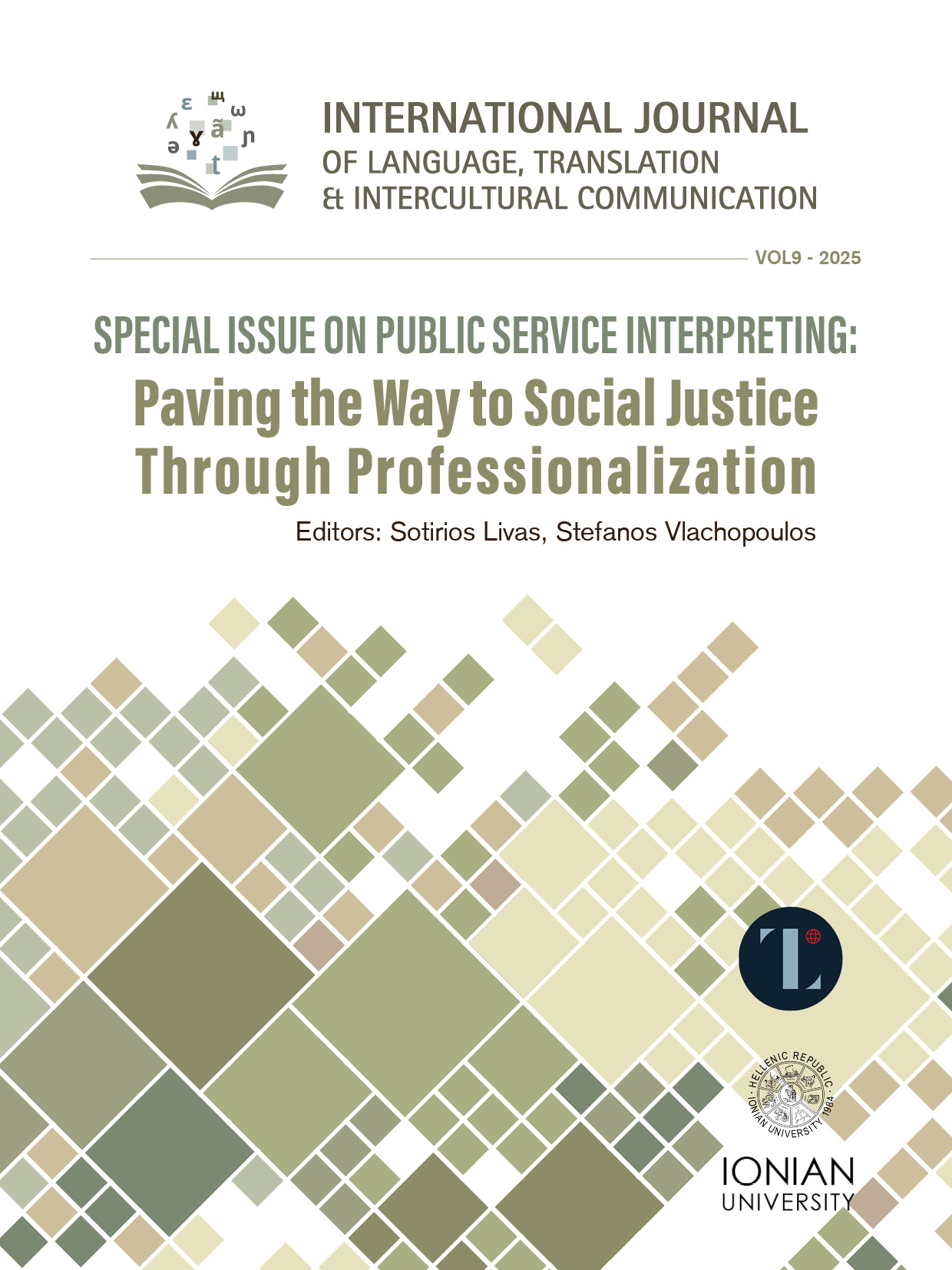
Multimodal Language Testing for Interpreter Training Designing and Implementing an AI-Supported Proficiency Test for Punjabi Public Service Interpreters in Greece
Abstract
This article documents the design and implementation of Greece’s first multimodal, AI-supported proficiency test for Punjabi public service interpreters, developed in response to the March 2024 launch of the Public Service Interpreter Register. The test addresses the complex sociolinguistic and logistical realities faced in the Greek asylum and migration context. The paper reviews current frameworks for interpreter competence and language proficiency—drawing on Common European Framework of Reference (CEFR) standards—and critiques the limitations of traditional assessment models. The Punjabi test integrates audio-based tasks and visual cues, leveraging AI-generated prompts to accommodate dialectal and literacy variation, prioritizing fairness and scalability, thus offering a replicable model for rare and minority languages where written resources, local expertise, and institutional infrastructure are lacking. The paper concludes by evaluating initial implementation outcomes, highlighting both the potential and limitations of multimodal and AI-assisted testing approaches in professionalizing public service interpreting and safeguarding the communicative rights of vulnerable populations.
Article Details
- How to Cite
-
Fragkou, E. (2025). Multimodal Language Testing for Interpreter Training: Designing and Implementing an AI-Supported Proficiency Test for Punjabi Public Service Interpreters in Greece. International Journal of Language, Translation and Intercultural Communication, 9. https://doi.org/10.12681/ijltic.43367
- Section
- Articles

This work is licensed under a Creative Commons Attribution-NonCommercial-ShareAlike 4.0 International License.
Copyright Notice
Authors who publish with this journal agree to the following terms:
- Authors retain copyright and grant the journal right of first publication with the work simultaneously licensed under a Creative Commons Attribution License that allows others to share the work with an acknowledgement of the work's authorship and initial publication in this journal.
- Authors are able to enter into separate, additional contractual arrangements for the non-exclusive distribution of the journal's published version of the work (e.g., post it to an institutional repository or publish it in a book), with an acknowledgement of its initial publication in this journal.
- Authors are permitted and encouraged to post their work online (e.g., in institutional repositories or on their website) prior to and during the submission process, as it can lead to productive exchanges, as well as earlier and greater citation of published work (See The Effect of Open Access).