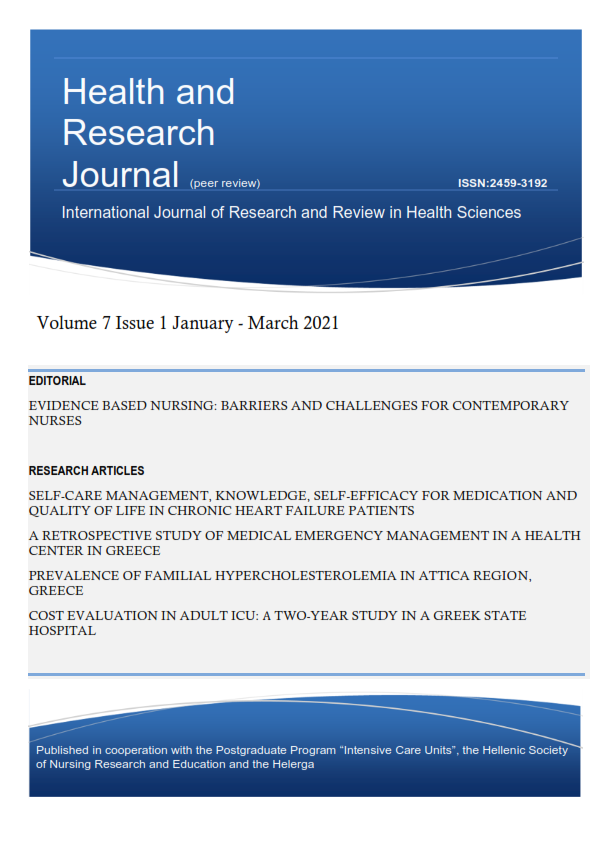
A retrospective study of medical emergency management in a Health Center in Greece
Abstract
Ιntroduction: Primary Health Centers face a plethora of emergencies of different nature and severity and it is necessary a decision -whether or not to refer patients to the nearest hospital for further treatment and investigation- to be made.
Aim: The aim of the present study was to investigate the management of emergencies in a HC of regional type near a large urban center.
Material and Methods: This was a retrospective study. The data of 400 randomly selected patients admitted to the health center with acute conditions during the years 2017-2018 were recorded.
Results: Out of all cases examined, 22% were rated as truly medical emergencies and 44% as not; 34% were classified as urgent; 25.9% of patients had arrived within the first hour of onset of symptoms, while 81.7% had already reached within the first 24 hours. Pain and respiratory diseases were the most common problems. In 15% of cases the patient was ambulance-transported to hospital. The proportion of ambulance referral to the nearest hospital was higher in patients with comorbidities (18.8%) than in those without (14.9%); 76% of cases were treated in accordance with evidence-based practice.
Conclusions: Despite the significant progress made in treating patients in the community, it is necessary to improve management of non-emergency cases, as well as to improve the procedures for emergencies management in the HCs.
Article Details
- How to Cite
-
Kampouridou, G., Arkouda, A., Toylia, G., Gerogianni, G., & Marvaki, C. (2021). A retrospective study of medical emergency management in a Health Center in Greece. Health & Research Journal, 7(1), 17–25. https://doi.org/10.12681/healthresj.26095
- Section
- Original Articles
Copyright notice:
Authors retain copyright of their work and grant the Health and Research Journal the right of first publication.
License:
Articles are published under the Creative Commons Attribution 4.0 International License (CC BY 4.0). This license permits use, sharing, adaptation, distribution, and reproduction in any medium or format, including for commercial purposes, provided that appropriate credit is given to the author(s) and the original publication in this journal, a link to the license is provided, and any changes are indicated.
Attribution requirement:
Any reuse must include the article citation and DOI (where available), and indicate if changes were made.