HealthResJ, health, medicine, nursing, research https://ejournals.epublishing.ekt.gr/index.php/HealthResJ/sitemap

Telemedicine in extreme conditions: Quality assurance, challenges, and directions for improvement: A systematic review
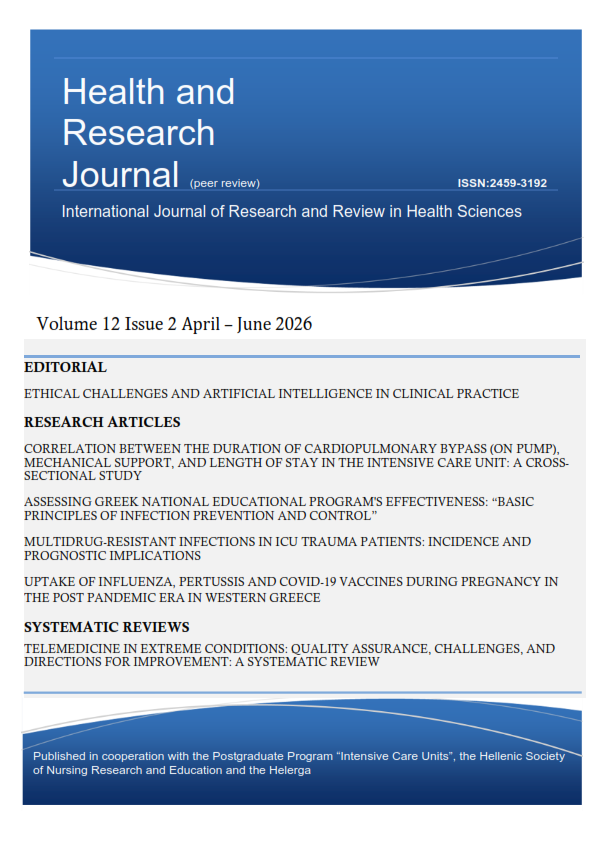

Published: Apr 1, 2026
Keywords:
Telemedicine quality assurance extreme conditions disaster response conflict zones remote monitoring
Angeliki Chandrinou
https://orcid.org/0000-0002-6104-5275
Konstantinos Exarchos
Konstantina Gaitanou
Panagiotis Mpogiatzidis
Abstract

Background: Telemedicine has become an important approach for delivering healthcare in settings where physical access to services is limited, disrupted, or impossible. Its relevance is particularly evident in extreme conditions, such as disasters, conflict-affected areas, remote locations, and other resource-constrained environments. However, the quality assurance of telemedicine services in such settings remains insufficiently clarified. This systematic review aimed to synthesize the current evidence on the quality assurance of telemedicine services in extreme conditions and to identify major challenges, quality-related considerations, and directions for improvement.


Method and Material: A systematic review was conducted in accordance with the PRISMA framework. Literature searches were performed in PubMed, Scopus, and Web of Science for studies published between January 2020 and July 2025, with a supplementary search of relevant open-access material. Eligible studies examined telemedicine applications in extreme, crisis-related, remote, or resource-constrained settings, or addressed quality-related dimensions of telemedicine relevant to such contexts. Fifteen studies met the inclusion criteria and were included in the final synthesis.


Results: The included studies suggest that telemedicine can improve access to specialist expertise, support continuity of care, and enhance responsiveness in unstable or disrupted environments. At the same time, recurrent challenges were identified, including limited connectivity, infrastructure constraints, insufficient institutional support, inadequate user training, and legal or regulatory uncertainty. Eleven studies were of moderate quality and four were of high quality.


Conclusions: Telemedicine appears to offer substantial value for healthcare delivery in extreme conditions, but its quality cannot be assumed on the basis of feasibility or technological availability alone. More robust quality frameworks, context-sensitive implementation models, and stronger evaluative evidence are needed.

Article Details
  • Section
  • Systematic Reviews
Downloads
Download data is not yet available.
References
World Health Organization. Consolidated telemedicine implementation guide [online]. 2022, Nov 9, 58. Available from: https://iris.who.int/server/api/core/bitstreams/d119a69e-e56d-4c78-a2b9-52572e14217c/content.
Habers F, Müller A, Kunczik J, Rossaint R, Czaplik M, Follmann A. Telemedicine in humanitarian aid: evaluation of potentials and challenges and an implementation trial in Ukraine. Front. Disaster Emerg. Med. 2025; 3:1718877. doi:10.3389/femer.2025.1718877.
OECD. The COVID-19 Pandemic and the Future of Tele-medicine. OECD Publishing; 2023. doi:10.1787/ac8b0a27-en.
Haimi M. Telemedicine in war zones: prospects, barriers, and meeting the needs of special populations. Front Med (Lausanne) 2024;11:1417025. doi:10.3389/fmed.2024.1417025.
World Health Organization. Telehealth Quality of Care Tool [online]. 2024, Mar 14, 47. Available from: https://iris.who.int/server/api/core/bitstreams/7e6d0958-8941-469c-ac0f-e0c879b3dad4/content.
Page MJ, McKenzie JE, Bossuyt PM, Boutron I, Hoffmann TC, Mulrow CD, et al. The PRISMA 2020 statement: an up-dated guideline for reporting systematic reviews. BMJ. 2021;372:n71. doi: 10.1136/bmj.n71. PMID: 33782057; PMCID: PMC8005924.
Page MJ, Moher D, Bossuyt PM, et al. PRISMA 2020 expla-nation and elaboration: updated guidance and exemplars for reporting systematic reviews. BMJ 2021;372:n160. doi:10.1136/bmj.n160.
Sirriyeh R, Lawton R, Gardner P, Armitage G. Reviewing studies with diverse designs: the development and evalua-tion of a new tool. J Eval Clin Pract. 2012;18(4):746-752. doi:10.1111/j.1365-2753.2011.01662.x.
Melnyk BM, Fineout-Overholt E. Evidence-Based Practice in Nursing & Healthcare: A Guide to Best Practice. 5th edi-tion. Wolters Kluwer, Philadelphia, 2023.
Mohammadzadeh N, Saeedi S, Rezayi S. Telemedicine and natural disasters: various services, requirements, challeng-es, and general framework. Frontiers in Emergency Medi-cine. 2022;6(4):e53. doi:10.18502/fem.v6i4.10440.
Okoh JC, Koshechkin K, Okoh LN. Telemedicine technology deployment for emergency and disaster response – a case in Sudan: Problems and outlook. ScienceOpen Preprints, 2024. doi:10.14293/PR2199.001042.v1.
Hadian M, Jelodar ZK, Khanbebin MJ, Atafimanesh P, Asi-abar AS, Dehagani SMH. Challenges of Implementing Tel-emedicine Technology: A systematized Review. Int J Prev Med. 2024;15(11):8. doi: 10.4103/ijpvm.ijpvm_48_23. PMID: 38563036; PMCID: PMC10982727.
Ting L, Wilkes M. Telemedicine for Patient Management on Expeditions in Remote and Austere Environments: A Sys-tematic Review. Wilderness Environ Med. 2021;32(1):102-111. doi:10.1016/j.wem.2020.09.009.
Eljack MMF, Elhadi YAM, Mahgoub EAA, et al. Physician experiences with teleconsultations amidst conflict in Su-dan. Sci Rep. 2023;13(1):22688. doi:10.1038/s41598-023-49967-5.
Koehlmoos TP, Kanagaratnam A, Korona-Bailey J, et al. Use of telemedicine for trauma care since the Russian invasion of Ukraine: A qualitative assessment. J Telemed Telecare. 2025;31(9):1344-1350. doi:10.1177/1357633X241288299.
Parkes P, Pillay TD, Bdaiwi Y, Simpson R, Almoshmosh N, Murad L, et al. Telemedicine interventions in six conflict-affected countries in the WHO Eastern Mediterranean re-gion: a systematic review. Confl Health. 2022;16(1):64. doi:10.1186/s13031-022-00493-7.
Tagne JF, Burns K, O’Brein T, Chapman W, Cornell P, Huck-vale K, et al. Challenges for remote patient monitoring pro-grams in rural and regional areas: a qualitative study. BMC Health Serv Res. 2025;25(1):374. doi:10.1186/s12913-025-12427-z.
Alansari AN, Zaazouee MS, Najar S, Elshanbary AA, Mesaoud M. Telemedicine applications in pediatric emer-gency surgery and trauma: a systematic review of diagnos-tic accuracy and clinical effectiveness. Pediatr Surg Int. 2025;41(1):122. doi:10.1007/s00383-025-06023-9.
Beckers R, Stellmacher L. Qualitätssicherung in der Tele-medizin. In: Telemedizin. Springer Berlin Heidelberg; 2021:53-71. doi:10.1007/978-3-662-60611-7_3.
Alelyani T, Shaikh A, Sulaiman AA, Asiri Y, Alshahrani H, Almakdi S. Research Challenges and Opportunities Towards a Holistic View of Telemedicine Systems: A Systematic Re-view. In: Marques, G., Kumar Bhoi, A., de la Torre Díez, I., Garcia-Zapirain, B. (eds) Enhanced Telemedicine and e-Health. Studies in Fuzziness and Soft Computing, vol 410. Springer, Cham. 2021;3-26. doi:10.1007/978-3-030-70111-6_1.
Mahmood U, Shukla-Dave A, Chan HP, Drukker K, Samala RK, Chen Q, et al. Artificial intelligence in medicine: miti-gating risks and maximizing benefits via quality assurance, quality control, and acceptance testing. BJR|Artificial Intel-ligence. 2024;1(1):ubae003. doi:10.1093/bjrai/ubae003.
Doarn CR. Telemedicine in Austere Conditions. In: Latifi, R., Doarn, C.R., Merrell, R.C. (eds) Telemedicine, Telehealth and Telepresence. Springer, Cham. 2021;471-483. doi:10.1007/978-3-030-56917-4_29
Pegoraro N, Rossini B, Giganti M, Brymer E, Monasterio E, Bouchat P, et al. Telemedicine in Sports under Extreme Conditions: Data Transmission, Remote Medical Consulta-tions, and Diagnostic Imaging. Int J Environ Res Public Health. 2023;20(14):6371. doi:10.3390/ijerph20146371.
Anwari F, Hutomo GS, Supinganto A, Utary D, Rita RS. Implementation of Telemedicine in Medical Practice: Op-portunities and Barriers. Global International Journal of In-novative Research. 2024;1(2):146-153. doi:10.59613/global.v1i2.16
Most read articles by the same author(s)