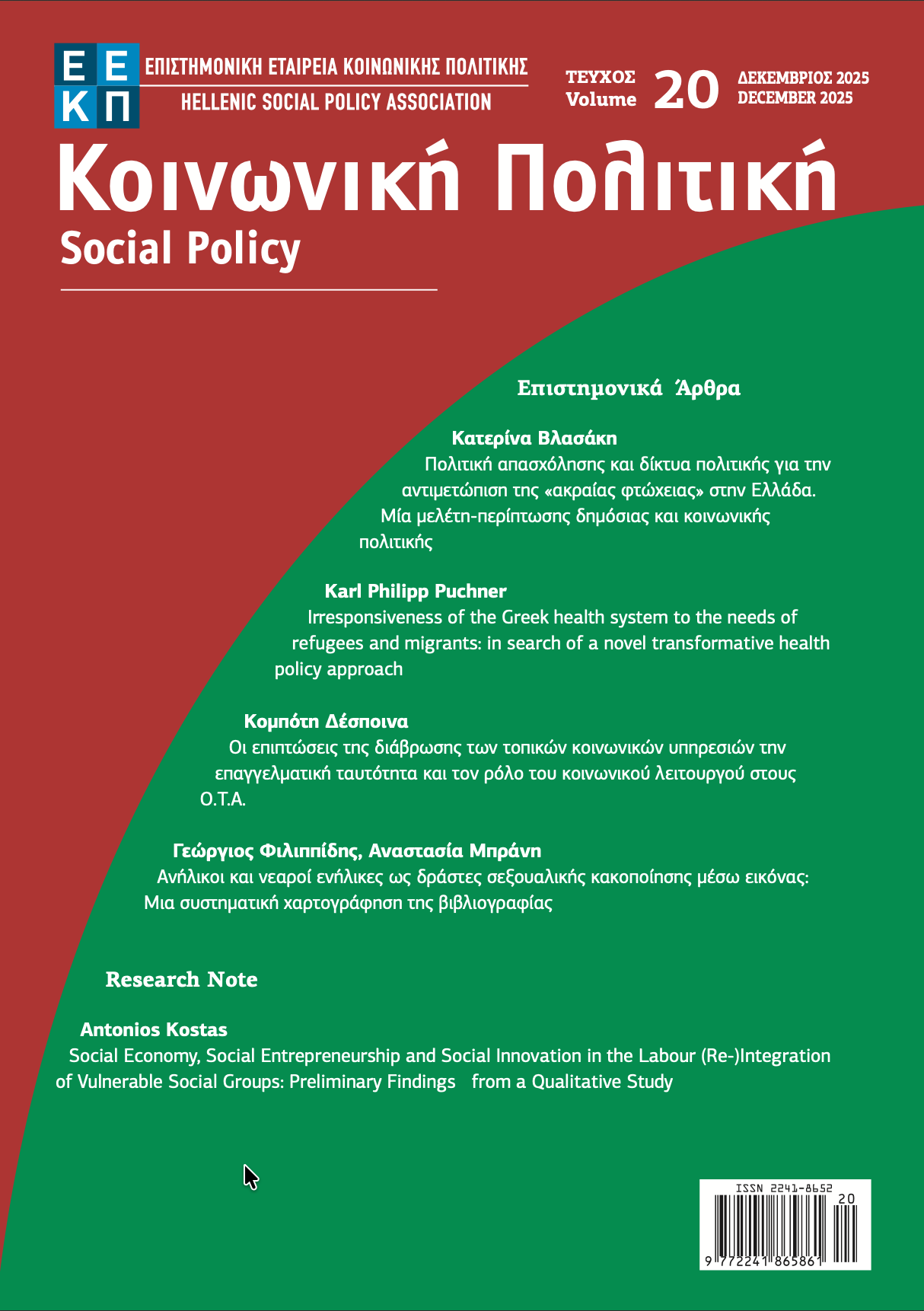
Employment Policy and Policy Networks for Combating Extreme Poverty in Greece: A Case Study of Public and Social Policy
Abstract
This article focuses on the design, implementation, and social effectiveness of employment policies as part of public interventions aimed at addressing extreme poverty in Greece during the period 2012–2025. Drawing on a researched in the field case study approach and situated within the theoretical framework of the policy cycle, it analyzes how public and social policy in Greece is formulated and enacted within a multi-level institutional environment and under the influence of international and European policy frameworks. The research emphasizes the operation of policy networks and local governance mechanisms, highlighting the interactive participation of local government actors, institutional stakeholders, and social agents—particularly unemployed women as both recipients and active participants in policy processes. The analysis explores the interrelations between state, society, and administration, shedding light on the conditions under which social policy is exercised during times of crisis, and the tensions inherent in efforts to promote social inclusion through targeted public interventions.
Article Details
- How to Cite
-
Βλασάκη Κ. (2026). Employment Policy and Policy Networks for Combating Extreme Poverty in Greece: A Case Study of Public and Social Policy. Social Policy, 20, 11–29. https://doi.org/10.12681/sp.44569
- Issue
- Vol. 20 (2026)
- Section
- Articles

This work is licensed under a Creative Commons Attribution 4.0 International License.
Authors who publish with this journal agree to the following terms:
Authors retain copyright and grant the journal right of first publication with the work simultaneously licensed under a Creative Commons Attribution Non-Commercial License that allows others to share the work with an acknowledgement of the work's authorship and initial publication in this journal.
Authors are able to enter into separate, additional contractual arrangements for the non-exclusive distribution of the journal's published version of the work (e.g. post it to an institutional repository or publish it in a book), with an acknowledgement of its initial publication in this journal.
Authors are permitted and encouraged to post their work online (preferably in institutional repositories or on their website) prior to and during the submission process, as it can lead to productive exchanges, as well as earlier and greater citation of published work.