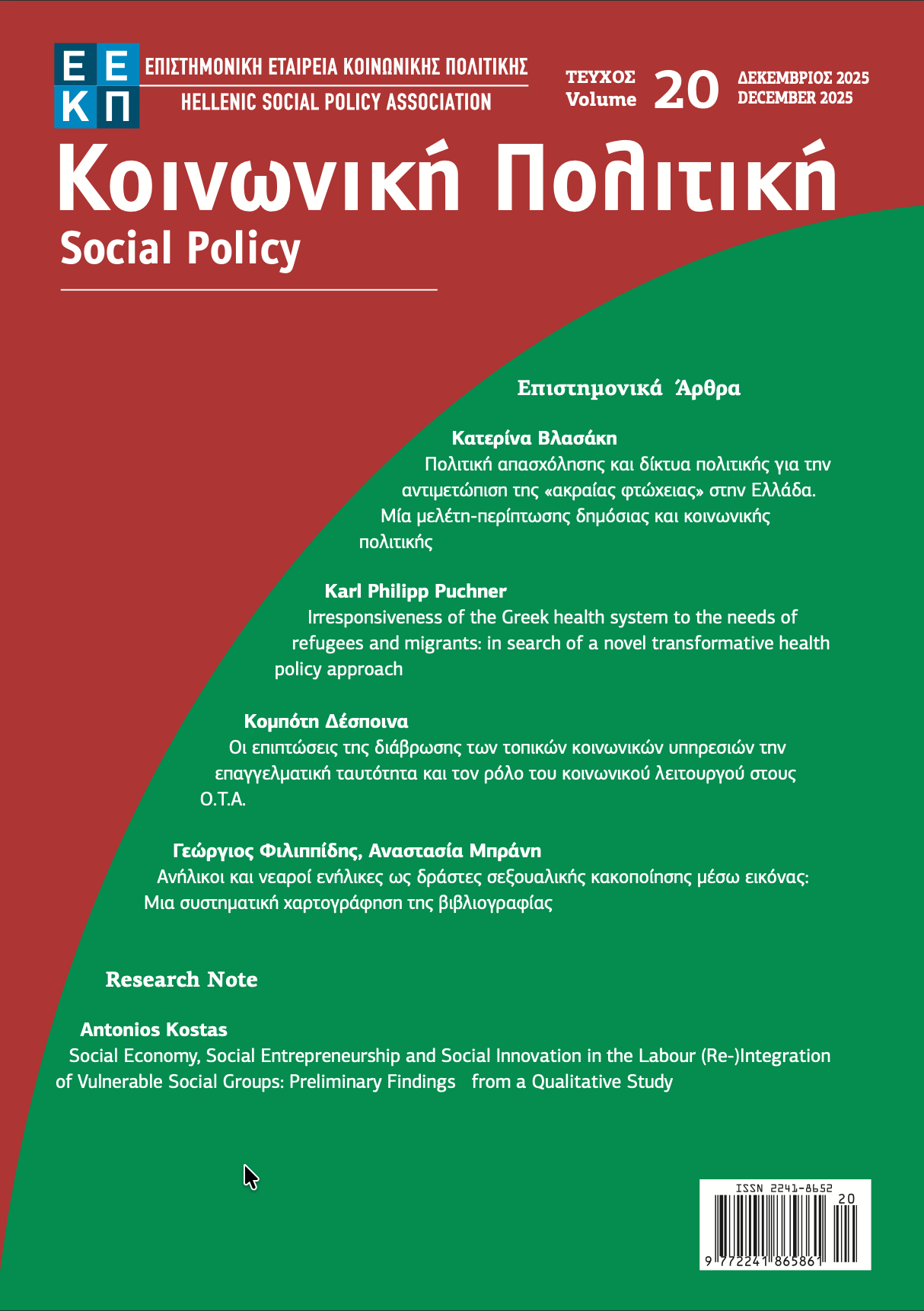
Minors and young adults as perpetrators of sexual abuse through images: A systematic mapping of the literature.


Published: Feb 16, 2026
Keywords:
Image-based sexual abuse (I.B.S.A.) non-consensual distribution of intimate images risk factors perpetrator motivations gender-based violence clinical social work
Γεώργιος Φιλιππίδης
Αναστασία Μπράνη
Abstract

Image-Based Sexual Abuse (I.B.S.A.) is a contemporary and alarming form of digital violence with serious implications for the youth population. I.B.S.A. encompasses the non-consensual distribution of sexual images, as well as related practices such as sexual extortion (sextortion), coerced sexting, cyberflashing, upskirting, and the production of deepfake/nude content. The phenomenon is linked to gender inequalities and diverse psychosocial parameters, reflecting the interplay of social, cultural, and technological factors. This scoping review examines and synthesizes current literature, focusing on the prevalence of I.B.S.A., associated risk factors, and the motivational mechanisms of adolescent and young adult perpetrators. The search was conducted across PubMed, Google Scholar, and SCOPUS databases, as well as the journal "Social Work – Review of Social Sciences," including studies from Europe, North America, and Australia. A total of 29 studies met the inclusion criteria. The main findings demonstrate that: (a) I.B.S.A. exhibits high prevalence rates with a strong gender dimension, where men are more frequently identified as perpetrators; (b) perpetration is associated with psycho-social factors, such as tolerance of sexist discourse and victim-blaming attitudes; (c) critical psychological traits of perpetrators emerge, including empathy deficits, low self-esteem, low self-control, and "Dark Tetrad" personality dimensions (narcissism, Machiavellianism, psychopathy, sadism); and (d) motivations focus on social approval from peer groups (social learning), entertainment, and the reinforcement of "hegemonic masculinity." The study concludes that there is a need for targeted interventions by Clinical Social Work to cultivate digital education and prevention, therapeutic treatment of perpetrators, as well as actions to dismantle gender stereotypes in the community.

Article Details
  • Section
  • Articles
Downloads
Download data is not yet available.
References
Alonso-Ruido, P., Rodríguez-Castro, Y., Lameiras-Fernández, M., & Martínez-Román, R. (2018). Sexting through the Spanish adolescent discourse. Saúde E Sociedade, 27(2), 398–409. https://doi.org/10.1590/s0104-12902018171835
Arksey, H., & O’Malley, L. (2005). Scoping studies: Towards a methodological framework. International Journal of Social Research Methodology, 8(1), 19–32. https://doi.org/10.1080/136455703200011961
Barrense-Dias, Y., Akre, C., Auderset, D., Leeners, B., Morselli, D., & Surí, J.-C. (2020). Non-consensual sexting: Characteristics and motives of youths who share received intimate content without consent. Sexual Health, 17(3), 270–278. https://doi.org/10.1071/SH19201
Boonmann, C., Grudzinskas, A., & Aebi, M. (2014). Juveniles, the Internet and Sexual Offending. In F. Saleh, A. Grudzinskas & A. Judge (Eds.), Adolescent Sexual Behavior in the Digital Age: Considerations for Clinicians, Legal Professionals and Educators (pp. 161–179). Oxford University Press.
Brewer, R. T., Sayer, M., & Lango, C. (2020). Identifying risk factors associated with adolescent cyber-deviance in Australia: Implications for policy and practice. University of Adelaide.
Call, C. (2021). Perceptions of image-based sexual abuse among the American public. Criminology, Criminal Justice, Law & Society, 22(3),30-43. https://doi.org/10.54555/ccjls.3769.30145
Chasapis, D., Touloupis, T., Sofos, A., Tsibidaki, A., & Lipourli, E. (2025). Non-consensual sexting among adolescents: Role of parents, peers, and sexual self-concept. In T. Touloupis, A. Sofos, & A. Vasiou (Eds.), Students' online risk behaviors: Psychoeducational predictors, outcomes, and prevention (pp. 87–104). IGI Global Scientific Publishing.
Clancy, E. M., Klettke, B., Hallford, D. J., Crossman, A. M., Maas, M. K., & Toumbourou, J. W. (2020). Sharing is not always caring: Understanding motivations and behavioural associations with sext dissemination. Computers in Human Behavior, 112, 106460. https://doi.org/10.1016/j.chb.2020.106460
Crofts, T., Lee, M., McGovern, A., & Milivojevic, S. (2015). Sexting and young people. Palgrave Macmillan.
Dodaj, A., & Sesar, K. (2024). Sexting coercion within romantic context: A test of Akers’ social learning theory. Journal of Sexual Aggression, 30(2), 197–210. https://doi.org/10.1080/13552600.2023.2182377
Durán-Guerrero, E., & Sánchez-Jiménez, V. (2025). Perpetration of non-consensual sharing of sexual content among adolescents: Socio-moral and emotional competencies, gender-based attitudes, and sexual behavior correlates. Current Psychology, 44, 3690–3703. https://doi.org/10.1007/s12144-024-07241-5
Dymock, A., & van der Westhuizen, C. (2019). A dish served cold: Targeting revenge in revenge pornography. Legal Studies, 39(3), 361–377. https://doi.org/10.1017/lst.2018.27
Fido, D., & Harper, C. A. (2020). Non-consensual image-based sexual offending: Bridging legal and psychological perspectives. Springer Nature. https://doi.org/10.1007/978-3-030-59284-4
Franks, M. A. (2016). Drafting an effective “revenge porn” law: A guide for legislators. Cyber Civil Rights Initiative.
Gamez-Guadiz, M., Mateos-Pérez, E., Wachs, S., Wright, M., Martínez, J., & Incera, D. (2022). Assessing image-based sexual abuse: Measurement, prevalence, and temporal stability of sextortion and nonconsensual sexting ("revenge porn") among adolescents. Journal of Adolescence, 94(5), 789–799. https://doi.org/10.1002/jad.12064
Garrard, J. (2017). Health Sciences Literature Review Made Easy: The Matrix Method (5th ed.). Jones & Bartlett Learning.
Hall, M., Hearn, J., & Lewis, R. (2023). Image-Based Sexual Abuse: Online Gender-Sexual Violations. Encyclopedia, 3, 327–339. https://doi.org/10.3390/encyclopedia3010020
Hanson, S. (2022). “Weaponised sexuality” to the normalisation of sexual violence: Rape culture and the non-consensual distribution of intimate imagery (NCDII) [Master’s dissertation, University of Winnipeg].
Harper, C. A., Smith, L., Leach, J., Daruwala, N. A., & Fido, D. (2023). Development and validation of the beliefs about revenge pornography questionnaire. Sexual Abuse, 35(6), 748–783. https://doi.org/10.1177/10790632221082663
Henry, N., Flynn, A., & Powell, A. (2020). Technology-facilitated domestic and sexual violence: A review. Violence Against Women, 26(15-16), 1828–1854. https://doi.org/10.1177/1077801219875821
Henry, N., & Powell, A. (2016). Sexual violence in the digital age: The scope and limits of criminal law. Social & Legal Studies, 25(4), 397–418. https://doi.org/10.1177/0964663915624273
Hunehäll Berndtsson, K., & Odenbring, Y. (2020). ‘They don’t even think about what the girl might think about it’: students’ views on sexting, gender inequalities and power relations in school. Journal of Gender Studies, 30(1), 91–101. https://doi.org/10.1080/09589236.2020.1825217
Kernsmith, P. D., Victor, B. G., & Smith-Darden, J. P. (2018). Online, offline, and over the line: Coercive sexting among adolescent dating partners. Youth & Society, 50(7), 891–904. https://doi.org/10.1177/0044118X18764040
Klein, J. L., & Cooper, D. T. (2019). Deviant cyber-sexual activities in young adults: Exploring prevalence and predictions using in-person sexual activities and social learning theory. Archives of Sexual Behavior, 48(2), 619–630. https://doi.org/10.1007/s10508-018-1251-2
Kopecký, K., & Voráč, D. (2025). The phenomenon of deep nudes—a new threat to children and adults. AI & Society. Advance online publication. https://doi.org/10.1007/s00146-025-02425-4
Levac, D., Colquhoun, H., & O’Brien, K. K. (2010). Scoping studies: Advancing the methodology. Implementation Science, 5(1), 1–9. https://doi.org/10.1186/1748-5908-5-69
Lewis, R., & Anitha, S. (2023). Upskirting: A systematic literature review. Trauma, Violence, & Abuse, 24(3), 2003–2018. https://doi.org/10.1177/15248380221082091
Magaldi, J. A., Sales, J. S., & Paul, J. (2020). Revenge porn: The name doesn’t do nonconsensual pornography justice and the remedies don’t offer the victims enough justice. Oregon Law Review, 98(1), 57–110.
Marcotte, A. S., Gesselman, A. N., Fisher, H. E., & Garcia, J. R. (2020). Women’s and men’s reactions to receiving unsolicited genital images from men. The Journal of Sex Research, 58(3), 512–521. https://doi.org/10.1080/00224499.2020.1779171
McGlynn, C., & Johnson, K. (2020). Criminalising cyberflashing: Options for law reform. The Journal of Criminal Law, 85(3), 171–188. https://doi.org/10.1177/0022018320972306
McGlynn, C., Rackley, E., & Houghton, R. (2017). Beyond “Revenge Porn”: The continuum of image-based sexual abuse. Feminist Legal Studies, 25(1), 25–46. https://doi.org/10.1007/s10691-017-9343-2
Mooney, R., & Batko, W. (2025). Right-wing authoritarianism, empathy, and judgements of non-consensual distribution of intimate image (NCDII) victims. The Journal of Concurrent Disorders, 12–32. https://cdspress.ca/wp-content/uploads/2025/09/Robyn-Mooney-Proof_FINAL.pdf
Naezer, M., & van Oosterhout, L. (2020). Only sluts love sexting: youth, sexual norms and non-consensual sharing of digital sexual images. Journal of Gender Studies, 30(1), 79–90. https://doi.org/10.1080/09589236.2020.1799767
O’Malley, R. L., & Holt, K. M. (2022). Cyber sextortion: An exploratory analysis of different perpetrators engaging in a similar crime. Journal of Interpersonal Violence, 37(1–2), 258–283. https://doi.org/10.1177/0886260520909186
Patchin, J. W., & Hinduja, S. (2020). Sextortion among adolescents: Results from a national survey of U.S. youth. Sexual Abuse, 32(1), 30–54. https://doi.org/10.1177/1079063218800469
Patrick, K., Heywood, W., Pitts, M. K., & Mitchell, A. (2015). Demographic and behavioural correlates of six sexting behaviours among Australian secondary school students. Sexual Health, 12(6), 480–487. https://doi.org/10.1071/SH15004
Peterson, J., Pearce, P. F., Ferguson, L. A., & Langford, C. A. (2017). Understanding scoping reviews: Definition, purpose, and process. Journal of the American Association of Nurse Practitioners, 29(1), 12–16. https://doi.org/10.1002/23276924.1238
Pina, A., Bell, A., Griffin, K., & Vasquez, E. (2021). Image based sexual abuse proclivity and victim blaming: The role of dark personality traits and moral disengagement. Oñati Socio-Legal Series, 11(5), 1179–1197. https://doi.org/10.35295/osls.iisl/0000-0000-0000-1213
Powell, A., Henry, N., Flynn, A., & Scott, A. J. (2019). Image based sexual abuse: The extent, nature, and predictors of perpetration in a community sample of Australian residents. Computers in Human Behavior, 92, 393–402. https://doi.org/10.1016/j.chb.2018.11.009
Ray, A., & Henry, N. (2024). Sextortion: A scoping review. Trauma, Violence, & Abuse, 26(1), 138–155. https://doi.org/10.1177/15248380241277271
Ricciardelli, R., & Adorjan, M. (2019). ‘If a girl’s photo gets sent around, that’s a way bigger deal than if a guy’s photo gets sent around’: Gender, sexting, and the teenage years. Journal of Gender Studies, 28(5), 563–577. https://doi.org/10.1080/09589236.2018.1560245
Rigotti, C., & McGlynn, C. (2022). Towards an EU criminal law on violence against women: The ambitions and limitations of the Commission’s proposal to criminalise image-based sexual abuse. New Journal of European Criminal Law, 13(4), 452–477. https://doi.org/10.1177/20322844221140713
Ringrose, J., & Regehr, K. (2023). Recognizing and addressing how gender shapes young people's experiences of image‐based sexual harassment and abuse in educational settings. Journal of Social Issues, 79(4), 1251–1281. https://doi.org/10.1111/josi.12575
Rofer, J. (2016). Nonconsensual pornography: An old crime updates its software. Fordham Intellectual Property, Media and Entertainment Law Journal, 27(4), 936–999. https://ir.lawnet.fordham.edu/iplj/vol27/iss4/5
Rousay, V. (2023). Sexual deepfakes and image-based sexual abuse: Victim-survivor experiences and embodied harms [Master’s thesis, Harvard University].
Said, I., & McNealey, R. L. (2023). Nonconsensual distribution of intimate images: Exploring the role of legal attitudes in victimization and perpetration. Journal of Interpersonal Violence, 38(7–8), 5430–5451. https://doi.org/10.1177/08862605221122834
Scott, A. J., & Gavin, J. (2018). Revenge pornography: The influence of perpetrator-victim sex, observer sex and observer sexting experience on perceptions of seriousness and responsibility. Journal of Criminal Psychology, 8(2), 162–172. https://doi.org/10.1108/JCP-05-2017-0024
Sparks, B., Stephens, S., & Trendell, S. (2023). Image-based sexual abuse: Victim-perpetrator overlap and risk-related correlates of coerced sexting, non-consensual dissemination of intimate images, and cyberflashing. Computers in Human Behavior, 148, 107879. https://doi.org/10.1016/j.chb.2023.107879
Szyf, N. D., Gilen, A., & Giacometti, M. (2023). Deep nudes among young people in Belgium. Institute for the Equality of Women and Men. https://igvm-iefh.belgium.be/sites/default/files/deepnudes_among_young_people_in_belgium.pdf
Tangney, J. P., Baumeister, R. F., & Boone, A. L. (2004). High self-control predicts good adjustment, less pathology, better grades, and interpersonal success. Journal of Personality, 72(2), 271–324. https://doi.org/10.1111/j.0022-3506.2004.00263.x
Thorn. (2025). Deepfake nudes & young people: Navigating a new frontier in technology-facilitated nonconsensual sexual abuse and exploitation. ThornResearch.https://info.thorn.org/hubfs/Research/Thorn_DeepfakeNudes&YoungPeople_Mar2025.pdf
Trendell, S. G. (2019). “Send nudes?”: Risk factors for the perpetration of inappropriate intimate image-based behaviours and impacts on victim mental health [Master’s thesis, Saint Mary’s University].
Tricco, A. C., Lillie, E., Zarin, W., O’Brien, K. K., Colquhoun, H., Levac, D., ... & Straus, S. E. (2018). PRISMA extension for scoping reviews (PRISMA-ScR): Checklist and explanation. Annals of Internal Medicine, 169(7), 467–473. https://doi.org/10.7326/M18-0850
Van Oosten, J. M. F., & Vandenbosch, L. (2020). Predicting the willingness to engage in non-consensual forwarding of sexts: The role of pornography and instrumental notions of sex. Archives of Sexual Behavior, 49(4), 1121–1132. https://doi.org/10.1007/s10508-019-01580-2
Van Ouytsel, J., Walrave, M., De Marez, L., Vanhaelewyn, B., & Ponnet, K. (2021). Sexting, pressured sexting and image-based sexual abuse among a weighted-sample of heterosexual and LGB youth. Computers in Human Behavior, 117, 106630. https://doi.org/10.1016/j.chb.2020.106630
Walker, K., Sleath, E., Hatcher, R. M., Hine, B., & Crookes, R. L. (2019). Nonconsensual sharing of private sexually explicit media among university students. Journal of Interpersonal Violence, 36(17–18). https://doi.org/10.1177/0886260519853414
Winkelman, S. B., Smith, K. V., Brinkley, J., & Knox, D. (2014). Sexting on the college campus. The Electronic Journal of Human Sexuality, 17 (3),1-14. https://www.researchgate.net/publication/260868306_Sexting_on_the_College_Campus
Yar, M., & Drew, J. (2020). Image based abuse, non consensual pornography, revenge porn: A study of criminalization and crime prevention in Australia and England & Wales. International Journal of Cyber Criminology, 13(2), 578–594. https://doi.org/10.5281/zenodo.3709306
Κανδυλάκη, Α. (2015). Αντικαταπιεστικές προσεγγίσεις και ανθρώπινα δικαιώματα στην κοινωνική εργασία στο σχολείο. Στο Θ. Καλλινικάκη, Ζ. Κασσέρη & Μ. Αποστολοπούλου (Επιμ.), Κοινωνική εργασία στην εκπαίδευση: Στα θρανία των ετεροτήτων ( σ.317–346). Τόπος.
Μαλλούχου, Α. (2023). Η συνδιαλλαγή ανήλικου δράστη-θύματος στην ποινική δικαιοσύνη ανηλίκων. Αντιγόνη: Το ερώτημα, 2(4), 50–88.
Μπράνη, Α. (2024). Σεξουαλική κακοποίηση μέσω εικόνας ως μορφή έμφυλης βίας στο διαδίκτυο. Ανάδυση στοιχείων σεξισμού και ενοχοποίησης θύματος στον αφηγηματικό λόγο των ανήλικων δραστών. Κοινωνική Εργασία, 34(2), 77–94. https://doi.org/10.12681/socialwork-rss.37424
Νόμος 5090/2024, άρθρο 28, Παρεμβάσεις στον Ποινικό Κώδικα και τον Κώδικα Ποινικής Δικονομίας για την επιτάχυνση και την ποιοτική αναβάθμιση της ποινικής δίκης (ΦΕΚ 30/τ. Α’/23 02 2024).