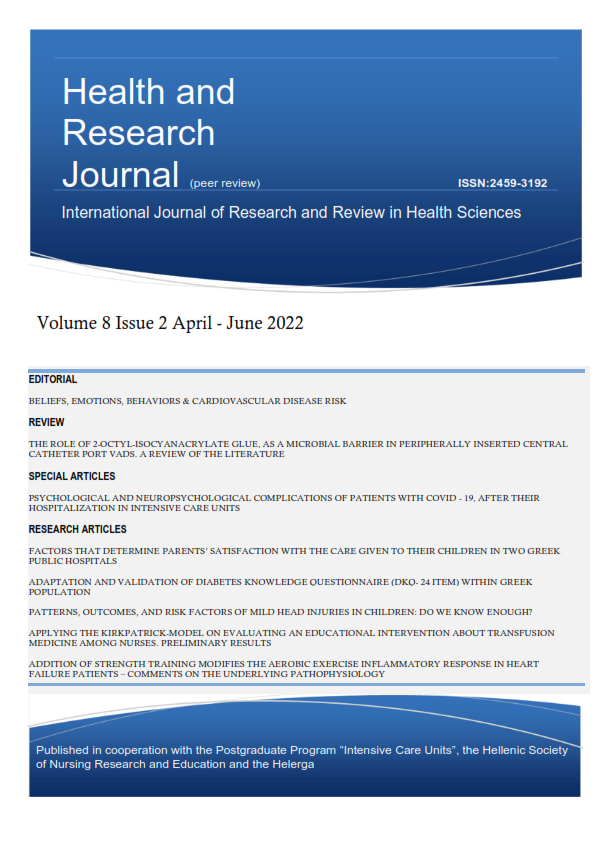
Factors that determine parents’ satisfaction with the care given to their children in two Greek public hospitals
Abstract
Background: Patient satisfaction is a valuable measure of the healthcare quality, which in turn is the most necessary condition for effective healthcare services.
Aim: To evaluate the inpatient children’s parental satisfaction, in order to assess the quality and outcomes of the public healthcare services.
Method and Material: A cross-sectional study was conducted, on a random sample of 120 parents of children who were hospitalized in the two major public pediatric hospitals of Athens, using the Greek version of the Swedish Pyramid Quality of Care Questionnaire - Parents version.
Results: Parental satisfaction was at high levels (overall index 80.2%), mainly due the medical and nursing staff attitudes (93.11%), medical & nursing care (92.32%) and information about the child’s illness / condition provided (84.75%). Low satisfaction observed due the accessibility of health services (66.16%) and the working environment of the staff (68.14%), and also in respect of waiting times for clinical and laboratory tests, in low-moderate severity cases.
Conclusions: The high levels of parents' satisfaction with hospital pediatric care is a result of the attitudes, knowledge and skills of the medical and nursing staff.
Article Details
- How to Cite
-
Xenodoxidou, E., Theodorou, P., Karagianni, R., Intas, G., & Platis, C. (2022). Factors that determine parents’ satisfaction with the care given to their children in two Greek public hospitals. Health & Research Journal, 8(2), 97–110. https://doi.org/10.12681/healthresj.26774
- Section
- Original Articles
Copyright notice:
Authors retain copyright of their work and grant the Health and Research Journal the right of first publication.
License:
Articles are published under the Creative Commons Attribution 4.0 International License (CC BY 4.0). This license permits use, sharing, adaptation, distribution, and reproduction in any medium or format, including for commercial purposes, provided that appropriate credit is given to the author(s) and the original publication in this journal, a link to the license is provided, and any changes are indicated.
Attribution requirement:
Any reuse must include the article citation and DOI (where available), and indicate if changes were made.