HealthResJ, health, medicine, nursing, research https://ejournals.epublishing.ekt.gr/index.php/HealthResJ/sitemap

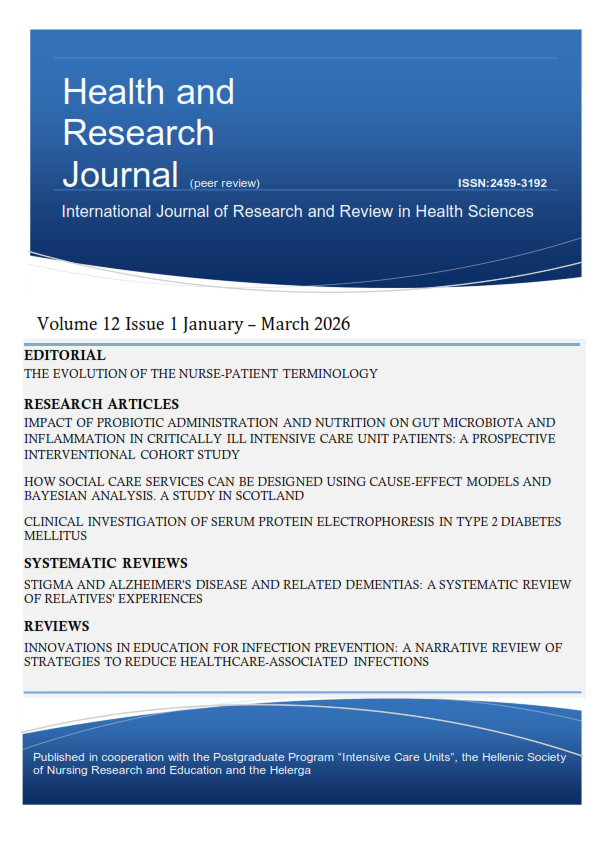
Clinical Investigation of Serum Protein Electrophoresis in Type 2 Diabetes Mellitus

Published: Jan 4, 2026
Keywords:
glycated hemoglobin serum protein electrophoresis type 2 diabetes mellitus
Akeem Olayinka Busari
Ibrahim Saheed Saka
Renata Teritin Perdomo
Malson Neilson de Lucena
Sulaiman Adebayo Nassar
Imam Malik Kabir
Munirudeen Ibrahim
Shefiat Bashir
Abstract

Background: Type 2 diabetes mellitus (T2DM) is characterized by hyperglycemia, insulin resistance, and relative insulin deficiency. Circulating proteins in the pathogenesis of T2DM have been implicated with different degrees of glucose intolerance. 


Objective: This study assessed the serum protein pattern in T2DM patients.


Method and Material: A comparative cross-sectional study was conducted on 120 participants comprising 60 T2DM patients and 60 non-diabetic individuals in General Hospital Ilorin, Kwara State, after the ethical approvals were obtained from both the Kwara State Ministry of Health and General Hospital Ilorin with the reference numbers ERC/MOH/2022/04/089 and GHI/IRC/246/VOL1/03, respectively. About 5 ml of venous blood sample was collected from each participant after an overnight fast of 10–12 hours for glycated hemoglobin and serum protein estimation. The glycated hemoglobin was estimated using the fluorescence immunoassay technique, while protein and albumin were estimated spectrophotometrically using biuret and bromocresol green dye-binding methods, respectively. The serum protein pattern was determined by serum protein electrophoresis.


Results: A total of 60 T2DM patients were included in the study; 8 (13.3%) showed hypergammaglobulinemia, 7 (11.7%) demonstrated hyperbetaglobulinemia, and 13 (21.7%) revealed hyperalpha-2-globulinemia serum protein patterns compared to normal serum protein patterns observed in the non-diabetic individuals. Also, a significant increase (p<0.05) in glycated hemoglobin was observed in T2DM patients compared to non-diabetic individuals. However, no significant difference (p > 0.05) was observed in serum protein, albumin, globulin, and A/G ratio of T2DM patients compared to non-diabetic individuals.


Conclusions: This study observed that diabetes mellitus significantly affects positive acute phase proteins, such as beta, alpha-2, and gamma globulin, compared to negative acute phase proteins, such as albumin, globulin, and the albumin/globulin ratio.

Article Details
  • Section
  • Original Articles
Downloads
Download data is not yet available.
References
Damanik, J., & Yunir, E. (2021). Type 2 Diabetes Mellitus and Cognitive Impairment. Acta medica Indonesiana, 53(2), 213–220.
Kandimalla, R., Thirumala, V., & Reddy, P. H. (2017). Is Alzheimer's disease a Type 3 Diabetes? A critical apprais-al. Biochimica et biophysica acta. Molecular basis of dis-ease, 1863(5), 1078–1089. https://doi.org/10.1016/j.bbadis.2016.08.018
Parker, E. D., Lin, J., Mahoney, T., Ume, N., Yang, G., Gabbay, R. A., ElSayed, N. A., & Bannuru, R. R. (2024). Economic Costs of Diabetes in the U.S. in 2022. Diabetes care, 47(1), 26–43. https://doi.org/10.2337/dci23-0085
Adeloye, D., Ige, J. O., Aderemi, A. V., Adeleye, N., Amoo, E. O., Auta, A., & Oni, G. (2017). Estimating the prevalence, hospitalisation and mortality from type 2 diabetes melli-tus in Nigeria: a systematic review and meta-analysis. BMJ open, 7(5), e015424.
Misra, S., Wagner, R., Ozkan, B., Schön, M., Sevilla-Gonzalez, M., Prystupa, K., Wang, C. C., Kreienkamp, R. J., Cromer, S. J., Rooney, M. R., Duan, D., Thuesen, A. C. B., Wallace, A. S., Leong, A., Deutsch, A. J., Andersen, M. K., Billings, L. K., Eckel, R. H., Sheu, W. H., Hansen, T., … Udler, M. S. (2023). Precision subclassification of type 2 diabetes: a systematic review. Communications medicine, 3(1), 138. https://doi.org/10.1038/s43856-023-00360-3
Sun, H., Saeedi, P., Karuranga, S., Pinkepank, M., Ogurt-sova, K., Duncan, B. B., ... & Magliano, D. J. (2022). IDF Dia-betes Atlas: Global, regional and country-level diabetes prevalence estimates for 2021 and projections for 2045. Diabetes research and clinical practice, 183, 109119.
Sundsten, T., Eberhardson, M., Göransson, M., & Bergsten, P. (2006). The use of proteomics in identifying differen-tially expressed serum proteins in humans with type 2 di-abetes. Proteome Science, 4, 1-10.
Kanmani S., Kwon M., Shin M. K., and Kim M. K., Associa-tion of C-reactive protein with risk of developing type 2 Diabetes mellitus, and role of obesity and hypertension: a large population-based Korean cohort study, Scientific Reports. (2019) 9, no. 1, https://doi.org/10.1038/s41598-019-40987-8, 2-s2.0-85062936408, 30872696.
Tuladhar, E. T., Sharma, V. K., Sigdel, M., & Shrestha, L. (2012). Type 2 diabetes mellitus with early phase acute in-flammatory protein on serum protein electrophoresis. Journal of Pathology of Nepal, 2(3), 211-214.
Bunn, H.F. (1981). Nonenzymatic glycosylation of protein: Relevance to diabetes. American Journal of Medicine, 70: 331-338.
Cheesbrough, M. (2009). District Laboratory Practice in Tropical Countries, Part 1, Second Edition. Cambridge University Press, 245.
Varley, H. (2005). Practical Clinical Biochemistry. 6th ed. CBS Publishers: New Delhi. 477pp.
Sattar, N., Rawshani, A., Franzén, S., Rawshani, A., Svens-son, A. M., Rosengren, A., ... & Gudbjörnsdottir, S. (2019). Age at diagnosis of type 2 diabetes mellitus and associa-tions with cardiovascular and mortality risks: findings from the Swedish National Diabetes Registry. Circulation, 139(19), 2228-2237.
Schofield, J. D., Liu, Y., Rao-Balakrishna, P., Malik, R. A., & Soran, H. (2016). Diabetes dyslipidemia. Diabetes therapy, 7, 203-219.
Zhang, C., Liu, S., & Yang, M. (2021). Hepatocellular carci-noma and obesity, type 2 diabetes mellitus, cardiovascu-lar disease: causing factors, molecular links, and treatment options. Frontiers in Endocrinology, 12, 808526.
Weir, G. C. (2020). Glucolipotoxicity, β-cells, and diabetes: the emperor has no clothes. Diabetes, 69(3), 273-278.
Yang, H., Jin, X., Kei Lam, C. W., & Yan, S. K. (2011). Oxida-tive stress and diabetes mellitus. Clinical chemistry and laboratory medicine, 49(11), 1773-1782.
Ghosh, R., Colon-Negron, K., & Papa, F. R. (2019). Endo-plasmic reticulum stress, degeneration of pancreatic islet β-cells, and therapeutic modulation of the unfolded pro-tein response in diabetes. Molecular metabolism, 27, S60-S68.
Xu, X. Y., Meng, X., Li, S., Gan, R. Y., Li, Y., & Li, H. B. (2018). Bioactivity, health benefits, and related molecular mech-anisms of curcumin: Current progress, challenges, and perspectives. Nutrients, 10(10), 1553.
Hasan, H. R., Aburahma, N. N. A., & AL-Kazaz, A. K. A. (2017). Protein levels in Sera and Saliva of Type 2 diabetic Iraqi patients with and without proliferative diabetic reti-nopathy. Oriental Journal of Chemistry, 33(6), 2776.
Su, L. Q., & Chi, H. Y. (2017). Effect of curcumin on glucose and lipid metabolism, FFAs, and TNF-α in serum of type 2 diabetes mellitus rat models. Saudi journal of biological sciences, 24(8), 1776-1780.
Most read articles by the same author(s)