HealthResJ, health, medicine, nursing, research https://ejournals.epublishing.ekt.gr/index.php/HealthResJ/sitemap

Multidrug-resistant infections in ICU trauma patients: Incidence and prognostic implications
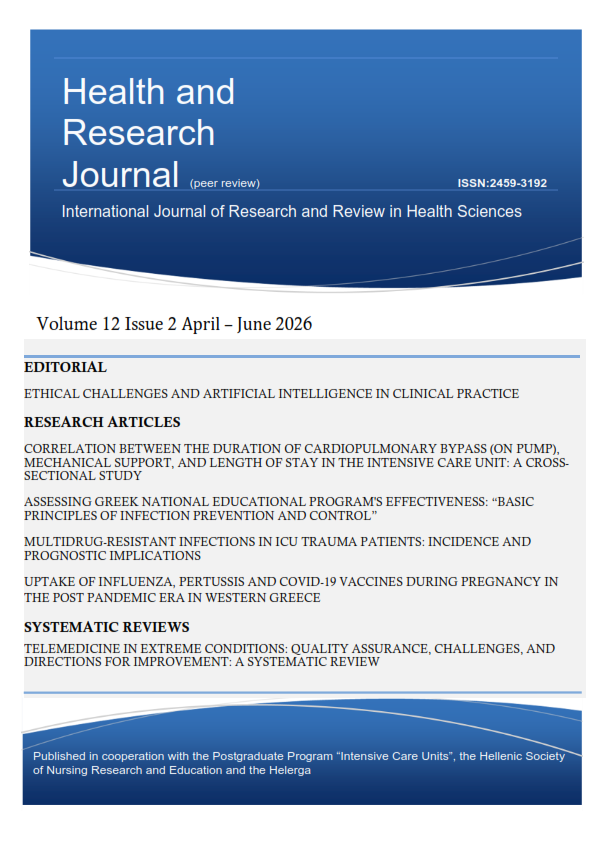

Published: Apr 1, 2026
Keywords:
Multidrug-resistant organisms trauma patients ICU Mechanical ventilation clinical outcomes
Athanasios Tsimpidis
George Kipourgos
https://orcid.org/0000-0002-5538-5548
Georgia Toulia
Niki Pavlatou
Abstract

Background: The increasing prevalence of multidrug-resistant (MDR), extensively drug-resistant (XDR), and pan-drug-resistant (PDR) organisms in the ICU has raised concerns regarding their impact on clinical outcomes in critically ill trauma patients. For this study, MDR, XDR, and PDR were defined according to the international consensus by Magiorakos et al. (2012): MDR = non-susceptibility to ≥3 antimicrobial classes; XDR = non-susceptibility to all but one or two classes; PDR = non-susceptibility to all agents in all classes. This study investigates the correlation between microbial resistance and severity indicators, length of stay, and patient outcomes.


Method and Material: A prospective observational study was conducted in a single-center ICU, including adult patients admitted due to severe trauma. Demographic data, clinical scores (SOFA, APACHE II, ISS), presence of MDR/XDR/PDR colonization or infection (defined using CDC/NHSN criteria), duration of mechanical ventilation and hospitalization, and patient outcomes were recorded and analyzed using appropriate statistical methods.


Results: Μultidrug resistant pathogens were frequently encountered in this trauma ICU cohort and were associated with significantly worse clinical outcomes. Age and BMI were associated with mortality in bivariate analyses; however, these findings should not be interpreted as independent risk factors in the absence of multivariable adjustment. Sex, smoking status, and ARDS did not show significant associations.


Conclusions: The presence of multidrug resistant infections represents a substantial clinical burden in critically ill trauma patients and was linked to worse outcomes in this cohort. These findings highlight the clinical importance of early detection, optimized antimicrobial stewardship, and careful management in this vulnerable population. Given the very small sample size for PDR cases, these findings should be interpreted with caution. Despite the significant associations identified, the study’s limitations—including the small sample size, single-center design, lack of long-term follow-up, and absence of time-dependent or multivariable analyses—warrant cautious interpretation. Future multicenter and longitudinal studies are needed to further investigate resistance mechanisms, optimize therapeutic strategies, and reduce bias in outcome attribution.

Article Details
  • Section
  • Original Articles
Downloads
Download data is not yet available.
Author Biographies
Athanasios Tsimpidis, RN, MSc, Intensive Care Unit, General Hospital of Attica KAT, Athens City, Greece

ORCID ID: 0009-0005-3602-7453

Niki Pavlatou, Assistant Professor, Department of Nursing, University of West Attica, Athens, Greece

ORCID ID: 0000-0003-3776-5296

References
Healthcare-associated infections acquired in intensive care units - Annual Epidemiological Report for 2020. Accessed September 10, 2025. https://www.ecdc.europa.eu/en/publications-data/healthcare-associated-infections-acquired-intensive-care-units-annual
Current HAI Progress Report | HAIs | CDC. Accessed Sep-tember 10, 2025. https://www.cdc.gov/healthcare-associated-infections/php/data/progress-report.html?utm_source=chatgpt.com
Michael CA, Dominey-Howes D, Labbate M. The antimi-crobial resistance crisis: Causes, consequences, and man-agement. Front Public Health. 2014;2(SEP). doi:10.3389/FPUBH.2014.00145,
Martin-Loeches I, Torres A, Rinaudo M, et al. Resistance patterns and outcomes in intensive care unit (ICU)-acquired pneumonia. Validation of European Centre for Disease Prevention and Control (ECDC) and the Centers for Disease Control and Prevention (CDC) classification of mul-tidrug resistant organisms. Journal of Infection. 2015;70(3):213-222. doi:10.1016/j.jinf.2014.10.004
Viswanathan VK. Off-label abuse of antibiotics by bacteria. Gut Microbes. 2014;5(1):3-4. doi:10.4161/GMIC.28027,
Zilahi G, Artigas A, Martin-Loeches I. What’s new in multi-drug-resistant pathogens in the ICU? Ann Intensive Care. 2016;6(1). doi:10.1186/S13613-016-0199-4,
Ramsamy Y, Hardcastle TC, Muckart DJJ. Surviving Sepsis in the Intensive Care Unit: The Challenge of Antimicrobial Re-sistance and the Trauma Patient. World J Surg. 2017;41(5):1165-1169. doi:10.1007/S00268-016-3531-0,
Lat I, Daley MJ, Shewale A, et al. A Multicenter, Prospective, Observational Study to Determine Predictive Factors for Multidrug-Resistant Pneumonia in Critically Ill Adults: The DEFINE Study. Pharmacotherapy. 2019;39(3):253-260. doi:10.1002/PHAR.2171,
Cucci M, Wooten C, Fowler M, Mallat A, Hieb N, Mullen C. Incidence and Risk Factors Associated with Multi-Drug-Resistant Pathogens in a Critically Ill Trauma Population: A Retrospective Cohort Study. Surg Infect (Larchmt). 2020;21(1):15-22. doi:10.1089/SUR.2019.031,
Munita JM, Bayer AS, Arias CA. Evolving Resistance among Gram-positive Pathogens. Clinical Infectious Diseases. 2015;61(Suppl 2):S48-S57. doi:10.1093/CID/CIV523,
Koulenti D, Song A, Ellingboe A, et al. Infections by multi-drug-resistant Gram-negative Bacteria: What’s new in our arsenal and what’s in the pipeline? Int J Antimicrob Agents. 2019;53(3):211-224. doi:10.1016/j.ijantimicag.2018.10.011
Becher RD, Hoth JJ, Neff LP, Rebo JJ, Martin RS, Miller PR. Multidrug-resistant pathogens and pneumonia: comparing the trauma and surgical intensive care units. Surg Infect (Larchmt). 2011;12(4):267-272. doi:10.1089/SUR.2010.052
Darouei B, Jafari S, Rostami S, Nasri P, Mahjoobipour H, Abbasi S. Epidemiology, risk factors, and antimicrobial re-sistance of nosocomial infections in the intensive care unit trauma patients: A cross-sectional study. J Res Med Sci. 2025;30(1). doi:10.4103/JRMS.JRMS_469_25
Nohl A, Hamsen U, Jensen KO, et al. Incidence, impact and risk factors for multidrug-resistant organisms (MDRO) in patients with major trauma: a European Multicenter Cohort Study. Eur J Trauma Emerg Surg. 2022;48(1):659-665. doi:10.1007/S00068-020-01545-4
Wilson L, Boase K, Nelson LD, et al. A Manual for the Glas-gow Outcome Scale-Extended Interview. J Neurotrauma. 2021;38(17):2435-2446. doi:10.1089/NEU.2020.7527,
Jennett B, Bond M. ASSESSMENT OF OUTCOME AFTER SEVERE BRAIN DAMAGE. A Practical Scale. The Lancet. 1975;305(7905):480-484. doi:10.1016/S0140-6736(75)92830-5
Wilson L, Boase K, Nelson LD, et al. A Manual for the Glas-gow Outcome Scale-Extended Interview. J Neurotrauma. 2021;38(17):2435-2446. doi:10.1089/NEU.2020.7527
Moksnes HØ, Schäfer C, Rasmussen MS, et al. Functional Outcomes at 6 and 12 Months Post-Injury in a Trauma Centre Population with Moderate-to-Severe Traumatic In-juries. J Clin Med. 2023;12(16). doi:10.3390/JCM12165300
Liu Z, Meng Z, Li Y, et al. Prognostic accuracy of the serum lactate level, the SOFA score and the qSOFA score for mor-tality among adults with Sepsis. Scand J Trauma Resusc Emerg Med. 2019;27(1). doi:10.1186/S13049-019-0609-3,
Godinjak A, Iglica A, Rama A, et al. Predictive value of SAPS II and APACHE II scoring systems for patient outcome in a medical intensive care unit. Acta Med Acad. 2016;45(2):97-103. doi:10.5644/AMA2006-124.165,
Gennarelli TA, Wodzin E. AIS 2005: A contemporary injury scale. Injury. 2006;37(12):1083-1091. doi:10.1016/j.injury.2006.07.009
Magiorakos AP, Srinivasan A, Carey RB, et al. Multidrug-resistant, extensively drug-resistant and pandrug-resistant bacteria: An international expert proposal for interim standard definitions for acquired resistance. Clinical Mi-crobiology and Infection. 2012;18(3):268-281. doi:10.1111/j.1469-0691.2011.03570.x
Moolchandani K, Sastry AS, Deepashree R, Sistla S, Harish BN, Mandal J. Antimicrobial resistance surveillance among intensive care units of a tertiary care hospital in South In-dia. Journal of Clinical and Diagnostic Research. 2017;11(2):DC01-DC07. doi:10.7860/JCDR/2017/23717.9247,
Han Y, Zhang J, Zhang HZ, Zhang XY, Wang YM. Multi-drug-resistant organisms in intensive care units and lo-gistic analysis of risk factors. World J Clin Cases. 2022;10(6):1795-1805. doi:10.12998/WJCC.V10.I6.1795,
Duhaniuc A, Păduraru D, Nastase EV, et al. Multidrug-Resistant Bacteria in Immunocompromised Patients. Phar-maceuticals. 2024;17(9). doi:10.3390/PH17091151,
Ibrahim ME. High antimicrobial resistant rates among gram-negative pathogens in intensive care units a retro-spective study at a tertiary care hospital in southwest saudi arabia. Saudi Med J. 2018;39(10):1035-1043. doi:10.15537/SMJ.2018.10.22944,
Durdu B, Koc MM, Hakyemez IN, et al. Risk factors affect-ing patterns of antibiotic resistance and treatment efficacy in extreme drug resistance in intensive care unit-acquired klebsiella pneumoniae infections: A 5-year analysis. Medi-cal Science Monitor. 2019;25:174-183. doi:10.12659/MSM.911338,
Oh Y, Roh J, Lee J, Chung HS, Lee K, Lee MK. Sequential Organ Failure Assessment score as a predictor of mortality in ventilated patients with multidrug-resistant bacteremia. Acute and Critical Care. 2020;35(3):169-178. doi:10.4266/ACC.2020.00143,
Iwuafor AA, Ogunsola FT, Oladele RO, et al. Incidence, clinical outcome and risk factors of intensive care unit in-fections in the lagos university teaching hospital (LUTH), Lagos, Nigeria. PLoS One. 2016;11(10). doi:10.1371/JOURNAL.PONE.0165242,
Nohl A, Hamsen U, Jensen KO, et al. Incidence, impact and risk factors for multidrug-resistant organisms (MDRO) in patients with major trauma: a European Multicenter Cohort Study. European Journal of Trauma and Emergency Sur-gery. 2022;48(1):659-665. doi:10.1007/S00068-020-01545-4,
Zorgani A, Abofayed A, Glia A, Albarbar A, Hanish S. Preva-lence of Device-associated Nosocomial Infections Caused By Gram-negative Bacteria in a Trauma Intensive Care Unit in Libya. Oman Med J. 2015;30(4):270-275. doi:10.5001/OMJ.2015.54
Pillai J, Yazicioglu C, Moeng S, et al. Prevalence and pat-terns of infection in critically ill trauma patients admitted to the trauma ICU, South Africa. J Infect Dev Ctries. 2015;9(7):736-742. doi:10.3855/JIDC.5865,
Khan ID, Basu A, Kiran S, Trivedi S, Pandit P, Chattoraj A. Device-Associated Healthcare-Associated Infections (DA-HAI) and the caveat of multiresistance in a multidiscipli-nary intensive care unit. Med J Armed Forces India. 2017;73(3):222-231. doi:10.1016/j.mjafi.2016.10.008
Iordanou S, Middleton N, Papathanassoglou E, Raftopou-los V. Surveillance of device associated infections and mor-tality in a major intensive care unit in the Republic of Cy-prus. BMC Infect Dis. 2017;17(1). doi:10.1186/S12879-017-2704-2,
Tran GM, Ho-Le TP, Ha DT, et al. Patterns of antimicrobial resistance in intensive care unit patients: A study in Vi-etnam. BMC Infect Dis. 2017;17(1). doi:10.1186/S12879-017-2529-Z,
Dou H, Hu F, Wang W, Ling L, Wang D, Liu F. Assessment of the sedative effects of dexmedetomidine and propofol treatment in patients undergoing mechanical ventilation in the ICU and relationship between treatment and occur-rence of ventilator associated pneumonia and detection of pathogenic bacteria. Exp Ther Med. 2020;20(1):599-606. doi:10.3892/ETM.2020.8699,
Al-Sunaidar KA, Aziz NA, Hassan Y, Jamshed S, Sekar M. Association of Multidrug Resistance Bacteria and Clinical Outcomes of Adult Patients with Sepsis in the Intensive Care Unit. Trop Med Infect Dis. 2022;7(11). doi:10.3390/TROPICALMED7110365,
Maia M de O, da Silveira CDG, Gomes M, et al. Multidrug-Resistant Bacteria on Critically Ill Patients with Sepsis at Hospital Admission: Risk Factors and Effects on Hospital Mortality. Infect Drug Resist. 2023;16:1693-1704. doi:10.2147/IDR.S401754,
Koukoubani T, Makris D, Daniil Z, et al. The role of antimi-crobial resistance on long-term mortality and quality of life in critically ill patients: a prospective longitudinal 2-year study. Health Qual Life Outcomes. 2021;19(1). doi:10.1186/S12955-021-01712-0,
Most read articles by the same author(s)