HealthResJ, health, medicine, nursing, research https://ejournals.epublishing.ekt.gr/index.php/HealthResJ/sitemap

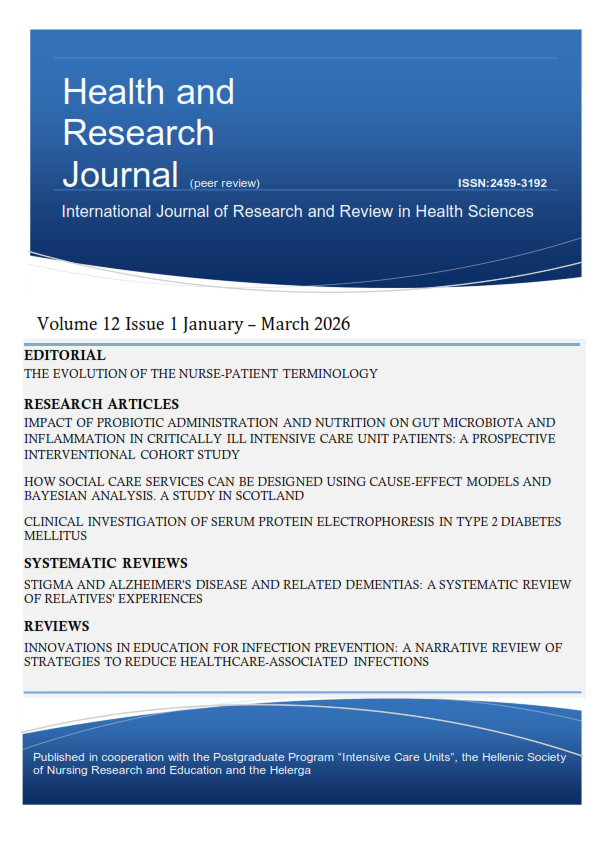
Innovations in Education for Infection Prevention: A Narrative Review of Strategies to Reduce Healthcare-Associated Infections

Published: Jan 4, 2026
Keywords:
Healthcare-associated infections infection prevention and control education simulation artificial intelligence
Panagiota Manthou
Georgios Lioliousis
Maria S. Chrysi
Maria Bourazani
Anna Giga
Aikaterini Atherini
Despoina Pappa
Abstract

Background: Healthcare-associated infections (HAIs) remain a major cause of morbidity, mortality, and healthcare costs worldwide. Education of healthcare workers is a cornerstone of infection prevention and control (IPC), yet traditional methods often fail to produce sustained behavioral change.


Objective: This narrative review synthesizes evidence on contemporary educational tools for IPC, focusing on their impact on compliance with infection prevention practices and infection outcomes, with emphasis on data from Western countries.


Methods: A narrative review approach incorporating systematic elements was used. PubMed, Embase, and Scopus were searched for English-language studies published between 2000 and 2024 evaluating educational interventions in IPC. Of 452 abstracts screened, 117 full texts were reviewed, and 67 studies were included. Data were synthesized narratively.


Results: Simulation-based and multimodal interventions were most consistently associated with reductions in HAIs, including 40–66% decreases in catheter-related bloodstream infections and ~50% reductions in MRSA bacteremia. E-learning, gamification, and mobile platforms improved scalability and engagement; VR/AR enhanced experiential learning but showed mixed effects on real-world compliance. AI-driven feedback systems provided continuous reinforcement and early evidence of infection reduction.


Conclusion: Theory-informed, multimodal educational strategies significantly improve compliance and can reduce HAI rates. Future directions include adaptive AI-based learning, expanded Just-in-Time Training (JITT), and rigorous evaluation of infection outcomes.

Article Details
  • Section
  • Reviews
Downloads
Download data is not yet available.
References
World Health Organization. Report on the burden of endemic health care-associated infection worldwide. Geneva: WHO; 2011.
Cassini A, Plachouras D, Eckmanns T, et al. Burden of six healthcare-associated infections on European population health. PLoS Med. 2016;13(10):e1002150. doi:10.1371/journal.pmed.1002150.
Allegranzi B, Bagheri Nejad S, Combescure C, et al. Burden of endemic health-care-associated infection in developing countries: systematic review and meta-analysis. Lancet. 2011;377(9761):228–41. doi:10.1016/S0140-6736(10)61458-4.
World Health Organization. WHO Guidelines on Hand Hygiene in Health Care. Geneva: WHO; 2009.
Centers for Disease Control and Prevention. Guideline for hand hygiene in health-care settings. MMWR Recomm Rep. 2002;51(RR-16):1–45.
Erasmus V, Daha TJ, Brug H, et al. Systematic review of studies on compliance with hand hygiene guidelines in hospital care. Infect Control Hosp Epidemiol. 2010;31(3):283–94. doi:10.1086/650451.
Kingston L, O’Connell NH, Dunne CP. Hand hygiene-related clinical trials reported since 2010: a systematic review. J Hosp Infect. 2016;92(4):309–20. doi:10.1016/j.jhin.2015.11.012.
Pittet D, Hugonnet S, Harbarth S, et al. Effectiveness of a hospital-wide programme to improve compliance with hand hygiene. Lancet. 2000;356(9238):1307–12. doi:10.1016/S0140-6736(00)02814-2.
Squires JE, Suh KN, Linklater S, et al. Improving physician hand hygiene compliance using behavioural theories: study proto-col. Implement Sci. 2013;8:16. doi:10.1186/1748-5908-8-16.
Gould DJ, Moralejo D, Drey N, Chudleigh JH. Interventions to improve hand hygiene compliance in patient care. Cochrane Database Syst Rev. 2017;9:CD005186. doi:10.1002/14651858.CD005186.pub4.
Sax H, Allegranzi B, Uçkay I, Larson E, Boyce J, Pittet D. ‘My five moments for hand hygiene’: a user-centred design approach. J Hosp Infect. 2007;67(1):9–21. doi:10.1016/j.jhin.2007.06.004.
Lateef F. Simulation-based learning: just like the real thing. J Emerg Trauma Shock. 2010;3(4):348–52. doi:10.4103/0974-2700.70743.
Haile LM, Chen J, Zhu J, et al. Immersive virtual reality training for infection control: a systematic review. Nurse Educ Today. 2022;118:105534. doi:10.1016/j.nedt.2022.105534.
Boud D, Cohen R, Sampson J. Peer Learning in Higher Education: Learning from and with Each Other. London: Routledge; 2014.
Fuller C, Michie S, Savage J, et al. The Feedback Intervention Trial (FIT)—improving hand-hygiene compliance in UK healthcare workers. Lancet Infect Dis. 2012;12(10):717–25. doi:10.1016/S1473-3099(12)70190-0.
Liu Q, Wang Y, Zhang X, et al. Augmented reality–based aseptic technique training improves procedural accuracy: ran-domized controlled trial. Nurse Educ Pract. 2021;53:103054. doi:10.1016/j.nepr.2021.103054.
Klasen M, Greiner L, Pausch N, et al. Virtual reality in infection prevention education: randomized comparison with lecture-based training. Am J Infect Control. 2020;48(7):763–9. doi:10.1016/j.ajic.2019.12.024.
Tada Y, Fukuda H, Iwahashi J, et al. Simulation-based training improves compliance with hand hygiene and reduces CRBSIs in Japan. J Hosp Infect. 2020;105(2):188–95. doi:10.1016/j.jhin.2020.03.012.
Palomar M, Álvarez-Lerma F, Riera A, et al. Impact of a national multimodal intervention to prevent catheter-related bloodstream infection in the ICU (Bacteremia Zero). Crit Care Med. 2013;41(10):2364–72. doi:10.1097/CCM.0b013e318292e63c.
Purwar S, Singh S, Bansal A, et al. Effectiveness of interprofes-sional simulation for hospital-acquired infection control. BMC Med Educ. 2021;21:2907. doi:10.1186/s12909-021-02907-1.
Sørensen JL, Østergaard D, LeBlanc V, et al. Design of simula-tion-based medical education programmes: a comprehensive review. Adv Simul. 2017;2:11. doi:10.1186/s41077-017-0043-4.
Kwon JH, Lee J, Kim HY, et al. Effectiveness of online infection control education using Moodle for hospital staff. BMC Med Educ. 2021;21:312. doi:10.1186/s12909-021-02722-8.
Lau AY, Gabarron E, Fernandez-Luque L, et al. Social media and e-learning in healthcare: a systematic review. BMJ Open. 2020;10:e033123. doi:10.1136/bmjopen-2019-033123.
Rahman S, Islam T, Karim MR, et al. Impact of structured training on hand hygiene compliance among healthcare workers in Bangladesh. Antimicrob Resist Infect Control. 2022;11(1):8. doi:10.1186/s13756-021-01071-1.
Kerfoot BP, Turchin A, Breydo E, et al. Spaced education improves knowledge retention and adherence to guidelines in infection control. Acad Med. 2010;85(10 Suppl):S45–S48. doi:10.1097/ACM.0b013e3181ed3ad4.
Paterson A, Holden E, Thomas K, et al. Using gamification to improve hand hygiene compliance: a UK-based intervention study. J Hosp Infect. 2020;104(1):59–64. doi:10.1016/j.jhin.2019.10.004.
Hsu L, Lee J, Ho C, et al. Gamified education improves hand hygiene compliance among healthcare workers. Am J Infect Control. 2021;49(6):743–9. doi:10.1016/j.ajic.2020.12.025.
Ellison RT, Barysauskas CM, Rundensteiner E, et al. Improving hand hygiene compliance with a novel mobile app-based feedback system. Am J Infect Control. 2021;49(4):431–6. doi:10.1016/j.ajic.2020.11.010.
Pahwa A, Pahwa P, Taneja N, et al. Microlearning with spaced repetition enhances infection prevention knowledge reten-tion: randomized study. J Hosp Infect. 2023;134:27–35. doi:10.1016/j.jhin.2023.03.009.
Lee J, Kim J, Jeong H, et al. Deep learning–based automated hand hygiene monitoring using WHO technique standards. Comput Biol Med. 2022;147:105707. doi:10.1016/j.compbiomed.2022.105707.
Boyce JM, Stone S, Grayson ML, et al. Automated hand hygiene monitoring: evidence-based recommendations for implementation. Infect Control Hosp Epidemiol. 2020;41(10):1121–33. doi:10.1017/ice.2020.282.
Alvarez-Lerma F, Palomar M, Olaechea P, et al. Nurse mentor-ship and bedside feedback improve infection control adher-ence in Spanish ICUs. Intensive Care Med. 2018;44(4):531–40. doi:10.1007/s00134-017-5004-1.
John A, Tomas ME, Cadnum JL, et al. Just-in-time training for PPE use during infectious disease outbreaks: lessons from Ebola and COVID-19. Infect Control Hosp Epidemiol. 2021;42(4):438–45. doi:10.1017/ice.2020.435.
Shabot MM, Munoz-Price LS, Sexton DJ. Implementation of just-in-time training for central line insertion reduces device-associated infections. Am J Infect Control. 2020;48(9):1081–7. doi:10.1016/j.ajic.2020.03.014.
Rowe M, Frantz J, Bozalek V. The role of blended learning in improving clinical education: a systematic review. BMC Med Educ. 2012;12:93. doi:10.1186/1472-6920-12-93.
Klompas M, Brankston G, Hayden MK, et al. Implementation of multimodal infection prevention training in the PROHIBIT study: effects on compliance and infection rates. Clin Infect Dis. 2016;63(5):642–9. doi:10.1093/cid/ciw370.
Pronovost P, Needham D, Berenholtz S, et al. An intervention to decrease catheter-related bloodstream infections in the ICU. N Engl J Med. 2006;355(26):2725–32. doi:10.1056/NEJMoa061115.
Stone S, Slade R, Fuller C, et al. Does a national campaign to improve hand hygiene affect rates of MRSA bacteraemia and C. difficile infection? BMJ. 2012;344:e3005. doi:10.1136/bmj.e3005.
Grayson ML, Russo PL, Cruickshank M, et al. Outcomes from the first five years of the Australian National Hand Hygiene Initiative. Med J Aust. 2018;208(5):217–23. doi:10.5694/mja17.01256.
Kampf G, Löffler H, Gastmeier P. Hand hygiene for the prevention of nosocomial infections. Dtsch Arztebl Int. 2009;106(40):649–55. doi:10.3238/arztebl.2009.0649.
Reichardt C, Königer D, Bunte-Schönberger K, et al. Three years of national hand hygiene campaign in Germany: out-comes and perspectives. J Hosp Infect. 2013;83(Suppl 1):S45–S51. doi:10.1016/S0195-6701(13)60010-2.
Zawacki-Richter O, Marín VI, Bond M, Gouverneur F. Systemat-ic review of research on artificial intelligence applications in higher education. Int J Educ Technol High Educ. 2019;16:39. doi:10.1186/s41239-019-0171-0.
Johnson D, Deterding S, Kuhn KA, et al. Gamification for health and wellbeing: a systematic review. Internet Interv. 2016;6:89–106. doi:10.1016/j.invent.2016.10.002.
Beam EL, Gibbs SG, Boulter KC, et al. Just-in-time training improves personal protective equipment technique during infectious disease responses. Clin Infect Dis. 2021;73(3):e698–e705. doi:10.1093/cid/ciaa1476.
Castro-Sánchez E, Holmes AH. Impact of education and training on antimicrobial stewardship programmes and infec-tion prevention: a review. Clin Microbiol Infect. 2015;21(10):977–83. doi:10.1016/j.cmi.2015.07.031.
Allegranzi B, Kilpatrick C, Storr J, et al. Global infection prevention initiatives and open-access education to support universal hand hygiene improvement. J Infect Public Health. 2021;14(5):643–49. doi:10.1016/j.jiph.2021.02.008.
Boyce JM, Stone S, Grayson ML, et al. Automated hand hygiene monitoring: evidence-based recommendations for implementation. Infect Control Hosp Epidemiol. 2020;41(10):1121–33. doi:10.1017/ice.2020.282.
Most read articles by the same author(s)