Vol. 2 No. 1 (2026): GIORDANO BRUNO – Issue 2
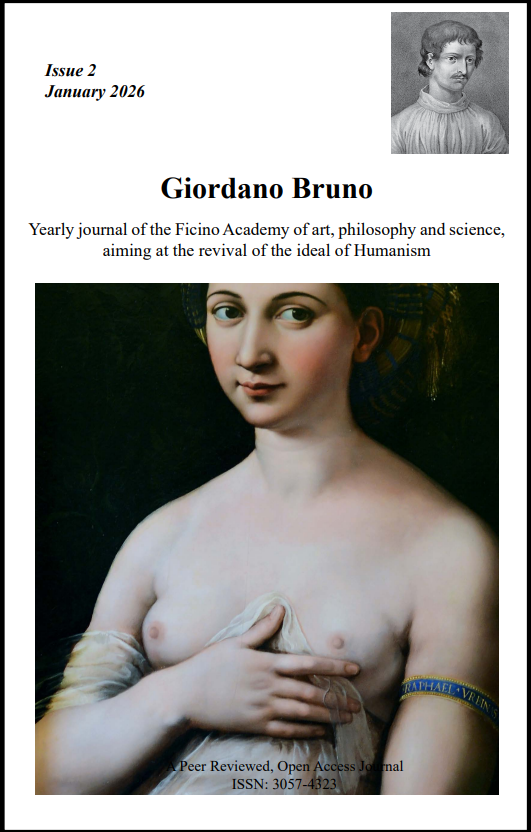
Published: 2026-01-29
In the 2nd issue of our journal Giordano Bruno (Jan. 2026), which serves as the scientific instrument for disseminating the goals of the Marsilio Ficino Academy of Humanistic Studies, the following are included:
- Homo universalis today?
Art and Science Reimagined: Bridging the Epistemological Gap. An article of Angeliki Antoniou, which envisions the future of science by considering elements such as the prevalence of technology, the rise of artificial intelligence, and the evolving role of humans in the years to come. It is argued that the future of science depends on its integration with the arts, a synergy that fosters innovation and creativity while enabling individuals to achieve a more holistic intellectual development.
- History of Renaissance
Sappho Reborn: Portraiture of Women Poets in Renaissance Italy. An article of Anna Griva, which highlights the prominence of women’s writing in sixteenth-century Italy and its connection to the rise of print culture and the vernacular. These images reveal how Renaissance artists employed symbolism and classical models to construct the poetess as an intellectual, moral and creative authority.
- Ancient Greek Literature
Α theatrical reading of Plato, Lysis. An article (in Greek) of Efstathia Dimou, which offers a theatrical reading of Lysis, one of Plato’s early dialogues on the theme of friendship. It calls attention to four different types of friendship and considers them as constitutive parts of the human condition.
- History of ideas from Late Antiquity to Kant and the critique of feminism
The search for meaning in Ecclesiastes (Qoheleth). An article (in Greek) of Markos Dendrinos, which attempts to shed light on the notion of meaning based on Keefer’s work, who approached the text by drawing on the distinction between psychological and philosophical meaning, as well as the three components of meaning (coherence, significance, and purpose) as defined by Martela and Steger.
Half-Truths and Dubious Heraclitean Quotations: Clement’s Rhetoric Against Orpheus, Apollo, and Dionysus. An article of Dimitrios Pappas, which studies the texts of Clement of Alexandria and reveals systematic misrepresentations, possible manipulation of authentic sources. The study employs a methodological approach to evaluate primary sources, detect historical and cultural inconsistencies, and identify stable narrative patterns to distinguish authentic content from rhetorical constructions.
The transcendental conjunction of Ethics and Freedom in Kant's Metaphysics as a lever for the evolution of society. An article (in Greek) of Ioannis Gainnis, which analyses the transcendental path that Kant carved out, founding the principle of moral autonomy on the concept of freedom and how these two concepts/principles, according to the philosopher, can shape the historical progress and evolution of societies.
A critical and comparative analysis on two antifeminist worldviews of the last century (Esther Vilar, Gina Lombroso). An article (in Greek) of Myron Zacharakis, which examines the anti-feminist theories of the Argentine-German physician Esther Vilar and the Italian Gina Lombroso, also a physician and daughter of the renowned criminologist Cesare Lombroso. The aim is to highlight the deeper similarities and contrasts between the two perspectives on gender, love and power, in order to explore how anti-feminist viewpoints can function as opportunities for a self-critique within the feminist movement.
- Philosophy of Science
From Medieval Aristotelianism to Modern Philosophies of Science: Key Stages in the Development of Scientific Thought. An article of Foteini Efthymiou, which presents a concise exploration of the evolutionary course of scientific thought, highlighting four major periods as its key milestones: the medieval era marked by the dominance of Christianity; the period of the Scientific Revolution; the era of Rationalism and Empiricism; and the period of contemporary Philosophy of Science, from logical positivism to Kuhn and Feyerabend.
- Philosophy of entropy
Philosophy of Entropy: Eastern and Western Approaches. An article of Fivos Papadimitriou that examines how the scientific concept of entropy has been interpreted and developed within diverse philosophical traditions, revealing its significance as a bridge between physical description and existential meaning; from Husserl, Heidegger and Nietzsche to Buddhism and Hinduism.
.~.
Στο 2ο τεύχος του περιοδικού μας Giordano Bruno που αποτελεί το επιστημονικό όργανο διάδοσης των στόχων της Ακαδημίας Ουμανιστικών Σπουδών Marsilio Ficino περιλαμβάνονται τα ακόλουθα:
- Homo universalis σήμερα?
Art and Science Reimagined: Bridging the Epistemological Gap. Ένα άρθρο της Αγγελικής Αντωνίου όπου οραματίζεται το μέλλον της επιστήμης λαμβάνοντας υπόψη στοιχεία όπως η διάδοση της τεχνολογίας και η άνοδος της τεχνητής νοημοσύνης. Θεωρεί ότι το μέλλον της επιστήμης εξαρτάται από τη σύζευξή της με τις τέχνες, μια συνέργεια που ενισχύει την καινοτομία και τη δημιουργικότητα, ενώ παράλληλα επιτρέπει στα άτομα να επιτυγχάνουν μια ολιστική πνευματική ανάπτυξη.
- Ιστορία της Αναγέννησης
Sappho Reborn: Portraiture of Women Poets in Renaissance Italy. Ένα άρθρο της Άννας Γρίβα που αφορά τα ζωγραφικά πορτρέτα των σημαντικών ποιητριών της Αναγέννησης και την ανάδειξή των συμβολισμών τους. Έτσι, αναδεικνύεται ο τρόπος με τον οποίο προσλαμβάνεται η γυναίκα δημιουργός κατά τους κρίσιμους αιώνες της μετάβασης στον νεότερο ευρωπαϊκό κόσμο.
- Αρχαία Γραμματεία
Για μια θεατρική ανάγνωση του πλατωνικού Λύσι. Ένα άρθρο της Ευσταθίας Δήμου όπου προτείνεται μια θεατρική ανάγνωση του Λύσι, ενός από τους νεανικούς διαλόγους του Πλάτωνα με θέμα τη φιλία. Συγκεκριμένα, επιχειρείται η ανάδειξη των ποικίλων όψεων του φιλικού δεσμού, των διαφορετικών εκδοχών με τις οποίες αυτός παρουσιάζεται μέσα στην ανθρώπινη συνθήκη.
- Ιστορία των ιδεών από την ύστερη αρχαιότητα στον Kant και την κριτική του φεμινισμού
Η αναζήτηση του νοήματος στον Εκκλησιαστή (Qoheleth). Ένα άρθρο του Μάρκου Δενδρινού όπου επιχειρεί να φωτίσει την έννοια του νοήματος στον Εκκλησιαστή με βάση το έργο του Keefer, ο οποίος προσέγγισε το κείμενο στηριγμένος στη διάκριση ψυχολογικού και φιλοσοφικού νοήματος και στις τρεις συνιστώσες του νοήματος (συνέπεια, σημασία και σκοπό) κατά τους Martela και Steger.
Half-Truths and Dubious Heraclitean Quotations: Clement’s Rhetoric Against Orpheus, Apollo, and Dionysus. Ένα άρθρο του Δημητρίου Παππά όπου μελετά τα κείμενα του Κλήμεντος Αλεξανδρέως μέσα από μια συγκριτική ανάλυση με αυθεντικές λογοτεχνικές και ιστορικές πηγές και αποκαλύπτει συστηματικές παραποιήσεις. Η μελέτη επιχειρεί τον εντοπισμό ιστορικών και πολιτισμικών ασυνεπειών με στόχο τη διάκριση του αυθεντικού περιεχομένου από τις ρητορικές κατασκευές.
Η Υπερβατολογική Σύζευξη Ηθικής και Ελευθερίας στη Μεταφυσική του Kant ως μοχλός εξέλιξης της Κοινωνίας. Ένα άρθρο του Γιάννη Γιαννή όπου αναλύει την υπερβατολογική δίοδο που χάραξε ο Kant, θεμελιώνοντας την αρχή της ηθικής αυτονομίας πάνω στην έννοια της ελευθερίας. Αυτές οι δύο έννοιες/αρχές, κατά τον φιλόσοφο, δύνανται να διαμορφώσουν την ιστορική πρόοδο και την εξέλιξη των κοινωνιών.
Μια κριτική και συγκριτική ανάλυση δύο προκλητικών αντιφεμινιστικών κοσμοθεάσεων του περασμένου αιώνα (Esther Vilar, Gina Lombroso). Ένα άρθρο του Μύρωνα Ζαχαράκη όπου εξετάζει τις αντιφεμινιστικές θεωρίες της Αργεντινο-Γερμανίδας ιατρού Esther Vilar, και της Ιταλίδας Gina Lombroso, επίσης ιατρού και κόρης του επιφανούς εγκληματολόγου Cesare Lombroso. Στόχος του άρθρου είναι η ανάδειξη των ομοιοτήτων και των αντιθέσεων ανάμεσα στις δύο θεωρίες, προκειμένου να διερευνηθεί πώς οι αντιφεμινιστικές θεωρήσεις μπορούν να λειτουργήσουν ως ευκαιρίες για αυτοκριτική στο φεμινιστικό κίνημα.
- Φιλοσοφία της επιστήμης
From Medieval Aristotelianism to Modern Philosophies of Science: Key Stages in the Development of Scientific Thought. Ένα άρθρο της Φωτεινής Ευθυμίου όπου παρουσιάζει μια συνοπτική διερεύνηση της εξελικτικής πορείας της επιστημονικής σκέψης, αναδεικνύοντας τέσσερις σημαντικές περιόδους ως βασικά ορόσημά της: τους μεσαιωνικούς χρόνους με την επικράτηση του Χριστιανισμού, την περίοδο της Επιστημονικής Επανάστασης, την περίοδο του Ορθολογισμού και του Εμπειρισμού και την περίοδο της σύγχρονης Φιλοσοφίας της Επιστήμης από τον λογικό θετικισμό μέχρι τον Kuhn και τον Feyerabend.
- Μαθηματικά και εντροπία
Philosophy of Entropy: Eastern and Western Approaches. Ένα άρθρο του Φοίβου Παπαδημητρίου που εξετάζει πώς η επιστημονική έννοια της εντροπίας έχει ερμηνευθεί και αναπτυχθεί στο πλαίσιο διαφορετικών φιλοσοφικών παραδόσεων, αναδεικνύοντας τη σημασία της ως γέφυρας ανάμεσα στη φυσική περιγραφή και το υπαρξιακό νόημα· από τον Husserl, τον Heidegger και τον Nitzsche έως τον Βουδισμό και τον Ινδουισμό.
Articles