Precursor models in the thinking of 3-8 year olds: entities between empirical and scientific knowledge
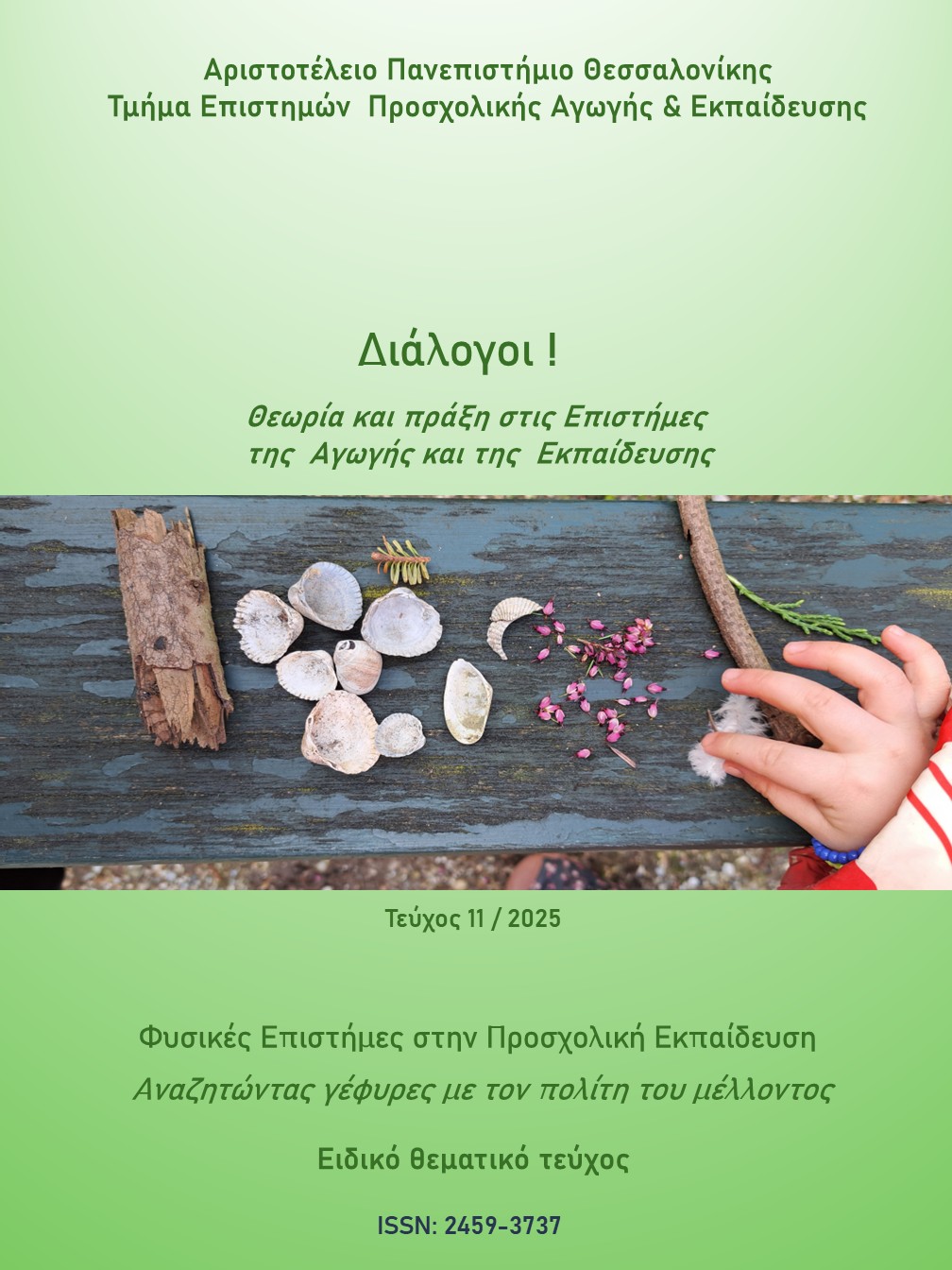
Abstract
The issue of the approach to Physical Sciences in pre-school and early school age has been an issue of research and application of different fields of knowledge such as the Psychology of learning, the Epistemology of Cognitive Development, Early Childhood Education, the Science Education. The complexity that necessarily results from the multifaceted or one-sided approach to individual questions sometimes creates epistemological confusions that lead to the damping of critical questions for a rational attempt to shift from the experiential and spontaneous relationship of young children's thinking to structural and/or functional elements of Physical Sciences. At the same time, the emergence of educational proposals with a loose theoretical foundation which, for various reasons, are becoming widely disseminated, adding new parameters of ambiguity at least on the issue of the dimension of cognitive development of young children. In this article an attempt is made to capture the concept of the precursor model as a mental entity that interposes itself between scientific school knowledge and children's experiences, is built in children's minds through appropriate activities and constitutes a stable tool that prepares children's minds for the formation of school scientific models. At the same time, if the relevant research shows that some children at the age of 3-8 years can form a precursor model in their thinking about a particular phenomenon, this can be the aim of activities in any type of pedagogical context chosen.
Article Details
- How to Cite
-
Ravanis, K. (2025). Precursor models in the thinking of 3-8 year olds: entities between empirical and scientific knowledge. Dialogoi! Theory and Praxis in Education, 11, 7–27. https://doi.org/10.12681/dial.41730
- Section
- Special Theme

This work is licensed under a Creative Commons Attribution-NonCommercial-ShareAlike 4.0 International License.
Authors who publish with this journal agree to the following terms:
- Authors retain copyright and grant the journal right of first publication with the work simultaneously licensed under a Creative Commons Attribution Non-Commercial License that allows others to share the work with an acknowledgement of the work's authorship and initial publication in this journal.
- Authors are able to enter into separate, additional contractual arrangements for the non-exclusive distribution of the journal's published version of the work (e.g. post it to an institutional repository or publish it in a book), with an acknowledgement of its initial publication in this journal.
- Authors are permitted and encouraged to post their work online (preferably in institutional repositories or on their website) prior to and during the submission process, as it can lead to productive exchanges, as well as earlier and greater citation of published work (See The Effect of Open Access).