test Echoes of Resistance |Education & Theatre

Echoes of Resistance The role of storytelling and performing arts in preserving Palestinian identity
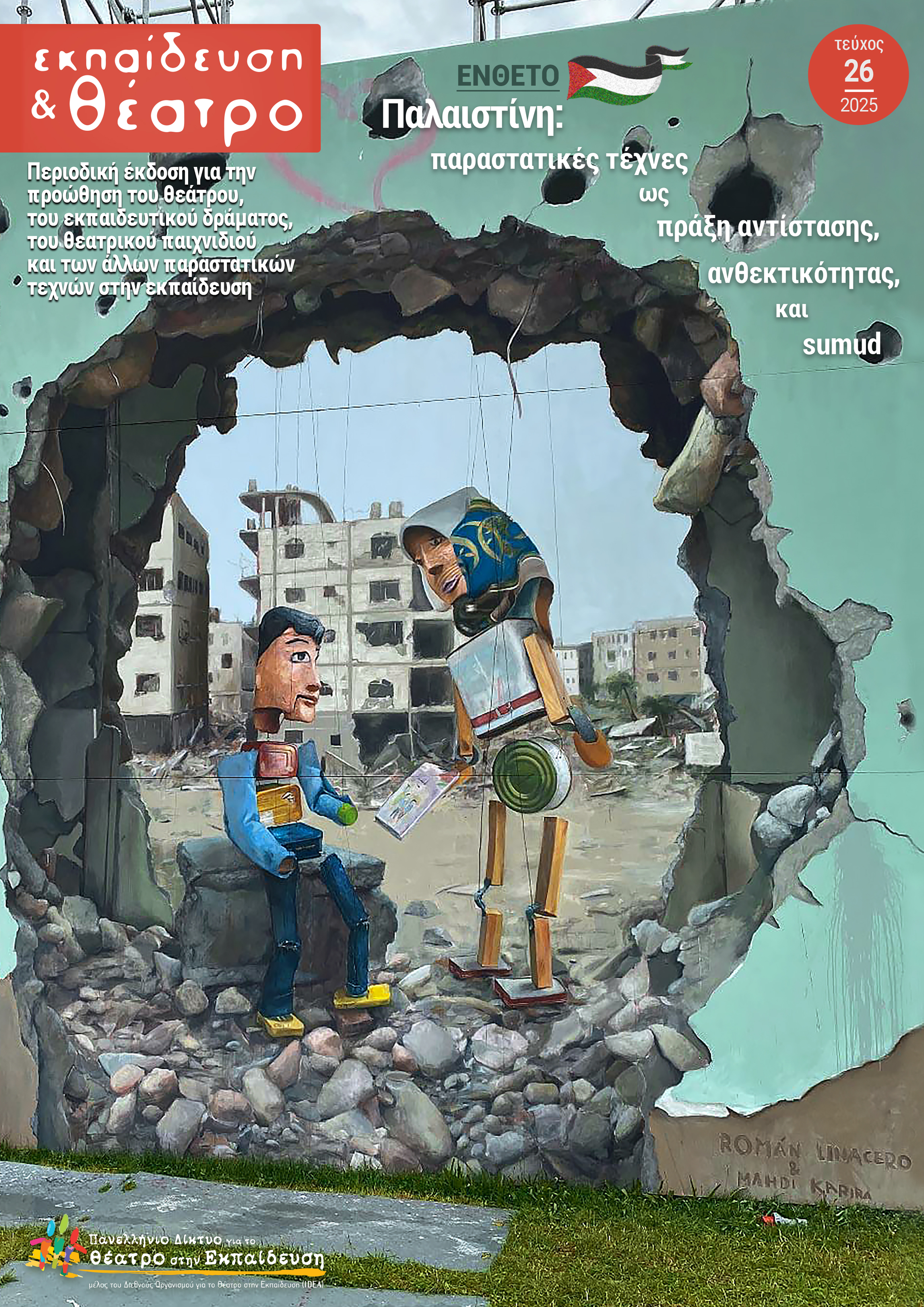

Published: Nov 29, 2025
Keywords:
Storytelling performing arts Palestinian identity Gaza hassan Kanafani memory resistance Indigenous peoples graffiti intergenerational trauma digital media
Khitam Edelbi
Shams Almanal Timraz
Abstract

This article examines the central role of the native voice in transmitting historical memory, emphasising how it sustains collective identity and shapes our vision of the future. In the Palestinian context, storytelling serves as both a cultural archive and an act of resistance, countering fragmentation by maintaining narrative continuity. The analysis engages with embodied art forms such as dabkeh, theatre, literature and mural painting on the separation wall as vital modes of cultural expression and political testimony. The legacy of Ghassan Kanafani is highlighted, recognising his assertion that storytelling is a form of cultural survival and a revolutionary act. Contributions by Khitam Edelbi and Shams Almanal Timraz further ground the discussion. The first is a narrative recounted by Muhibah Edelbi and the second is a performance by Sabha Timraz. Both recount intergenerational memories of displacement from Al-Birwa and Isdud during the Nakba of 1948. These stories serve as a form of mnemonic resistance against erasure. Finally, the article examines the role of graffiti during the First and Second Intifadas, as well as how Palestinian narratives have gained a wider reach through theatre and digital media. These continue to amplify marginalised voices across global platforms.

Article Details
  • Section
  • Insert Palestine: Academic papers
Downloads
Download data is not yet available.
Author Biographies
Khitam Edelbi, Dar al-Kalima University

Dr Khitam Edelbi (PhD, Lesley University) is an Expressive Arts Therapies specialist with over 30 years' experience in drama, storytelling, theatre production and art therapy. She currently teaches on the Art Therapy Programme at Dar al-Kalima University in Bethlehem. Since 2009, Dr Edelbi has been training psychologists and social workers in the use of various artistic methods of expression and psychological support. She worked as an actress in theatre, children’s theatre and cinema for several years. She also writes and tells stories for children. Her doctoral dissertation, Using Playback Theatre with Adolescents in the Qalandia Refugee Camp in Palestine, was published by Lesley University. She has co-written and published several academic papers: “A Colorful Language: Playback Theatre as a Way of Listening with Youth in Palestine” with Hussein-Shannan in 2023, and “Assessment and Cultural Sensitivity Regarding International Graffiti on the Separation Wall in Palestine” with Waybright in 2025.

Shams Almanal Timraz, producer, art critic and cultural consultant

Shams Almanal Timraz is a producer, art critic and cultural consultant with over twenty years of experience in art production and creative consultancy across all disciplines. Of Palestinian origin and raised in Europe, she has dedicated her career to enriching the Palestinian cultural landscape through critical discourse, creative production and strategic consultancy. Her expertise spans film and theatre criticism, artist development and curating programmes that connect local narratives with global audiences. She holds a Master’s degree in Conflict Resolution and International Mediation, and has worked in the Middle East for many years. She has managed cultural spaces, led exhibitions and helped shape arts policy. Shams brings unique expertise in cultural mediation and conflict-sensitive creative practices. She is the founder and director of Shams & Rise Arts, a consultancy and production platform that advances independent cultural initiatives with social impact.

References
American Psychiatric Association. (2013). Diagnostic and statistical manual of mental disorders (5th ed.). https://doi.org/10.1176/appi.books.9780890425596
Ankori, G. (2006). Palestinian Art. Reaktion Books.
Calder, G. (2013). Narrative, empathy and morality. Ethical Theory and Moral Practice, 16(2), 205–220.
Ceaușu, A. (2018). The healing power of art-therapy. Journal of Education Culture and Society, 9(1), 84–91.
Edelbi, K., & Waybright, C. L. (2025). Assessment and cultural sensitivity regarding international graffiti on the Separation Wall in Palestine. In V.-A. Ware, W. Al Kurdi, T. Prentki, K. Sadeghi-Yekta, & P. Kabanda (Eds.), Routledge handbook of arts and global development (pp. 231–245). Routledge.
Freire, P. (2000). Pedagogy of the oppressed (30th anniversary ed., M. B. Ramos, Trans.). Continuum. (Original work published 1968)
Gharavi, M. M. (2011, April 5). Art is freedom without force: An interview with the late Juliano Mer-Khamis. South is South. https://southissouth.wordpress.com/2011/04/05/art-is-freedom-without-force-interview-with-the-late-juliano-mer-khamis
Hlehel, A. (2017). Taha [Theatrical monodrama]. Young Vic Theatre. https://www.youngvic.org/whats-on/taha
Kanafani, G. (1999). Men in the sun and other Palestinian stories (H. Kilpatrick, Trans.). Lynne Rienner Publishers.
Kanafani, G. (2000). Palestine’s children: Returning to Haifa and other stories (B. Harlow, & K. E. Riley, Trans.). Lynne Rienner Publishers.
Karim, R. (2022). Art as Artillery: Art as a Method of Existence and Resistance in Palestine (Doctoral dissertation, School of the Art Institute of Chicago).
Kiser, L. J., Baumgardner, B., & Dorado, J. (2010). Who are we, but for the stories we tell: Family stories and healing. Psychological Trauma: Theory, Research, Practice, and Policy, 2(3), 243–249. https://doi.org/10.1037/a0019893
Luitel, B C., & Dahal, N. (2021). Autoethnography: Writing lives and telling stories. Journal of Transformative Praxis, 2(1), 1–7.
McEwen, B. S. (2007). Physiology and neurobiology of stress and adaptation: Central role of the brain. Physiological Reviews, 87(3), 873–904. https://doi.org/10.1152/physrev.00041.2006
Pennebaker, J. W. (2011). Opening up: The healing power of expressing emotions (3rd ed.). Guilford Press.
Peteet, J. (1996). The writing on the walls: The graffiti of the Intifada. Cultural Anthropology, 11(2), 139–159. https://doi. org/10.1525/can.1996.11.2.02a00010
Reeves, J. (2022). The Freedom Theatre/Bus: The challenges of narrative-formation in Palestine [Master’s thesis, University of Exeter]. MbyRes Dissertations. https://hdl.handle.net/10871/128263
Said, E. W. (1993). Culture and imperialism. Knopf.
Schore, A. N. (2001). The effects of early relational trauma on right brain development, affect regulation, and infant mental health. Infant Mental Health Journal, 22(1–2), 201–269. https://onlinelibrary.wiley.com/doi/10.1002/1097-0355(200101/04)22:1%3C201::AID-IMHJ8%3E3.0.CO;2-9
Severs, E., James, T., Letrondo, P., Løvland, L., Marchant, N. L., & Mukadam, N. (2023). Traumatic life events and risk for dementia: a systematic review and meta-analysis. BMC geriatrics, 23(1), 587. https://doi.org/10.1186/s12877-023-04287-1
Sium, A., & Ritskes, E. (2013). Speaking truth to power: Indigenous storytelling as an act of living resistance. Decolonization: indigeneity, education & Society, 2(1).
Teicher, M. H., & Samson, J. A. (2016). Annual Research Review: Enduring neurobiological effects of childhood abuse and neglect. Journal of Child P Psychology and Psychiatry, 57(3), 241–266. https://doi.org/10.1111/jcpp.12507
van der Kolk, B. A. (1996). Trauma and memory. In B. van der Kolk, A. C. McFarlane, & L. Weisaeth (Eds.), Traumatic stress: The effects of overwhelming experience on mind, body and society (pp. 279–302). The Guilford Press.
van der Kolk, B. A. (2014). The body keeps the score: Brain, mind, and body in the healing of trauma. Viking.
Yehuda, R., Daskalakis, N. P., Desarnaud, F., Makotkine, I., Lehrner, A. L., Koch, E., Flory, J. D., Buxbaum, J. D., Meaney, M. J., & Bierer, L. M. (2013). Epigenetic Biomarkers as Predictors and Correlates of Symptom Improvement Following Psychotherapy in Combat Veterans with PTSD. Frontiers in psychiatry, 4, 118. https://doi.org/10.3389/fpsyt.2013.00118
Young, M. (2022). The art of resistance: Art and resistance in Palestine. JANUS NET e-Journal of International Relation, 01(2), 18–36. https://doi.org/10.26619/1647-7251.DT0122.2