Investigating the predictors of academic language competences in primary school children: A machine learning approach
Abstract
Academic language plays a critical role in students’ ability to succeed in school. Since multilingual and socioeconomically disadvantaged students often face challenges in acquiring the necessary language register, academic language proficiency is widely recognized as a key factor in promoting educational equity. To investigate how academic language skills develop – and what factors influence this process over time, the Eva-Prim study (Rank et al., 2021) analysed longitudinal data from 570 German primary school students. Academic language comprehension and production in mathematical contexts were assessed. Drawing on over 1,000 student-, family-, and school-related variables, a machine learning approach (Random Forests) (Breiman, 2001) was employed to identify the most relevant predictors. The findings show that at the beginning of primary school, distal factors such as intelligence, parental education, and socioeconomic status were associated with academic language comprehension. Over time, however, the influence of these background characteristics declined, while trainable skills – particularly vocabulary, reading fluency, and mathematical competence, became increasingly important. Academic language production in grade four was predicted mainly by these proximal, trainable skills. Demographic factors – including migration background, played only a minor role in predicting academic language performance. These results suggest that academic language development is shaped less by static background variables and more by dynamic, educationally influenceable skills. Thus, supporting vocabulary and reading fluency within subject teaching may be key to fostering academic success for all students, regardless of their background.
Article Details
- How to Cite
-
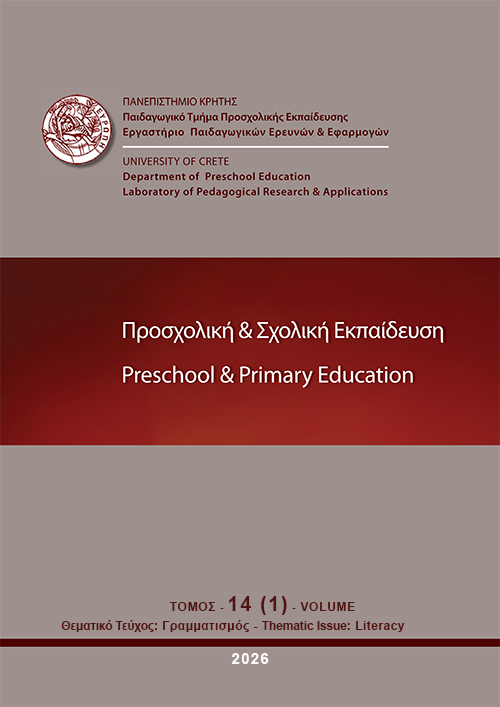
Rank, A., & Kraus, E. (2026). Investigating the predictors of academic language competences in primary school children: A machine learning approach. Preschool and Primary Education, 14(1), 144–162. https://doi.org/10.12681/ppej.40307
- Section
- Articles

This work is licensed under a Creative Commons Attribution-NonCommercial-ShareAlike 4.0 International License.
Authors who publish with this journal agree to the following terms:
- Authors retain copyright and grant the journal right of first publication with the work simultaneously licensed under a Creative Commons Attribution Non-Commercial License that allows others to share the work with an acknowledgement of the work's authorship and initial publication in this journal.
- Authors are able to enter into separate, additional contractual arrangements for the non-exclusive distribution of the journal's published version of the work (e.g. post it to an institutional repository or publish it in a book), with an acknowledgement of its initial publication in this journal.
- Authors are permitted and encouraged to post their work online (preferably in institutional repositories or on their website) prior to and during the submission process, as it can lead to productive exchanges, as well as earlier and greater citation of published work (See The Effect of Open Access).