Προς μια νέα κουλτούρα εκπαίδευσης STEM: προτάσεις από εκπαιδευτικούς προσχολικής ηλικίας
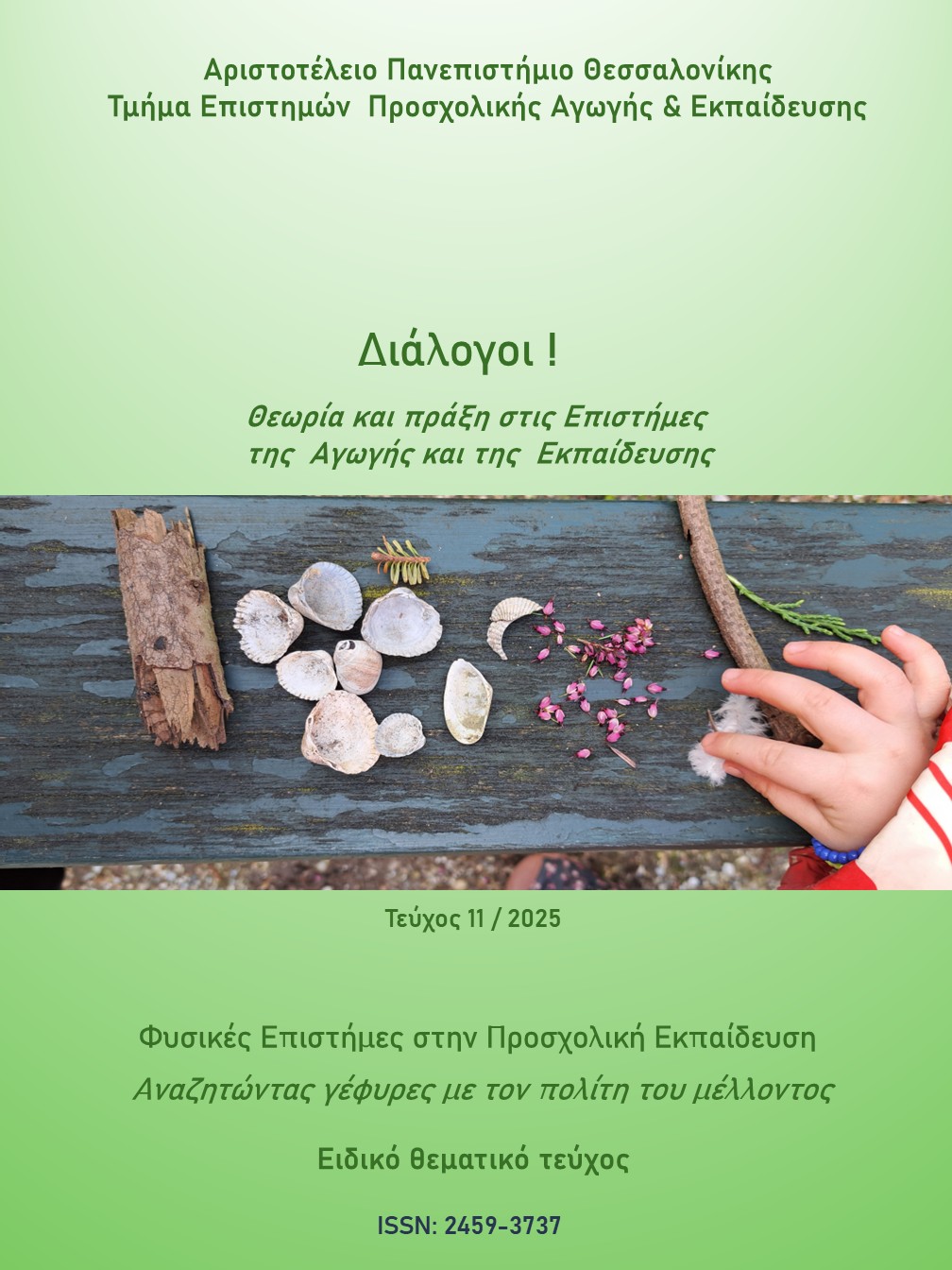

Δημοσιευμένα: Dec 23, 2025
Λέξεις-κλειδιά:
επιστημονικός εγγραμματισμός, STEM, προσχολική ηλικία, πρόγραμμα επαγγελματικής ανάπτυξης
Γλυκερία Φραγκιαδάκη
Ελένη Σταυροπούλου
Ηρώ Ζαχαριάδη
Φωτεινή Σκίζα
https://orcid.org/0000-0001-7280-783X
Δόμνα Κακανά
https://orcid.org/0000-0002-3646-1437
Βασιλεία Χρηστίδου
https://orcid.org/0000-0001-9706-0584
Περίληψη

Ο επιστημονικός γραμματισμός αποτελεί όχι μόνο ανάγκη αλλά και δικαίωμα όλων των παιδιών για να γίνουν ενεργοί μελλοντικοί πολίτες αλλά, κυρίως, για να είναι σημερινοί πολίτες STEM σε κοινωνίες που περιλαμβάνουν παιδιά. Ωστόσο, αυτό που συχνά παραβλέπεται είναι ότι οι εκπαιδευτικοί προσχολικής ηλικίας έχουν επίσης την ανάγκη, αλλά και το δικαίωμα, να υποστηρίζονται επαρκώς ώστε να ανταποκρίνονται στα υψηλά πρότυπα και απαιτήσεις της εκπαίδευσης STEM, καθώς επίσης να έχουν πρόσβαση σε προσιτή, συνεχή και υψηλής ποιότητας επαγγελματική ανάπτυξη. Όμως, η διεθνής βιβλιογραφία έχει αναδείξει επανειλημμένα ότι οι εκπαιδευτικοί προσχολικής ηλικίας αισθάνονται ευάλωτες στις τρέχουσες STEM προκλήσεις. Εστιάζοντας σε αυτή την αντίφαση, η μελέτη επιδιώκει να αναδείξει την προοπτική των εκπαιδευτικών προσδιορίζοντας την εμπειρία τους στην εκπαίδευση STEM και το είδος της επαγγελματικής ανάπτυξης που έχει νόημα για τις ίδιες. Τα εμπειρικά δεδομένα που παρουσιάζονται προέκυψαν μέσα από συνεντεύξεις με τρεις ομάδες εστίασης οι οποίες διαμορφώθηκαν με τη συμμετοχή είκοσι οκτώ νηπιαγωγών που συμμετείχαν σε πρόγραμμα επαγγελματικής ανάπτυξης στο πλαίσιο του ερευνητικού προγράμματος. Τα αποτελέσματα φανερώνουν την ανάγκη να επαναπροσδιοριστει η εκπαίδευση STEM ως μια ανοιχτή, διερευνητική, συστημική και διαλεκτική διαδικασία. Τα ευρήματα της έρευνας χαρτογραφούν ένα μεταβατικό μονοπάτι για την καλλιέργεια μιας νέα κουλτούρας για τη STEM εκπαίδευση στο νηπιαγωγείο.

Λεπτομέρειες άρθρου
  • Ενότητα
  • Ειδικό Θέμα
Λήψεις
Τα δεδομένα λήψης δεν είναι ακόμη διαθέσιμα.
Αναφορές
Braun, V., & Clarke, V. (2006). Using thematic analysis in psychology. Qualitative Research in Psychology, 3(2), 77–101. https://doi.org/10.1191/1478088706qp063oa
Braun, V., & Clarke, V. (2019). Reflecting on reflexive thematic analysis. Qualitative Research in Sport, Exercise and Health, 11(4), 589–597. https://doi.org/10.1080/2159676X.2019.1628806
Bowne, M., Cutler, K., DeBates, D., Gilkerson, D., & Stremmel, A. (2010). Pedagogical documentation and collaborative dialogue as tools of inquiry for pre-service teachers in early childhood education: An exploratory narrative. Journal of the Scholarship of Teaching and Learning, 10*(2), 48–59. https://scholarworks.iu.edu/journals/index.php/josotl/article/view/1739
Carr, W., & Kemmis, S. (1986). Becoming critical: Education, knowledge and action research. Falmer Press.
Patton, M. Q. (1990). Qualitative evaluation and research methods (2nd ed.). SAGE Publications.
Bagiati, A., & Evangelou, D. (2015). Engineering curriculum in the preschool classroom: The teacher’s experience. European Early Childhood Education Research Journal, 23(1), 112–128. https://doi.org/10.1080/1350293X.2014.991099
Bates, C. C., & Morgan, D. N. (2018). Seven elements of effective professional development. The reading teacher, 71(5), 623-626
Chen, Y.-L., Huang, L.-F., & Wu, P.-C. (2020). Preservice Preschool Teachers’ Self-efficacy in and Need for STEM Education Professional Development: STEM Pedagogical Belief as a Mediator. Early Childhood Education Journal. https://doi.org/10.1007/s10643-020-01055-3
DeBoer, G. E. (2000). Scientific literacy: Another look at its historical and contemporary meanings and its relationship to science education reform. Journal of Research in Science Teaching, 37(6), 582-601. https://doi.org/10.1002/1098-2736(200008)37:6%3C582::AID-TEA5%3E3.0.CO;2-L
Dale Tunnicliffe, S., & Gkouskou, E. (2020). Science in action in spontaneous preschool play – an essential foundation for future understanding. Early Child Development and Care, 190(1), 54–63. https://doi.org/10.1080/03004430.2019.1653552
Dogan, Y., & Simsar, A. (2018). Preschool Teachers’ Views on Science Education, the Methods They Use, Science Activities, and the Problems They Face. International Journal of Progressive Education, 14(5), 57–76.
Fleer, M. (2023). The role of imagination in science education in the early years under the conditions of a Conceptual PlayWorld. Learning, Culture and Social Interaction, 42, 100753. https://doi.org/10.1016/j.lcsi.2023.100753
Fleer, M. (2019). Conceptual PlayWorlds as a pedagogical intervention: Supporting the learning and development of the preschool child in a play-based setting. Obutchénie, 3(3). https://doi.org/10.14393/OBv3n3.a2019-51704
Fleer, M., Fragkiadaki, G., & Rai, P. (2020). STEM begins in infancy: Conceptual PlayWorlds to support new practices for professionals and families. International Journal of Birth and Parent Education, 7(4), 27–31. https://doi.org/10.1080/09575146.2018.1549024
Fleer, M., Fragkiadaki, G., & Rai, P. (2022). The place of theoretical thinking in professional development: Bringing science concepts into play practice. Learning, Culture and Social Interaction, 32, 100591.
Fragkiadaki, G., Fleer, M., & Rai, P. (2023). Science concept formation during infancy, toddlerhood, and early childhood: Developing a scientific motive over time. Research in Science Education, 1-20. https://doi.org/10.1007/s11165-022-10053-x
Fragkiadaki, G., Frangedaki, E.-M., Zachariadi, I., & Christidou, V. (2024). Scientific Toys in Early Childhood Settings: Teaching and Learning About Light and Shadows. Research in Science Education. https://doi.org/10.1007/s11165-024-10223-z
Garbett, D. (2003). Science Education in Early Childhood Teacher Education: Putting forward a case to enhance student teachers' confidence and competence. Research in Science Education, 33, 467-481.
Glauser-Abou Ismail, N., Pahl, A., & Tschiesner, R. (2022). Play-Based Physics Learning in Kindergarten. Education Sciences, 12(5), 300. https://doi.org/10.3390/educsci12050300
Harlen, W. 2010. “Principles and Big Ideas of Science Education.” Duns. https://www.ase.org.uk/bigideas(open in a new window)
Hasmawaty, H., Usman, U., & Intisari, I. (2023). Improving Children’s Science Skills Through Play Activities in Outdoor Play. TEMATIK: Jurnal Pemikiran Dan Penelitian Pendidikan Anak Usia Dini, 9(1), 45–54. https://doi.org/10.26858/tematik.v9i1.47953
Hedegaard, M. (2012). Analyzing Children’s Learning and Development in Everyday Settings from a Cultural-Historical Wholeness Approach. Mind, Culture, and Activity, 19(2), 127–138. https://doi.org/10.1080/10749039.2012.665560
Holbrook, J., & Rannikmae, M. (2009). The meaning of scientific literacy. International Journal of Environmental and Science Education, 4(3), 275-288.
Jamil, F. M., Linder, S. M., & Stegelin, D. A. (2018). Early Childhood Teacher Beliefs About STEAM Education After a Professional Development Conference. Early Childhood Education Journal, 46(4), 409–417. https://doi.org/10.1007/s10643-017-0875-5
Κουλαϊδής, Β., Δημόπουλος, Κ., Σκλαβενίτη, Σπ., & Χρηστίδου, Β. (2002). Τα κείμενα της τεχνο-Επιστήμης στον δημόσιο χώρο. Μεταίχμιο.
Laugksch, R. C. (2000). Scientific literacy: A conceptual overview. Science Εducation, 84(1), 71-94. https://doi.org/10.1002/(SICI)1098-237X(200001)84:1%3C71::AID-SCE6%3E3.0.CO;2-C
MacDonald, A., Huser, C., Sikder, S., & Danaia, L. (2020). Effective Early Childhood STEM Education: Findings from the Little Scientists Evaluation. Early Childhood Education Journal, 48(3), 353–363. https://doi.org/10.1007/s10643-019-01004-9
Mahon, A., Glendinning, C., Clarke, K., & Craig, G. (1996). Researching Children: Methods and Ethics. Children and Society, 10, 145-154. https://doi.org/10.1111/j.1099 0860.1996.tb00464.x
Mason, J. (2003). Η Διεξαγωγή της Ποιοτικής Έρευνας. Ελληνικά Γράμματα.
Millar, R. (2006). Twenty First Century Science: Insights from the design and implementation of a scientific literacy approach in school science. International Journal of Science Education, 28(13), 1499–1521. https://doi.org/10.1080/09500690600718344
Millar, R., & Wynne, B. (1988). Public understanding of science: From contents to processes. International Journal of Science Education, 10(4), 388-398. https://doi.org/10.1080/0950069880100406
Miller, J. D. (1983). Scientific literacy: A conceptual and empirical review. Daedalus, 112(2), 29-48.
OECD. (2023). PISA 2025 Science Framework. OECD Publishing.
Park, M.-H., Dimitrov, D. M., Patterson, L. G., & Park, D.-Y. (2017). Early childhood teachers’ beliefs about readiness for teaching science, technology, engineering, and mathematics. Journal of Early Childhood Research, 15(3), 275–291. https://doi.org/10.1177/1476718X15614040
Popli, R. (1999). Scientific literacy for all citizens: different concepts and contents. Public Understanding of Science, 8(2), 123- 137. https://doi.org/10.1088/0963-6625/8/2/304
Ryder, J. (2001). Identifying science understanding for functional scientific literacy. Studies in Science Education, 36(1), 1-44. https://doi.org/10.1080/03057260108560166
Speldewinde, C., & Campbell, C. (2023). “Bush Kinders”: Developing Early Years Learners Technology and Engineering Understandings. International Journal of Technology and Design Education, 33(3), 775–792. https://doi.org/10.1007/s10798-022-09758-x
Stephenson, T., Fleer, M., Fragkiadaki, G., & Rai, P. (2021). Teaching STEM through play: conditions created by the Conceptual PlayWorld model for early childhood teachers. Early Years, 1-17. https://doi.org/10.1080/09575146.2021.2019198
Stetsenko, A. (2010). Teaching, Learning, and Development: A Post‐Vygotskian Perspective. Learning for Life in the 21st Century, 5(1), 6–16. https://doi.org/10.1080/15544800903406266
Τσιώλης, Γ. (2015). Ανάλυση ποιοτικών δεδομένων: διλήμματα, δυνατότητες, διαδικασίες. Στο Γ. Πυργιωτάκης & Χρ. Θεοφιλίδης (Επιμ.). Ερευνητική Μεθοδολογία στις Κοινωνικές Επιστήμες και στην Εκπαίδευση. Συμβολή στην επιστημολογική θεωρία και την ερευνητική πράξη. Πεδίο, 473-498.
Vogt, F., Hauser, B., Stebler, R., Rechsteiner, K., & Urech, C. (2018). Learning through play – pedagogy and learning outcomes in early childhood mathematics. European Early Childhood Education Research Journal, 26(4), 589–603. https://doi.org/10.1080/1350293X.2018.1487160
Vygotsky, L. S. (1967). Play and Its Role in the Mental Development of the Child. Soviet Psychology, 5(3), 6–18. https://doi.org/10.2753/RPO1061-040505036
Yıldırım, B. (2020). Preschool STEM Activities: Preschool Teachers’ Preparation and Views. Early Childhood Education Journal, 49(2), 149–162. https://doi.org/10.1007/s10643-020-01056-2
Zachariadi, I., Lavidas, K., & Zacharos, K. (2022). Preschool Teachers’ Practices in Teaching Mathematics. In M. Kampeza, A. Vellopoulou, A. Giannopoulou, S. Deli, E. Didachou, E. Katsikonouri, V. Matzouratou, & S. Saiti (Eds.), Supporting the interaction and expession: Challenges and prospects in early childhood students’ learning and teaching. (pp. 75–84). OMEP Greece - Department of ESECE, University of Patras. https://www.omep.gr/συνέδρια/259-12o-συνέδριο.html
Τα περισσότερο διαβασμένα άρθρα του ίδιου συγγραφέα(s)