The administrative management of resistance on the innovation and change in the educational system The role of multiple intelligence leadership
Abstract
The Greek educational system is centralizing, concentrating, autocratic and counterproductive, undermining the conscious adoption of innovation and change in the schools. Although the fact that under normal circumstances the schools owe autonomously to look for changes and search innovations, adopting and applying them for pedagogical scopes; in Greek unhealthy context, the administrations of schools need to operate as equalizers and therapists against to the resistance to change. In order to overcome the obstacles that the Ministry of Education create, the schools’ principals must become leaders, trying to find solutions to handle the resistances, investing on the reciprocal relationships with the educators, the students, their parents and the community. The multiple intelligence leadership is capable to be both successfully transformational and instructive, inducing a common conscious acceptance and support of desirable changes.
Article Details
- How to Cite
-
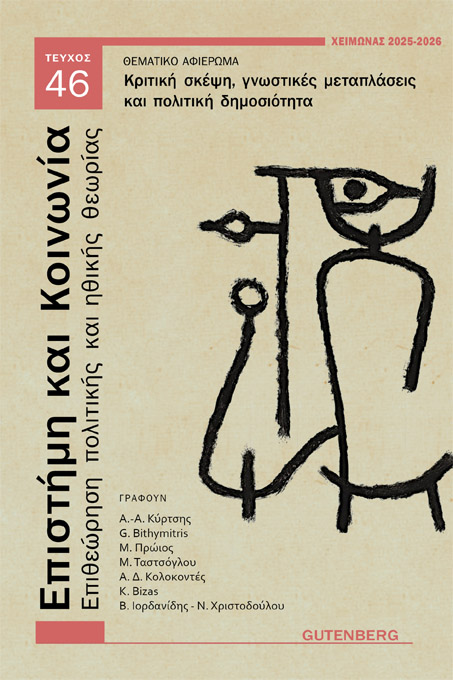
Kolokontes, A. D. (2026). The administrative management of resistance on the innovation and change in the educational system: The role of multiple intelligence leadership. Science and Society: Journal of Political and Moral Theory, (46), 128–156. Retrieved from https://ejournals.epublishing.ekt.gr/index.php/sas/article/view/38686
- Section
- Articles

This work is licensed under a Creative Commons Attribution-NonCommercial-ShareAlike 4.0 International License.
Authors who publish with this journal agree to the following terms:- Authors retain copyright and grant the journal right of first publication with the work simultaneously licensed under a Creative Commons Attribution-NonCommercial-ShareAlike License that allows others to share the work, not for commercial purposes, with an acknowledgement of the work's authorship and initial publication in this journal. If you remix, transform, or build upon the material, you must distribute your contributions under the same license as the original.
- Authors are able to enter into separate, additional contractual arrangements for the non-exclusive distribution of the journal's published version of the work (e.g., post it to an institutional repository or publish it in a book), with an acknowledgement of its initial publication in this journal.
- Authors are permitted and encouraged to post their work online (e.g., in institutional repositories or on their website) prior to and during the submission process, as it can lead to productive exchanges, as well as earlier and greater citation of published work (See The Effect of Open Access).